

Cover Picture
Nuclear magnetic resonance-guided Monte Carlo/molecular dynamics structure inference for amorphous solids
Kangren Kong, Zaiqiang Ma, Yu Yin, Zhaoming Liu, Ruikang Tang* Submit a Manuscript
Nuclear magnetic resonance-guided Monte Carlo/molecular dynamics structure inference for amorphous solids
Kangren Kong, Zaiqiang Ma, Yu Yin, Zhaoming Liu, Ruikang Tang* Submit a Manuscript
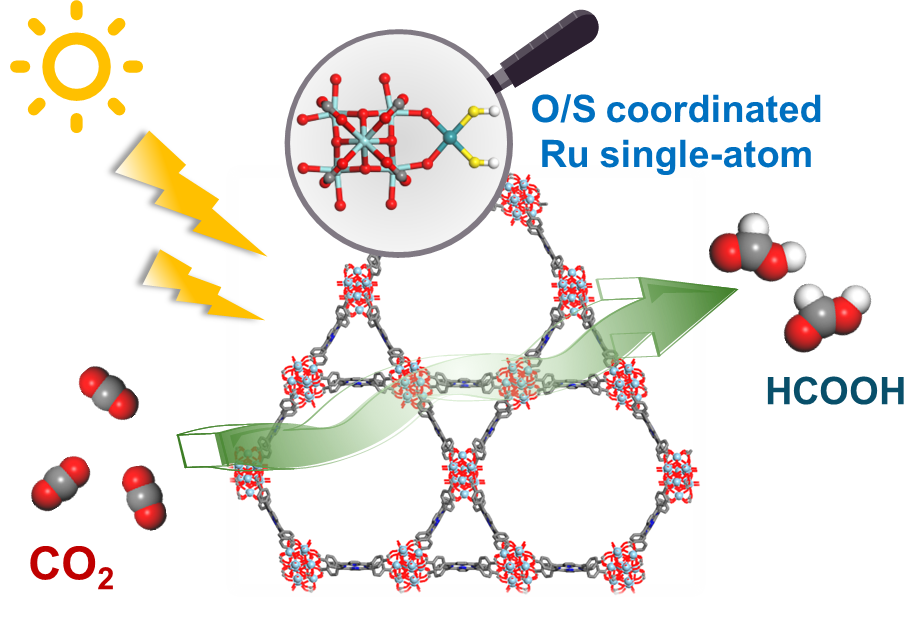
Engineering S-coordinated Ru single-atoms in a porphyrinic metal-organic framework for CO2 photoreduction
Sihong Li+, Weiping Deng+, Qijie Mo, Haili Song, Chunying Chen*, Li Zhang*
Chin. J. Struct. Chem., 2026, 45(3), 100841. DOI: 10.1016/j.cjsc.2025.100841
March 1, 2026
CO2 reduction; Single-atom; Metal-organic frameworks; Prphyrin; Precise chemistry
ABSTRACT
The catalytic performance of single-atom catalysts in CO2 photoreduction can be optimized through precise modulation of the coordination structures of single-atoms. In this study, Ru single-atoms (Ru-SAs) immobilized on the Zr6O8 clusters of a porphyrinic metal–organic framework (Zn-PCN-222) were modified with sulfhydryl groups (–SH). The resulting RuS-SAs@Zn-PCN-222 exhibited high photocatalytic activity for CO2 reduction to HCOO− using ammonia borane as the H* donor, giving rise to a HCOO− production rate of 54.4 mmol·g–1·h–1 with 99.9% selectivity, which was approximately 20.1 and 4.5 times higher than that of Zn-PCN-222 and –SH-free Ru-SAs@Zn-PCN-222, respectively. Photoelectrochemical measurements demonstrated that the incorporated RuS-SAs enhanced the separation and migration of photogenerated charges in RuS-SAs@Zn-PCN-222. Further in situ experiments revealed that the RuS-SAs could accept photogenerated electrons from Zn-PCN-222 as well as electrons from the –SH groups, and then inject to inert CO2 molecules, thereby facilitating CO2 activation and its subsequent coupling with H* to form HCOO−.




- Address: Fuzhou High & New Technology Industrial Zone, Shangjie, Minhou, Fuzhou, Fujian 350108, China
- Tel: (86)-591-63173769, 63173770
- E-mail: cjsc@fjirsm.ac.cn
CN 35–1112/TQ, ISSN 0254–5861, Online ISSN: 2949-768X Copyright @ 2022 Chinese Journal of Structural Chemistry-www.Chinese Journal of Structural Chemistry.net. All Rights Reserved 闽ICP备2022002645号-1