


Cover Picture
Fast hydrogenolytic debenzylation enabled by hierarchically ordered porosity and accessibly rich Pd(0) sites
Zhe Li, Gui-Long Wang, Xin Feng, Jia-Hui Guo, Lu Bai, Jie Chen*, Ming-Shui Yao* Submit a Manuscript
Fast hydrogenolytic debenzylation enabled by hierarchically ordered porosity and accessibly rich Pd(0) sites
Zhe Li, Gui-Long Wang, Xin Feng, Jia-Hui Guo, Lu Bai, Jie Chen*, Ming-Shui Yao* Submit a Manuscript
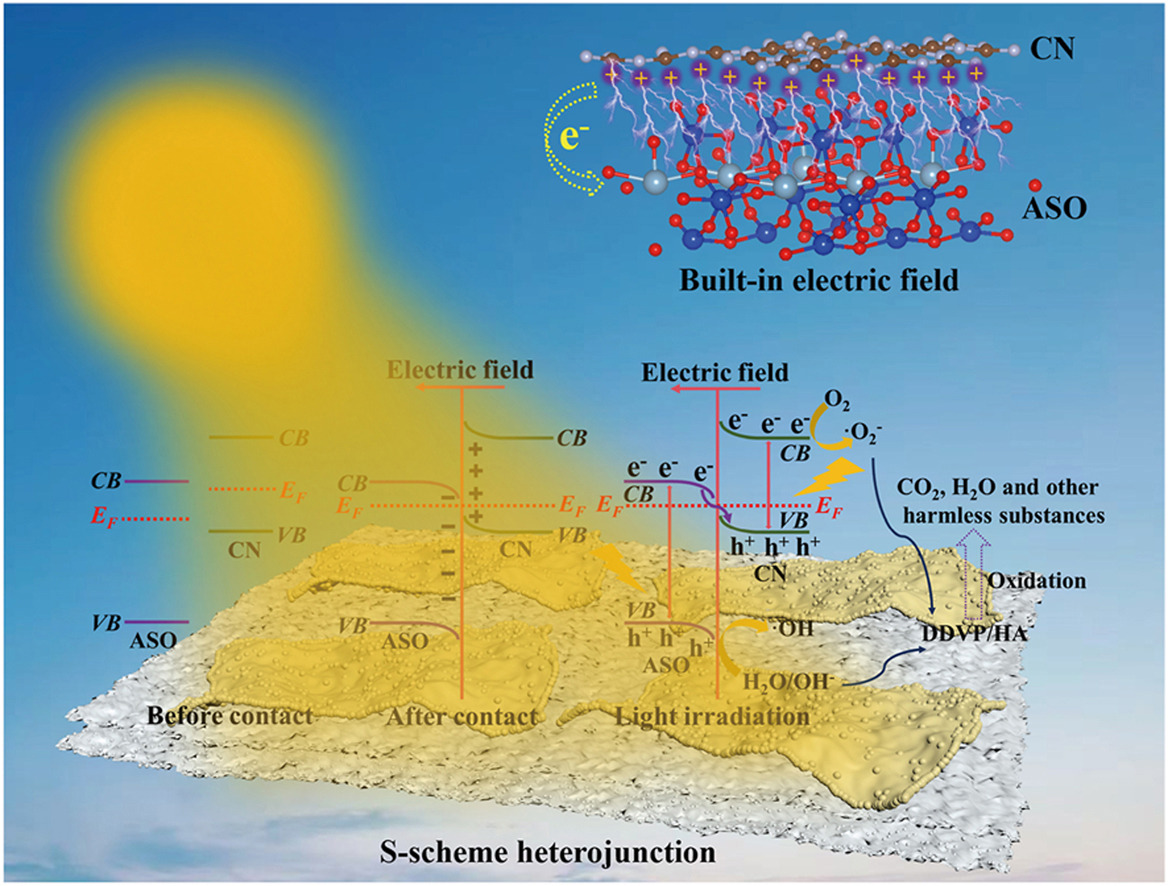
Rapid and stable degradation of dichlorvos on chili pepper and histamine in sardines using S-scheme Al6Si2O13/g-C3N4 nanocomposites
Aoyun Meng, Zhenhua Li, Guoyuan Xiong, Zhen Li *, Jinfeng Zhang*
Chin. J. Struct. Chem., 2026, 45(5), 100867. DOI: 10.1016/j.cjsc.2026.100867
May 1, 2026
Food safety; Controlling; Contaminants; Nanocomposites; S-scheme
ABSTRACT
As food safety concerns grow, controlling organophosphorus pesticide residues and food spoilage substances has become a priority. Effectively degrading contaminants like dichlorvos (DDVP) on chili peppers and histamine (HA) in sardines is crucial for food safety. This study explores the rapid degradation and mechanism of DDVP on chili pepper surfaces and HA in sardines using S-scheme Al6Si2O13/g-C3N4 (ASO/CN) nanocomposites. Rapid detection methods analyzed standard solutions of DDVP and HA. The synthesized ASO/CN nanocomposites showed excellent photocatalytic activity, reducing DDVP from 100% to 17.7% in 100 min, outperforming individual ASO and CN. The catalyst maintained high degradation efficiency over five cycles (500 min). The ASO/CN nanocomposites also degraded HA in sardines, lowering it from 100% to 9.2% in 70 min, with stable performance over five cycles (350 min). Characterization techniques, including in situ X-ray photoelectron spectroscopy (XPS), Kelvin probe force microscopy (KPFM), femtosecond transient absorption spectroscopy (fs-TAS), and differential charge density calculations, confirmed an S-scheme photocatalytic mechanism that enhanced radical formation. Based on these findings, practical tests under natural conditions were conducted. The catalyst reduced DDVP on chili peppers from 100% to 39.2% over seven days, outperforming the control (100% to 78%). In sardines, HA in the ASO/CN-treated group increased from 25.1% to 71.6% over five days, while the untreated group increased from 25% to 90.5%. These results offer a new approach for organophosphorus pesticide degradation and meat preservation.




- Address: Fuzhou High & New Technology Industrial Zone, Shangjie, Minhou, Fuzhou, Fujian 350108, China
- Tel: (86)-591-63173769, 63173770
- E-mail: cjsc@fjirsm.ac.cn
CN 35–1112/TQ, ISSN 0254–5861, Online ISSN: 2949-768X Copyright @ 2022 Chinese Journal of Structural Chemistry-www.Chinese Journal of Structural Chemistry.net. All Rights Reserved 闽ICP备2022002645号-1