


Cover Picture
Recent progress in amorphous metal halides for optoelectronics
Shun-Shun Li, Kaifeng Wu*, Pengfei Cheng* Submit a Manuscript
Recent progress in amorphous metal halides for optoelectronics
Shun-Shun Li, Kaifeng Wu*, Pengfei Cheng* Submit a Manuscript
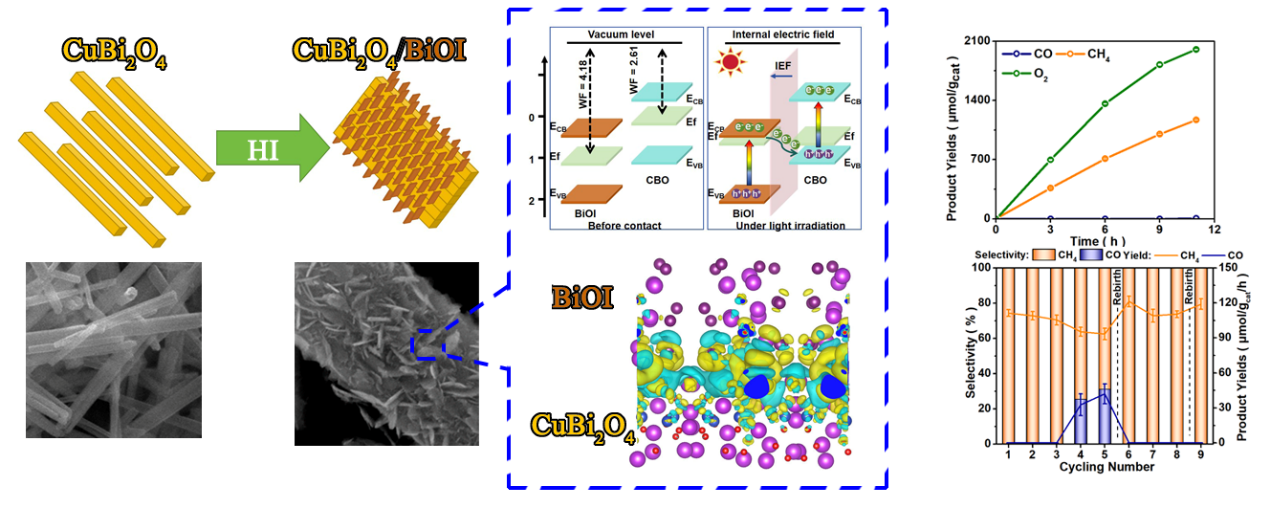
Construction of S-scheme CuBi2O4/BiOI heterojunction with oxygen vacancy for efficient photocatalytic CO2-to-CH4 conversion
Weina Shi, Leilei Zhang*, Ran Zhang, Baocheng Yang, Jiao Guo*, Xiaowei Guo, Haoran Ma*, Ji-Chao Wang*
Chin. J. Struct. Chem., 2026, 45(7), 100913. DOI: 10.1016/j.cjsc.2026.100913
July 1, 2026
S-scheme photocatalyst; CO2 reduction; Surface defect; Product selectivity; CuBi2O4/BiOI
ABSTRACT
S-scheme heterojunction has demonstrated high superiority in the separation and transfer of charge carriers, which is desirable for efficient photocatalytic CO2 reduction into high-value-added chemical feedstocks. Herein, BiOI flake supported on CuBi2O4 rod (CBO/BOI) with oxygen vacancy was in-situ developed. The CBO/BOI composite demonstrated superior photocatalytic performance for CO2 reduction with H2O vapor compared with those of the individual components. Notably, the product of CO2 reduction changed from CO/CH4 to exclusively CH4 by modulating oxygen vacancies. The CH4 and O2 yields of the optimal CBO/BOI-07 catalyst were 121.7 and 232.6 μmol/gcat/h under visible light illumination, with an apparent quantum yield of 2.25% at 405 nm. The S-scheme charge transfer mode at the CBO/BOI interface was demonstrated through in-situ XPS analysis and theoretical simulations. Furthermore, the presence of oxygen vacancy was found to significantly influence the adsorptive behavior of *CO intermediates, which is crucial for selective conversion of CO2 to CH4. Based on the in-situ Fourier transform infrared spectroscopy and adsorption studies, the reaction mechanism of photocatalytic CO2 reduction was speculated and experimentally validated.




- Address: Fuzhou High & New Technology Industrial Zone, Shangjie, Minhou, Fuzhou, Fujian 350108, China
- Tel: (86)-591-63173769, 63173770
- E-mail: cjsc@fjirsm.ac.cn
CN 35–1112/TQ, ISSN 0254–5861, Online ISSN: 2949-768X Copyright @ 2022 Chinese Journal of Structural Chemistry-www.Chinese Journal of Structural Chemistry.net. All Rights Reserved 闽ICP备2022002645号-1