

Just Accepted

Jun Hu, Shyam Chand Pal*, Yingxiang Ye*
https://doi.org/10.1016/j.cjsc.2026.100974
ABSTRACT
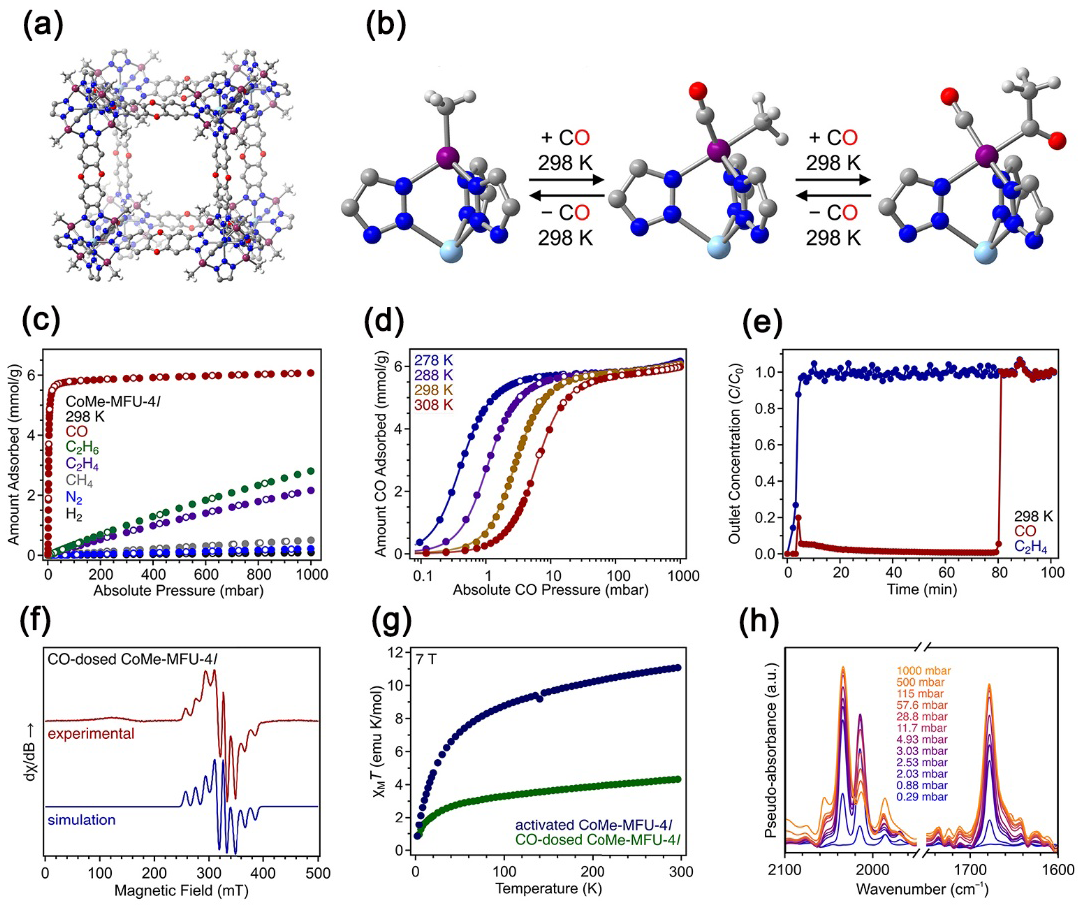
In summary, this study reports a novel single-site cooperativity
mechanism that enables high-capacity CO capture, representing a paradigm shift by
moving beyond conventional dependence on long-range structural phase
transitions. Unlike traditional cooperative systems, which incur substantial
energy penalties during regeneration, this localized strategy achieves positive
cooperativity through tandem spin transition and reversible migratory insertion
at isolated Co(II)-methyl sites. This approach effectively resolves the
long-standing trade-off between selectivity and regeneration energy. Effective
implementation of this strategy requires integrating spin-active sites within a
porous framework. However, several practical challenges remain
to be addressed before practical application. For instance, the reactive cobalt-methyl
bonds exhibit high sensitivity to atmospheric oxygen and moisture, and the approach
also demands precise metal-ligand pairing. Despite these limitations, the mechanism
of single-site cooperativity holds promise for extension to the capture or
activation of other π-acidic gases, such as NO or SO2, through
deliberate engineering of the coordination environment.




- Address: Fuzhou High & New Technology Industrial Zone, Shangjie, Minhou, Fuzhou, Fujian 350108, China
- Tel: (86)-591-63173769, 63173770
- E-mail: cjsc@fjirsm.ac.cn