

Just Accepted
Just Accepted Articles have been posted online after technical editing and typesetting for immediate view. The final edited version with page numbers will appear in the Current Issue soon.
Submit a Manuscript

Structure-function relationships in metal-ligand coordination sensors for metal-ion detection
Brij Mohan*, Ismayil M. Garazade, Khayala Seyidova, Matlab Khamiyev, M. Fátima C. Guedes da Silva, Armando J.L. Pombeiro, Wei Sun*
https://doi.org/10.1016/j.cjsc.2026.100972
Preorganized ligands; Supramolecular cages; Coordination polymers; MOFs; Metal ion detection
ABSTRACT
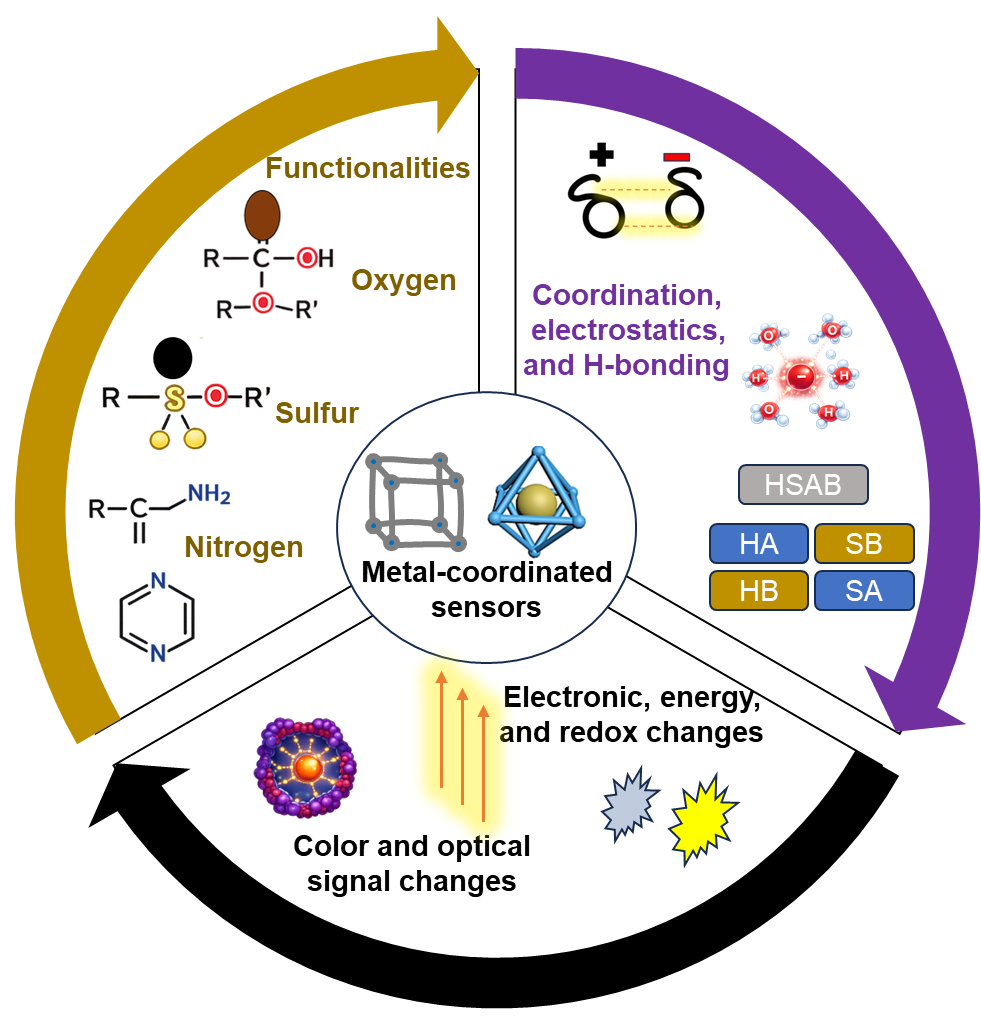
Metal–ligand coordination complexes serve as versatile platforms for the targeted detection of metal ions. However, the relationship between molecular structure, binding interactions, and sensing performance remains dispersed across different sensing systems. This review provides a structure–function perspective on metal–ligand coordination sensors, highlighting how ligand architecture, donor atom types, coordination geometry, and secondary supramolecular interactions collectively influence metal-ion recognition and signal transduction. Particular attention is given to the interaction between primary coordination bonds and auxiliary forces such as hydrogen bonding, π–π stacking, and electrostatic interactions, which together govern binding affinity, selectivity, and sensing behavior. The review discusses key sensing architectures—including preorganized ligands, multidentate chelating probes, supramolecular cages, coordination polymers, and metal–organic frameworks—and demonstrates how structural design principles yield distinct optical and electrochemical responses, such as photoinduced electron transfer, chelation-enhanced fluorescence, and charge-transfer modulation. By connecting molecular design with sensing mechanisms and analytical results, this review establishes a unified framework for understanding metal–ligand coordination-based sensing systems. Finally, emerging strategies to enhance selectivity, stability, and suitability for real-world applications are discussed, offering guidance for designing the next generation of metal-ion sensors for environmental monitoring, biological analysis, and industrial use.




- Address: Fuzhou High & New Technology Industrial Zone, Shangjie, Minhou, Fuzhou, Fujian 350108, China
- Tel: (86)-591-63173769, 63173770
- E-mail: cjsc@fjirsm.ac.cn
CN 35–1112/TQ, ISSN 0254–5861, Online ISSN: 2949-768X Copyright @ 2022 Chinese Journal of Structural Chemistry-www.Chinese Journal of Structural Chemistry.net. All Rights Reserved 闽ICP备2022002645号-1