


Cover Picture
Strengthening hydrophilicity in covalent-organic frameworks to boost CO2 photoreduction
Si-Zhan Feng†, Chong-Jiu Lu†, Ji-Hua Deng*, Tong-Bu Lu, Di-Chang Zhong* Submit a Manuscript
Strengthening hydrophilicity in covalent-organic frameworks to boost CO2 photoreduction
Si-Zhan Feng†, Chong-Jiu Lu†, Ji-Hua Deng*, Tong-Bu Lu, Di-Chang Zhong* Submit a Manuscript
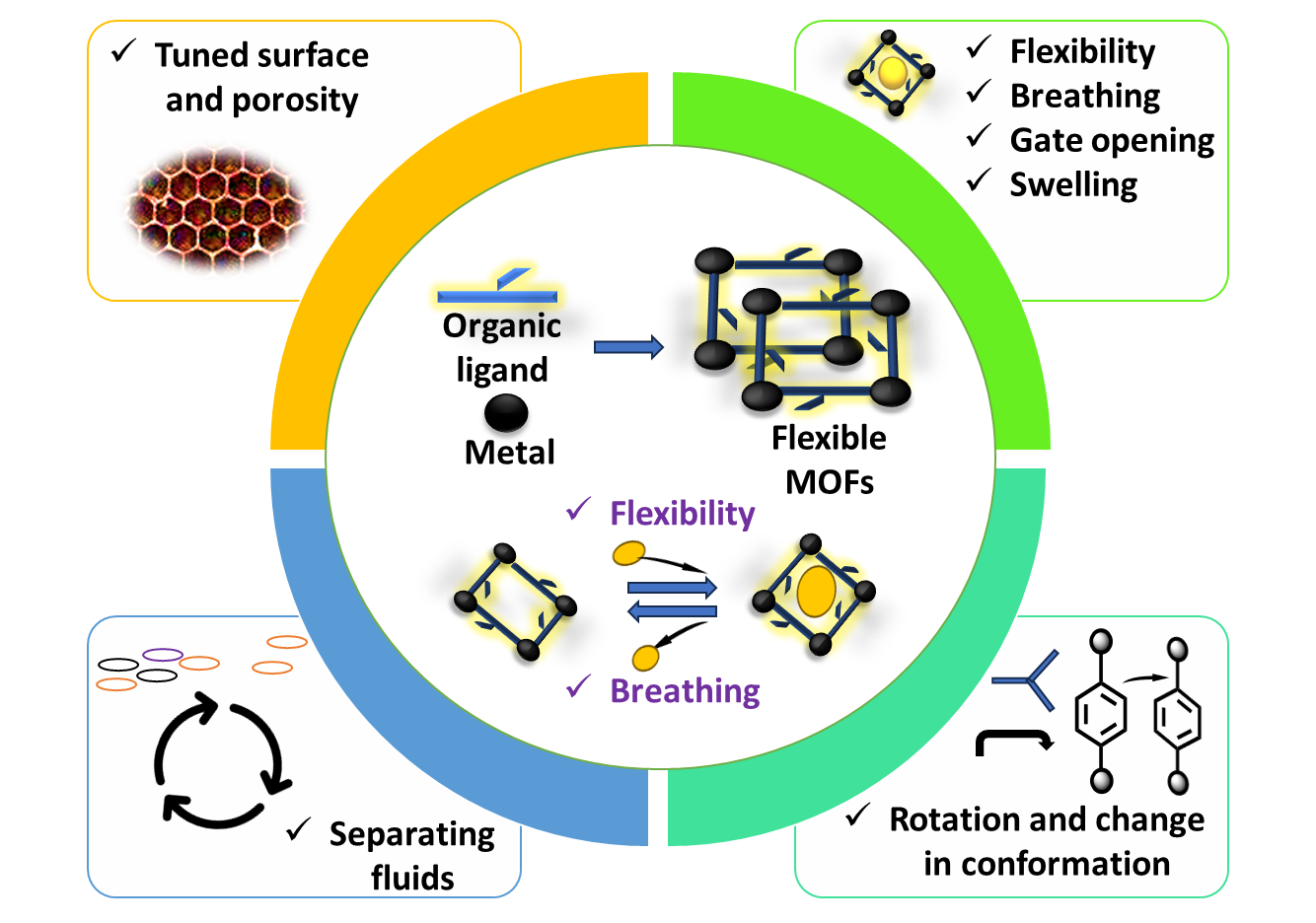
Switchable frameworks: Using MOF structural dynamics to achieve high-selectivity sustainable separations for gases and liquid phases
Brij Mohan, Virender Virender, Harish Kumar Sharma, Sandeep Kumar, Ajeet Singh, Armando J.L. Pombeiro, Rakesh Kumar Gupta*, Gurjaspreet Singh*, Wei Sun*
Chin. J. Struct. Chem., 2026, 45(10), 100982. DOI: 10.1016/j.cjsc.2026.100982
October 1, 2026
Metal-organic frameworks; Breathing; Structural flexibility; Surface area; Gas and liquid separation
ABSTRACT
Flexible metal–organic frameworks (MOFs) are revolutionizing separation science by offering tunable selectivity based on structural dynamics, unlike traditional rigid adsorbents. These materials respond to stimuli such as pressure, adsorption, and temperature through gate opening, breathing, and swelling, allowing dynamic pore reconfiguration. This review links these structural transitions to separation performance in gas and liquid systems, categorizing behavior by thermodynamics and kinetics. These responsive changes produce pressure-dependent selectivity, stepwise isotherms, and inversion, phenomena impossible with conventional porous materials. This review discusses the impact of framework flexibility on mixed-component separations, focusing on transition kinetics, hysteresis, and stability. Despite the promise, challenges like slow rates, fatigue, and response variability hinder industrial use. Insights from molecular design, thermodynamics, and engineering guide tuning gate pressures, transition pathways, and selectivity. We highlight future research directions and scale-up opportunities for practical separation technologies.




- Address: Fuzhou High & New Technology Industrial Zone, Shangjie, Minhou, Fuzhou, Fujian 350108, China
- Tel: (86)-591-63173769, 63173770
- E-mail: cjsc@fjirsm.ac.cn
CN 35–1112/TQ, ISSN 0254–5861, Online ISSN: 2949-768X Copyright @ 2022 Chinese Journal of Structural Chemistry-www.Chinese Journal of Structural Chemistry.net. All Rights Reserved 闽ICP备2022002645号-1