

Just Accepted
Just Accepted Articles have been posted online after technical editing and typesetting for immediate view. The final edited version with page numbers will appear in the Current Issue soon.
Submit a Manuscript

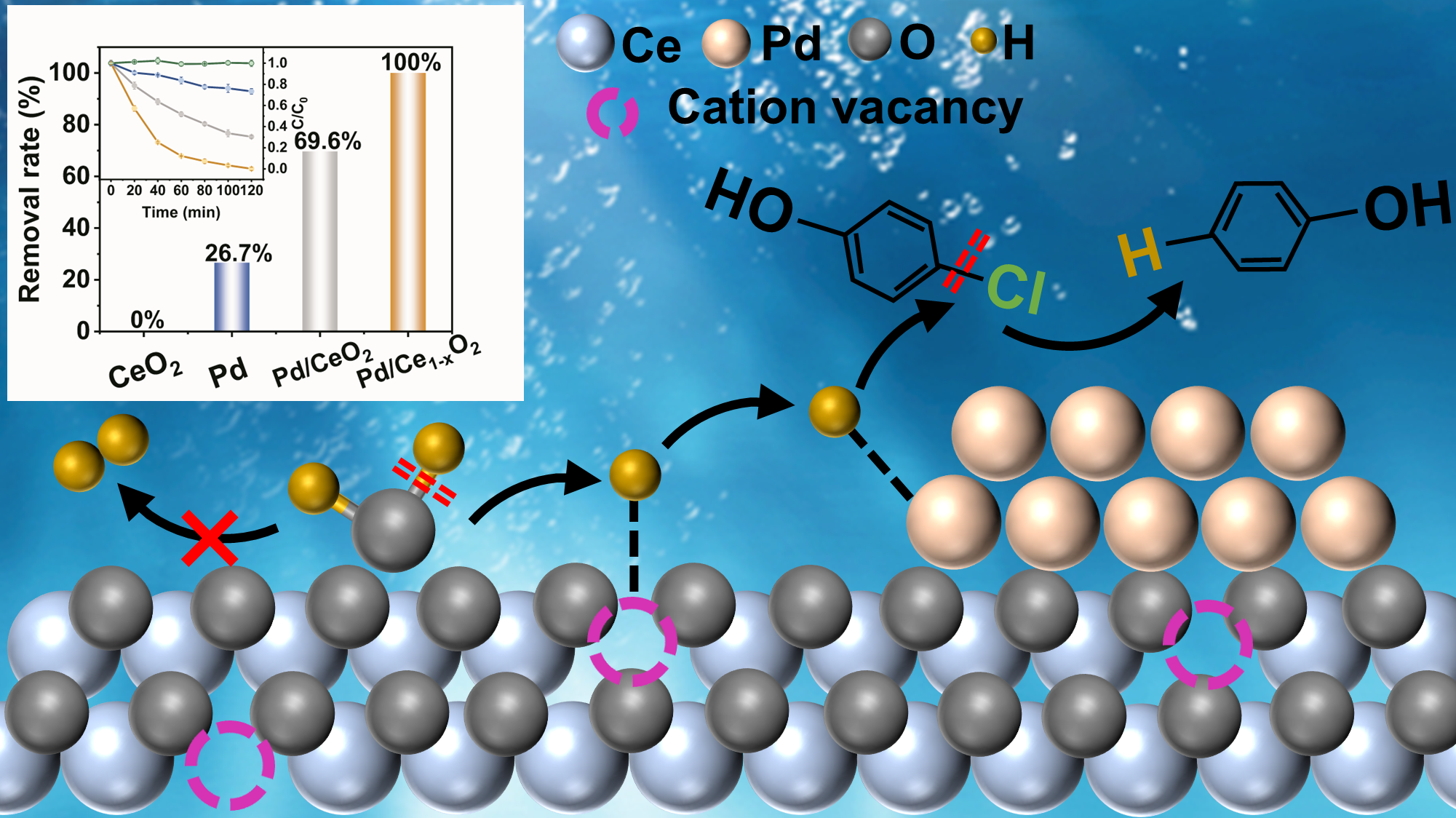
Cation vacancy-enriched Ce1-xO2/Pd with enhanced H* utilization for efficient electrocatalytic hydrodechlorination
Yujia Tang, Xiaokun Fan, Kaixuan Zhang, Yuanyuan Sun, Hao Tan, Yukun Zhu*, Lijie Zhang*
https://doi.org/10.1016/j.cjsc.2026.101012
Electrocatalytic hydrodechlorination; Chlorinated organic compounds; Pd catalysts; Cationic vacancy; H* utilization efficiency
ABSTRACT
Palladium (Pd) is an optimal electrocatalyst for electrocatalytic hydrodechlorination (EHDC), but its activity is severely restricted by the insufficient H* generation and low utilization efficiency. Herein, nano-Pd supported on cation-vacancy-rich Ce1-xO2 (Pd/Ce1-xO2) was synthesized. The excellent water activation property of CeO2 accelerates proton supply and promotes H* generation. Meanwhile, abundant cation vacancies facilitate the H* adsorption and stabilization, reserving more active H* for EHDC. Furthermore, the strong metal-support interaction (SMSI) between Ce1-xO2 and Pd induces electron-rich Pd sites, boosting the adsorption of both H* and pollutant. Using 4-Chlorophenol (4-CP) as the target pollutant, it achieves 100% 4-CP removal across a concentration range of 20-200 mg L−1. At a 4-CP concentration of 100 mg L−1, its dechlorination activity (DA) reaches 6.2 mmol 4-CP gPd−1 min−1, which is 2.7 times that of Pd/CeO2 (2.3 mmol4-CP gPd−1 min−1), and 8.9 times that of pure Pd (0.7 mmol4-CP gPd−1 min−1). Additionally, it displays efficient degradation performance toward various pollutants, coupled with excellent stability and anti-interference ability. This work offers a feasible strategy for the rational design of high-efficiency Pd-based EHDC electrocatalysts.




- Address: Fuzhou High & New Technology Industrial Zone, Shangjie, Minhou, Fuzhou, Fujian 350108, China
- Tel: (86)-591-63173769, 63173770
- E-mail: cjsc@fjirsm.ac.cn
CN 35–1112/TQ, ISSN 0254–5861, Online ISSN: 2949-768X Copyright @ 2022 Chinese Journal of Structural Chemistry-www.Chinese Journal of Structural Chemistry.net. All Rights Reserved 闽ICP备2022002645号-1