

Just Accepted
Just Accepted Articles have been posted online after technical editing and typesetting for immediate view. The final edited version with page numbers will appear in the Current Issue soon.
Submit a Manuscript

Temporal engineering of MOF skeletons: Emerging opportunities in energy storage and molecular motors
Brij Mohan*
https://doi.org/10.1016/j.cjsc.2026.101030
MOFs; Defect engineering and ligand exchange; Cage-on-MOFs; Energy devices; Molecular motors
ABSTRACT
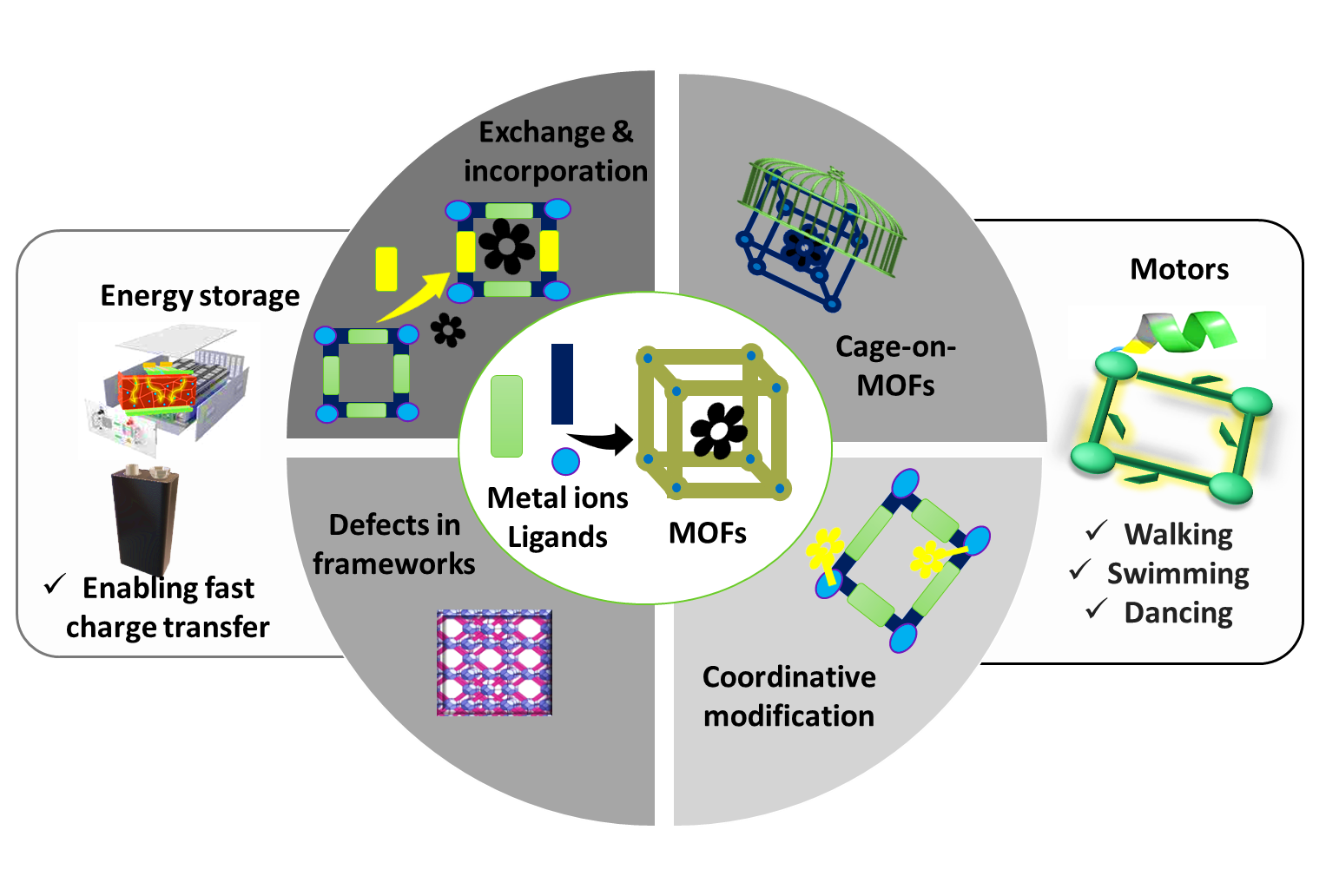
Metal-organic frameworks (MOFs) are commonly characterized by their crystallinity, porosity, and static structures. However, many important functions depend on how their frameworks form, evolve, and degrade over time. This review focuses on the concept of temporal engineering, which involves controlling, monitoring, and utilizing the evolution of MOFs during their synthesis, modification, and usage. Unlike traditional reviews, this one highlights kinetic and dynamic processes such as nucleation, crystal growth, defect formation, ligand exchange, and framework breathing. It specifically examines how defect engineering, component selection, and bond tuning influence the relationship among structure, time, and function. Time-resolved and in situ methods are essential for connecting structural changes to long-term performance. In the context of energy storage, temporally engineered MOFs affect ion diffusion, electrolyte access, charge transfer, and stability. In molecular motors, dynamic MOFs control motion, response, reversibility, and durability. By distinguishing between static and time-dependent changes, this review outlines future design opportunities for adaptive and durable MOF materials.




- Address: Fuzhou High & New Technology Industrial Zone, Shangjie, Minhou, Fuzhou, Fujian 350108, China
- Tel: (86)-591-63173769, 63173770
- E-mail: cjsc@fjirsm.ac.cn
CN 35–1112/TQ, ISSN 0254–5861, Online ISSN: 2949-768X Copyright @ 2022 Chinese Journal of Structural Chemistry-www.Chinese Journal of Structural Chemistry.net. All Rights Reserved 闽ICP备2022002645号-1