

Just Accepted
Just Accepted Articles have been posted online after technical editing and typesetting for immediate view. The final edited version with page numbers will appear in the Current Issue soon.
Submit a Manuscript

Biomimetic polymer photocathode-Rh complex coupling for bias-free and selective photoelectrochemical 1,4-NADH regeneration
Yan Li#, Li Tong#, Yipu Liu, Hongliang Peng, Shiwei Lin*, Bingqing Zhang*
https://doi.org/10.1016/j.cjsc.2026.101032
Photoelectrochemical NADH regeneration; Bias-free; A polymer photocathode; Rh complex; Coupled electron-proton transfer
ABSTRACT
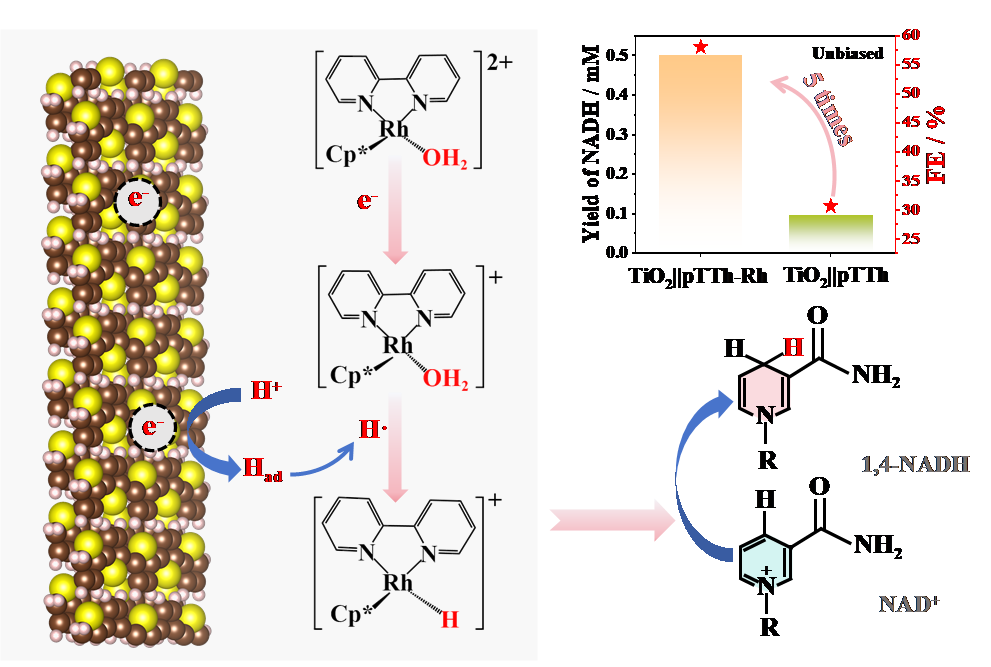
Reduced nicotinamide adenine dinucleotide (NADH) is a requisite energy carrier functioned in natural photosynthesis and numerous oxidoreductase-involved reactions to provide electrons and protons. However, its stoichiometric usage and high cost limit its widespread applications. Therefore, the regeneration of NADH holds a significant importance. Photoelectrocatalytic (PEC) NADH regeneration is a green synthesis route by using solar energy as a driving force and water as an electron and proton source. In this study, we demonstrate a coupled system comprised of an organic polyterthiophene (pTTh) photocathode and a Rh molecular catalyst (denoted as pTTh-Rh) for PEC NADH regeneration. It was observed that the yield and selectivity of NADH in the coupled pTTh-Rh system are 1.9 times and 3.2 times those of the bare pTTh system. The significant improvement is attributed to the synergistic effect between pTTh and Rh molecules, that is, the electron transfer from pTTh to Rh follows a coupled electron-proton transfer (CEPT) pathway. The CEPT process accelerates the formation of Rh hydrides (Rh-H) active intermediate, which are regioselective to generate enzymatic active products of 1,4-NADH. Furthermore, we further combined pTTh photocathode with a TiO2 photoanode (TiO2||pTTh) to construct a dual-photoelectrode PEC device. It can achieve unbiased regeneration of NADH, with an average NADH regeneration rate of 1.34 mM h-1 cm-2, an accumulated NADH concentration of 4.05 mM, and a total NAD+ conversion of 80% in 5 h. Interestingly, the dual-photoelectrode PEC device can also drive external resistor work during the production of NADH, but the greater the load resistance, the lower the yield of NADH. It is found that the highest solar energy conversion efficiency is obtained when solar energy is simultaneously converted into chemicals (NADH) and electricity, which is 1.63 times that of converting all photons to NADH. This study offers a novel and efficient unbiased PEC NADH regeneration system.




- Address: Fuzhou High & New Technology Industrial Zone, Shangjie, Minhou, Fuzhou, Fujian 350108, China
- Tel: (86)-591-63173769, 63173770
- E-mail: cjsc@fjirsm.ac.cn
CN 35–1112/TQ, ISSN 0254–5861, Online ISSN: 2949-768X Copyright @ 2022 Chinese Journal of Structural Chemistry-www.Chinese Journal of Structural Chemistry.net. All Rights Reserved 闽ICP备2022002645号-1