

Just Accepted
Just Accepted Articles have been posted online after technical editing and typesetting for immediate view. The final edited version with page numbers will appear in the Current Issue soon.
Submit a Manuscript

Activation of oxygen on oxygenated boron nitride: the proof of quasi-MvK mechanism on a nonmetal catalyst
Hao Yang, Yushu Xie, Libin Zeng, Wandong Xing, Rui Xiong*, Yidong Hou, Jimmy C. Yu, Can Yang*
https://doi.org/10.1016/j.cjsc.2026.101041
Oxygen activation; Quasi-MvK mechanism; Non-metallic BON; H2S-ODH
ABSTRACT
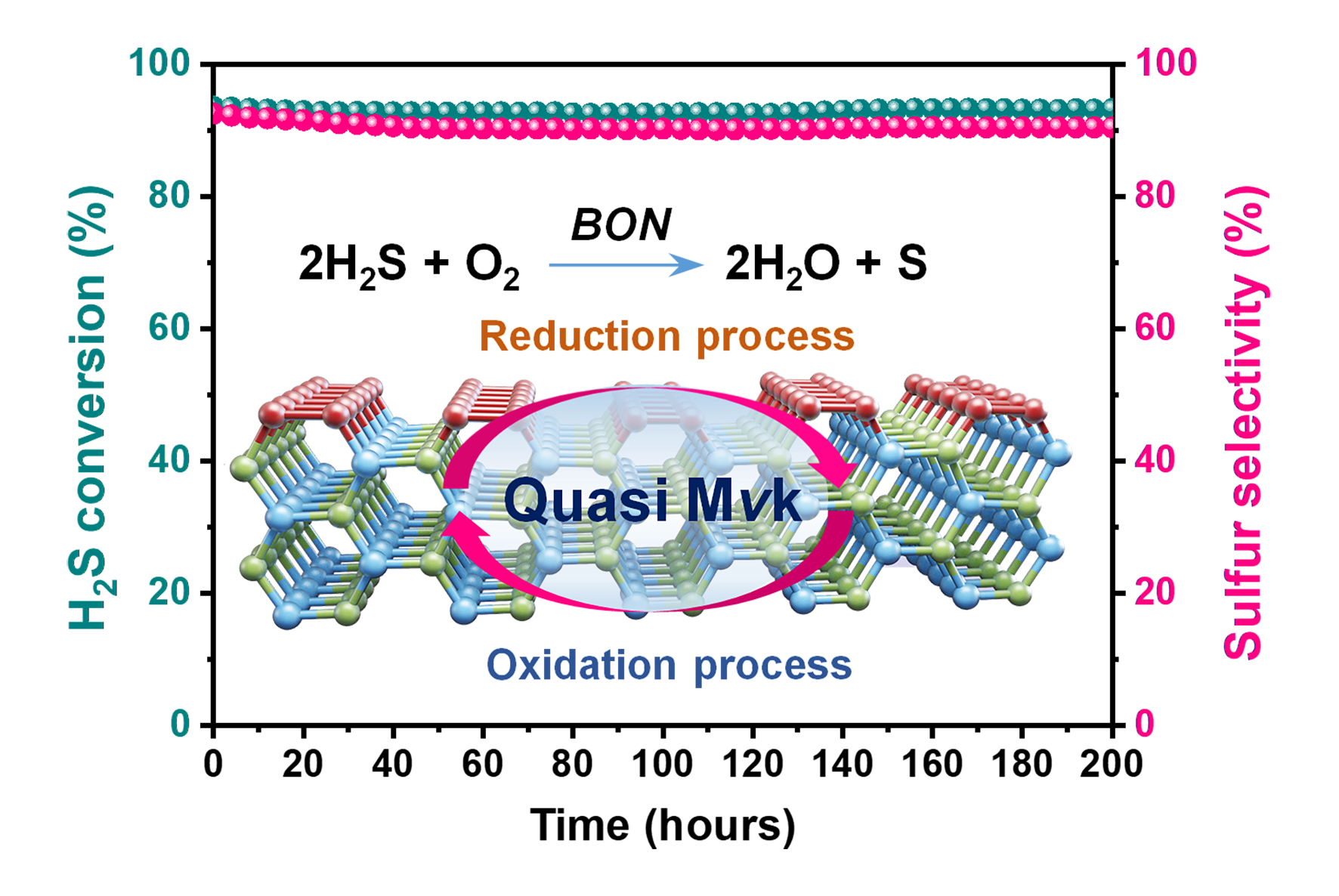
Oxygen activation is a critical step in heterogeneous aerobic oxidation processes. Although conventional metal-based catalysts are effective for oxygen activation, they are often vulnerable to sulfur poisoning, which limits their practical applications. A sensible solution is to develop a stable non-metallic catalyst with a sufficient number of active sites for oxygen activation. Herein, we report the synthesis of an oxygenated boron nitride (BON) ceramic featuring a high concentration of oxygen species incorporated into its framework. The resulting metal-free BON catalyst exhibits excellent performance in the selective oxidative dehydrogenation of hydrogen sulfide (H2S-ODH). The reaction mechanisms, particular the roles of proton transfer and oxygen activation on BON, was systematically investigated, and a quasi-Mars-Van Krevelen (quasi-MvK) mechanism is proposed. The results reveal that the lattice oxygen species (O-O species) in BON possess an excellent affinity for protons and readily accepts hydrogen from H2S, generating oxygen vacancies on the BON surface. These vacancies subsequently facilitate the activation of oxygen molecules. As a result, the BON catalyst achieves high H2S conversion, excellent sulfur selectivity (above 90%), and outstanding long-term stability over 200 h of continuous operation. This proton-transfer-assisted oxygen activation strategy provides new insights into the design of efficient metal-free catalysts for aerobic oxidation reactions.




- Address: Fuzhou High & New Technology Industrial Zone, Shangjie, Minhou, Fuzhou, Fujian 350108, China
- Tel: (86)-591-63173769, 63173770
- E-mail: cjsc@fjirsm.ac.cn
CN 35–1112/TQ, ISSN 0254–5861, Online ISSN: 2949-768X Copyright @ 2022 Chinese Journal of Structural Chemistry-www.Chinese Journal of Structural Chemistry.net. All Rights Reserved 闽ICP备2022002645号-1