

Just Accepted
Just Accepted Articles have been posted online after technical editing and typesetting for immediate view. The final edited version with page numbers will appear in the Current Issue soon.
Submit a Manuscript

AuNCs@Co(OH)x nanocage-based SERS platform for carcinogen detection and cancer cell classification
Yuanying Ni+, Gengchen Xie+, Xinyu Miao+, Aochi Liu, Yuening Wang, Xiaoyu Song, Xinnan Yu, Hong Wang, Wen Ma, Xiangyu Meng*, Jie Lin*, Xiaotian Wang*, Xinghua Liu*
https://doi.org/10.1016/j.cjsc.2026.101039
Surface-enhanced Raman scattering (SERS); Au nanoclusters; Carcinogenic aromatic amines; Gastrointestinal cancer cell discrimination; Machine learning
ABSTRACT
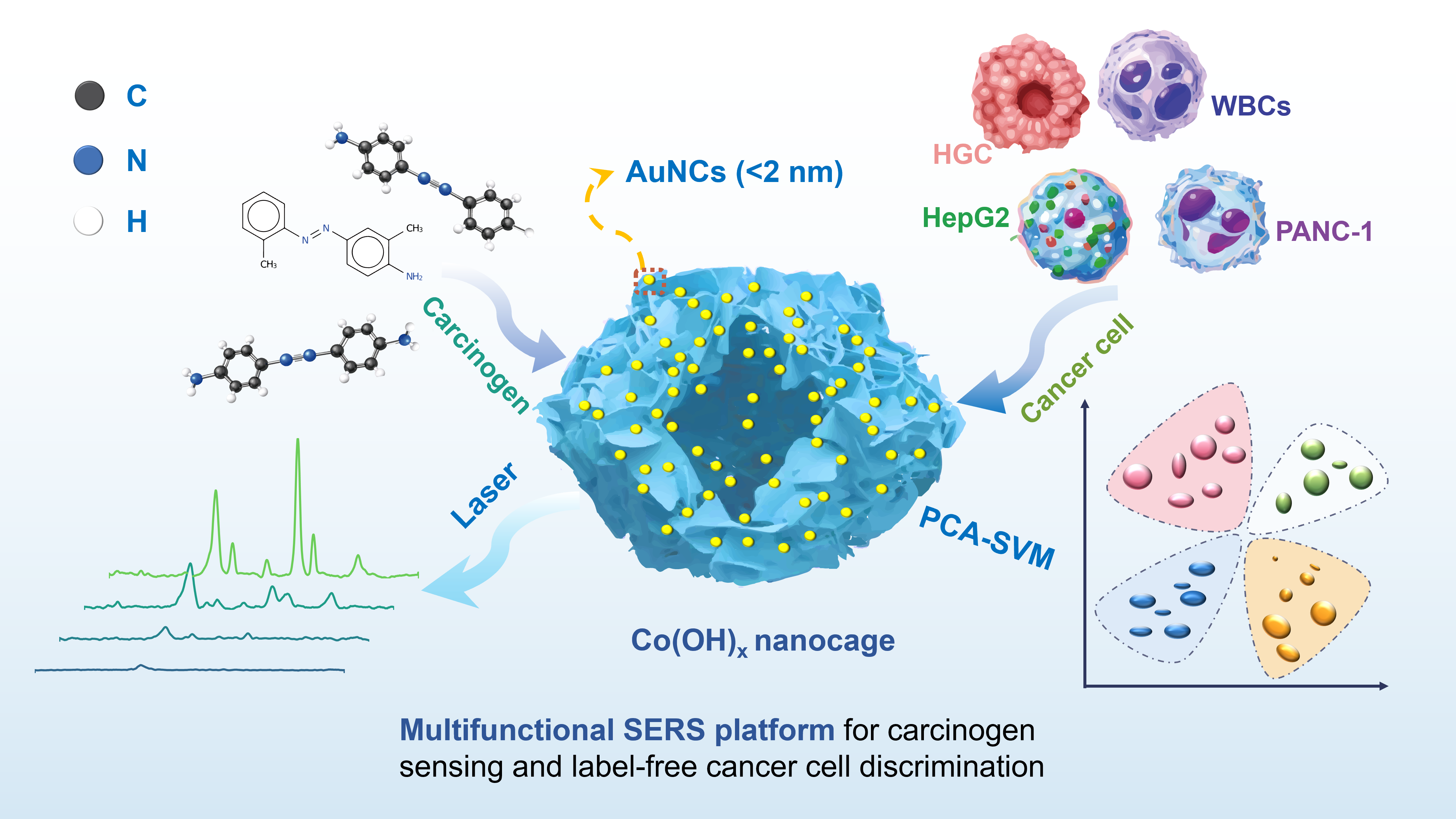
Constructing multifunctional surface-enhanced Raman scattering (SERS) substrates capable of sensing carcinogenic and identifying cancer cells offers great potential for realizing integrated cancer risk warning and diagnostic applications. Hence, we in situ grew Au nanoclusters (AuNCs, <2 nm) on the surface of hollow cobalt hydroxide nanocages, and successfully fabricated a novel SERS substrate (AuNCs@Co(OH)x) for analytical detection and biological cell discrimination simultaneously. AuNCs exhibit a higher density of states (DOS) near the Fermi level (EF), which is more conducive to promoting interfacial charge transfer between the substrate and probe molecules. Meanwhile, the porous structure of Co(OH)x nanocages provides abundant adsorption sites, collectively boosting the high SERS performance. As a multifunctional SERS platform, AuNCs@Co(OH)x realized the ultrasensitive sensing of carcinogenic aromatic amines and effective discrimination of structurally similar molecules through multivariate analysis. More importantly, by integrating SERS spectroscopy with a principal component analysis-support vector machine (PCA-SVM)-based machine learning framework, the platform achieves label-free and accurate classification of gastrointestinal cancer cell lines and white blood cells (WBCs), including gastric cancer (HGC), liver cancer (HepG2), and pancreatic cancer (PANC-1). Achieving high classification accuracy and specificity (macro-averaged F1-score of 95.47%), the method enables reliable differentiation between malignant and non-malignant cells. Notably, non-malignant WBCs are identified with perfect precision and recall (1.00), with no false-positive classification as malignant cells. This multifunctional SERS platform preserves sample integrity, requires no exogenous labeling, and demonstrates strong robustness, highlighting its potential in predicting cancer risks, real-time cancer diagnosis, and specific molecular detection in complex samples.




- Address: Fuzhou High & New Technology Industrial Zone, Shangjie, Minhou, Fuzhou, Fujian 350108, China
- Tel: (86)-591-63173769, 63173770
- E-mail: cjsc@fjirsm.ac.cn
CN 35–1112/TQ, ISSN 0254–5861, Online ISSN: 2949-768X Copyright @ 2022 Chinese Journal of Structural Chemistry-www.Chinese Journal of Structural Chemistry.net. All Rights Reserved 闽ICP备2022002645号-1