

Just Accepted
Just Accepted Articles have been posted online after technical editing and typesetting for immediate view. The final edited version with page numbers will appear in the Current Issue soon.
Submit a Manuscript

Second-order nonlinear optical organic crystals exhibit reversible photoisomerization
Xiangzhao Zhu, Songhua Chen, Zhihua Wang, Jianfeng Yan, Dandan Xin, Jialiang Xu, Yaofeng Yuan*
https://doi.org/10.1016/j.cjsc.2026.101045
ABSTRACT
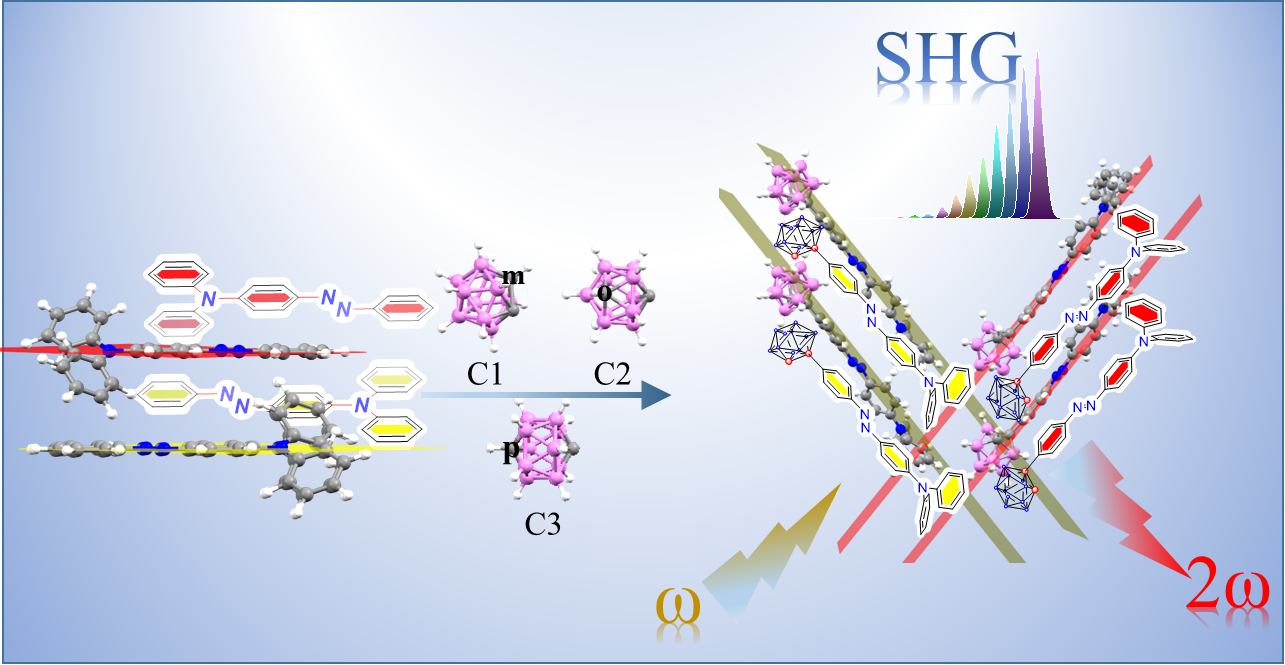
The development of switchable single-crystal nonlinear optical materials via molecular structural isomerization at the microscopic scale has emerged as a prominent research focus in the field of nonlinear optics. In this context, azobenzene, as the most common photoisomerization unit, is frequently employed in the study of optically switchable nonlinear optical materials. However, the planar aromatic rings of azobenzene readily induce π–π stacking between molecules, which significantly weakens the material's nonlinear optical properties. To address this issue, previous strategies have included the preparation of thin films, the incorporation of azobenzene as a photoisomerization unit into covalent organic frameworks (COFs), and the use of organic–inorganic hybrid approaches to mitigate these drawbacks. From a molecular design perspective, we introduced carborane units with three-dimensional aromaticity, which effectively increase the intermolecular distance, suppress π–π stacking, and simultaneously achieve an efficient nonlinear optical response and reversible photoisomerization within a D–π–A molecular framework. We synthesized three carborane-functionalized compounds (C1–C3), among which C1, modified with an ortho-carborane group, exhibited the strongest intramolecular charge transfer and the highest second-harmonic generation intensity, with a first hyperpolarizability significantly higher than that of its non-carborane analogue. Furthermore, all three compounds undergo reversible cis–trans isomerization upon illumination. This work demonstrates that the introduction of carborane not only effectively suppresses π–π stacking but also acts as a three-dimensional rigid scaffold to promote non-centrosymmetric molecular packing, thereby providing a new strategy for the development of high-performance organic nonlinear optical materials with photoswitching capabilities.




- Address: Fuzhou High & New Technology Industrial Zone, Shangjie, Minhou, Fuzhou, Fujian 350108, China
- Tel: (86)-591-63173769, 63173770
- E-mail: cjsc@fjirsm.ac.cn
CN 35–1112/TQ, ISSN 0254–5861, Online ISSN: 2949-768X Copyright @ 2022 Chinese Journal of Structural Chemistry-www.Chinese Journal of Structural Chemistry.net. All Rights Reserved 闽ICP备2022002645号-1