

Just Accepted
Just Accepted Articles have been posted online after technical editing and typesetting for immediate view. The final edited version with page numbers will appear in the Current Issue soon.
Submit a Manuscript

Unlocking the mechanism of improved charge separation of FeVO4/BiOBr S-scheme heterojunction for polyphenolic pharmaceutical wastewater purification
Huanxian Shi*, Yanyan Zhao, Zhishu Tang, Jing Sun*, Enzhou Liu*, Xiaofei Zhang*
https://doi.org/10.1016/j.cjsc.2026.101048
Polyphenolic pharmaceutical wastewater; Bismuth oxybromides; Photocatalytic degradation; S-scheme heterojunction; In-situ irradiated technology
ABSTRACT
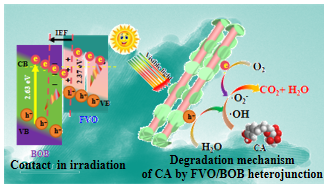
The increasing discharge of polyphenolic compounds from pharmaceutical wastewater has led to widespread environmental contamination, posing a severe threat to ecosystems and public health. In this paper, a innovative FeVO4/BiOBr (FVO/BOB) S-scheme heterostructure was successfully synthesized by in situ developing BOB on the surface of FVO nanorods. The optimal 3%-FVO/BOB heterojunction demonstrated significantly enhanced photocatalytic removal efficiency for chlorogenic acid (CA), achieving approximately 94.1% CA degradation under 60 minutes of visible light irradiation-150 times and 1.33 times greater than pure FVO and BOB, respectively. The superior photocatalytic performance of the FVO/BOB heterojunction can be stemmed from the elevation of charge transfer and separation efficiency, enhanced light absorption, and high reactive species concentration. The degradation pathway of CA was systematically elucidated through Fukui function calculations and liquid chromatography-mass spectrometry (LC-MS). Notably, the S-scheme transfer passage of photo-induced charges at the FVO/BOB interface was thoroughly investigated using in-situ photo-irradiated Kelvin probe force microscopy (KPFM), in-situ X-ray photoelectron spectroscopy (XPS), and density functional theory (DFT) analyses. This contribution offers new insights into the design and development of innovative bismuth oxyhalide-based photocatalysts for the purification of polyphenolic pharmaceutical wastewater in traditional Chinese medicine (TCM).




- Address: Fuzhou High & New Technology Industrial Zone, Shangjie, Minhou, Fuzhou, Fujian 350108, China
- Tel: (86)-591-63173769, 63173770
- E-mail: cjsc@fjirsm.ac.cn
CN 35–1112/TQ, ISSN 0254–5861, Online ISSN: 2949-768X Copyright @ 2022 Chinese Journal of Structural Chemistry-www.Chinese Journal of Structural Chemistry.net. All Rights Reserved 闽ICP备2022002645号-1