

Just Accepted
Just Accepted Articles have been posted online after technical editing and typesetting for immediate view. The final edited version with page numbers will appear in the Current Issue soon.
Submit a Manuscript

Electron-deficient Ag/TiO2 stabilizes surface hydrogen for nitroaromatic hydrogenation
Shuai Zhu, Zening Li, Xujia Cao, Yuan Lin, Jun Wan*, Mingxia Guo*, Lijun Liu*
https://doi.org/10.1016/j.cjsc.2026.101052
Nitroaromatic; Waste-to-resource conversion; Hydrogen donor; Interfacial electron transfer; d-band upshift
ABSTRACT
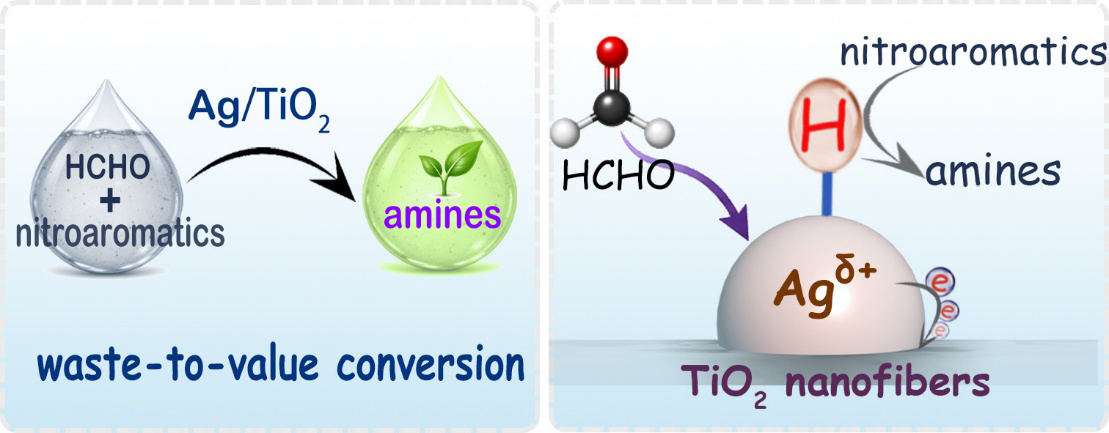
The coexistence of formaldehyde (HCHO) and nitroaromatic pollutants in industrial wastewater creates both environmental pressure and an opportunity for waste-to-resource conversion. Herein, electron-deficient Ag/TiO2 nanofibers were developed to couple HCHO transformation with selective nitroaromatic hydrogenation using HCHO as an in situ hydrogen donor. The large work-function mismatch between Ag and TiO2 drives interfacial electron transfer from Ag to TiO2, producing electron-deficient Ag sites with an upshifted d-band center. This electronic reconstruction lowers the kinetic barrier for HCHO dehydrogenation and strengthens Ag–H coupling, thereby stabilizing reactive surface hydrogen species (*H) and suppressing parasitic H2 evolution. Using 4-nitrophenol as a model substrate, the optimized 10%Ag/TiO2 catalyst achieved efficient hydrogenation to 4-aminophenol with a high TOF of 6.42 min-1 and near-unit selectivity, and was further applicable to substituted nitroaromatics including p-chloronitrobenzene and p-nitrotoluene. This work demonstrates that interfacial electron depletion enables the regulation of *H generation, stabilization, and utilization, providing a mechanistic strategy for converting coexisting HCHO and nitroaromatic pollutants into value-added aromatic amines.




- Address: Fuzhou High & New Technology Industrial Zone, Shangjie, Minhou, Fuzhou, Fujian 350108, China
- Tel: (86)-591-63173769, 63173770
- E-mail: cjsc@fjirsm.ac.cn
CN 35–1112/TQ, ISSN 0254–5861, Online ISSN: 2949-768X Copyright @ 2022 Chinese Journal of Structural Chemistry-www.Chinese Journal of Structural Chemistry.net. All Rights Reserved 闽ICP备2022002645号-1