

Just Accepted
Just Accepted Articles have been posted online after technical editing and typesetting for immediate view. The final edited version with page numbers will appear in the Current Issue soon.
Submit a Manuscript

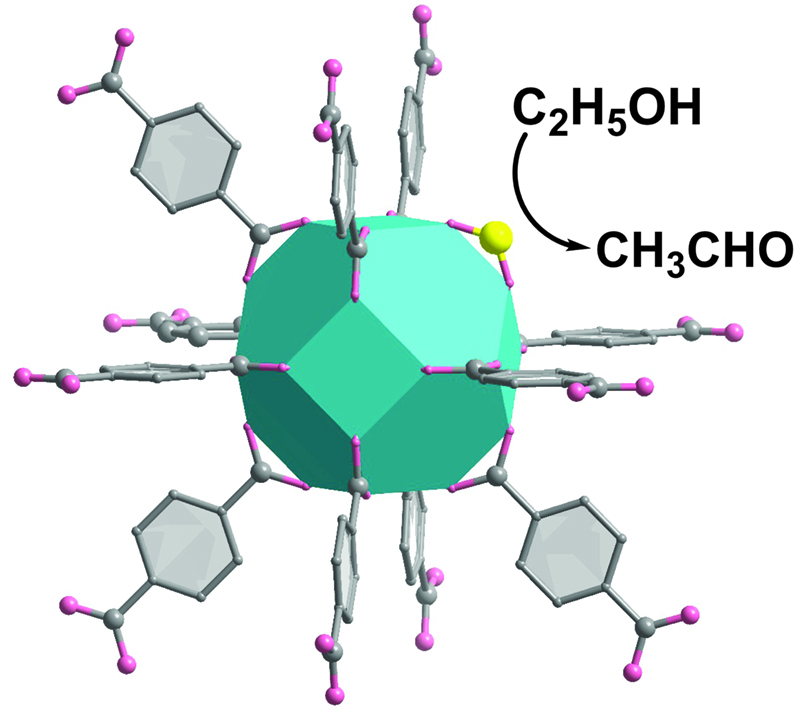
Single Cu sites in defective UiO-66 enable high selectivity in ethanol dehydrogenation
Mohmand Numan Zada Khan†, Huirong Ma †, Lianrun Cai†, Jia Wang, Junaid, Qazi Mohammad, Guo-Ying Han*, Dongqi Wang, Lei He, An-Hui Lu*, Xiao Feng*
https://doi.org/10.1016/j.cjsc.2026.101059
Metal-organic frameworks (MOFs); Defect; Single atom catalysts; Heterogeneous catalysis; Ethanol dehydrogenation
ABSTRACT
Selective ethanol dehydrogenation to acetaldehyde is a key step in biomass upgrading, yet achieving both high selectivity and activity remains challenging due to competing reaction pathways. Precise catalyst design is therefore essential. Herein, defective UiO-66 was synthesized via formic acid modulation and employed to precisely anchor Cu species, enabling controlled formation of single-atom and multi-atom Cu sites. At low Cu loading, atomically dispersed Cu sites stabilized at defect positions exhibit nearly complete selectivity toward acetaldehyde (≈100%) and an exceptional intrinsic activity of up to 7045 mmol g Cu-1 h-1. In contrast, higher Cu loading leads to the formation of Cu ensembles, which promote secondary reactions, including acetaldehyde coupling to acetone and C4 products, resulting in decreased selectivity. Density functional theory calculations reveal that single Cu sites lower the activation barrier for C-H bond cleavage and weaken product binding, favoring acetaldehyde formation. In contrast, multi-Cu sites induce stronger adsorption and facilitate further transformations. These findings demonstrate that defect engineering in metal-organic frameworks (MOFs) enables precise control over metal nuclearity, providing a rational strategy for designing highly selective and efficient single-atom catalysts.




- Address: Fuzhou High & New Technology Industrial Zone, Shangjie, Minhou, Fuzhou, Fujian 350108, China
- Tel: (86)-591-63173769, 63173770
- E-mail: cjsc@fjirsm.ac.cn
CN 35–1112/TQ, ISSN 0254–5861, Online ISSN: 2949-768X Copyright @ 2022 Chinese Journal of Structural Chemistry-www.Chinese Journal of Structural Chemistry.net. All Rights Reserved 闽ICP备2022002645号-1