

Just Accepted
Just Accepted Articles have been posted online after technical editing and typesetting for immediate view. The final edited version with page numbers will appear in the Current Issue soon.
Submit a Manuscript

Metal-organic framework-derived oxygen-deficient (FeCoNi)3O4 for optimised lithium storage: From experimental to theoretical investigation
Wei Qiu1, Dingyuan Hu1, Hongsheng Huang, Yuanxiang Fu*, Xuanyi Gao, Jian-En Zhou*, Yongbo Wu, Xiaoming Lin*
https://doi.org/10.1016/j.cjsc.2026.101073
Metal-organic framework-derived spinel oxide; Atomic-scale modulation; Oxygen vacancy engineering; Lithium storage
ABSTRACT
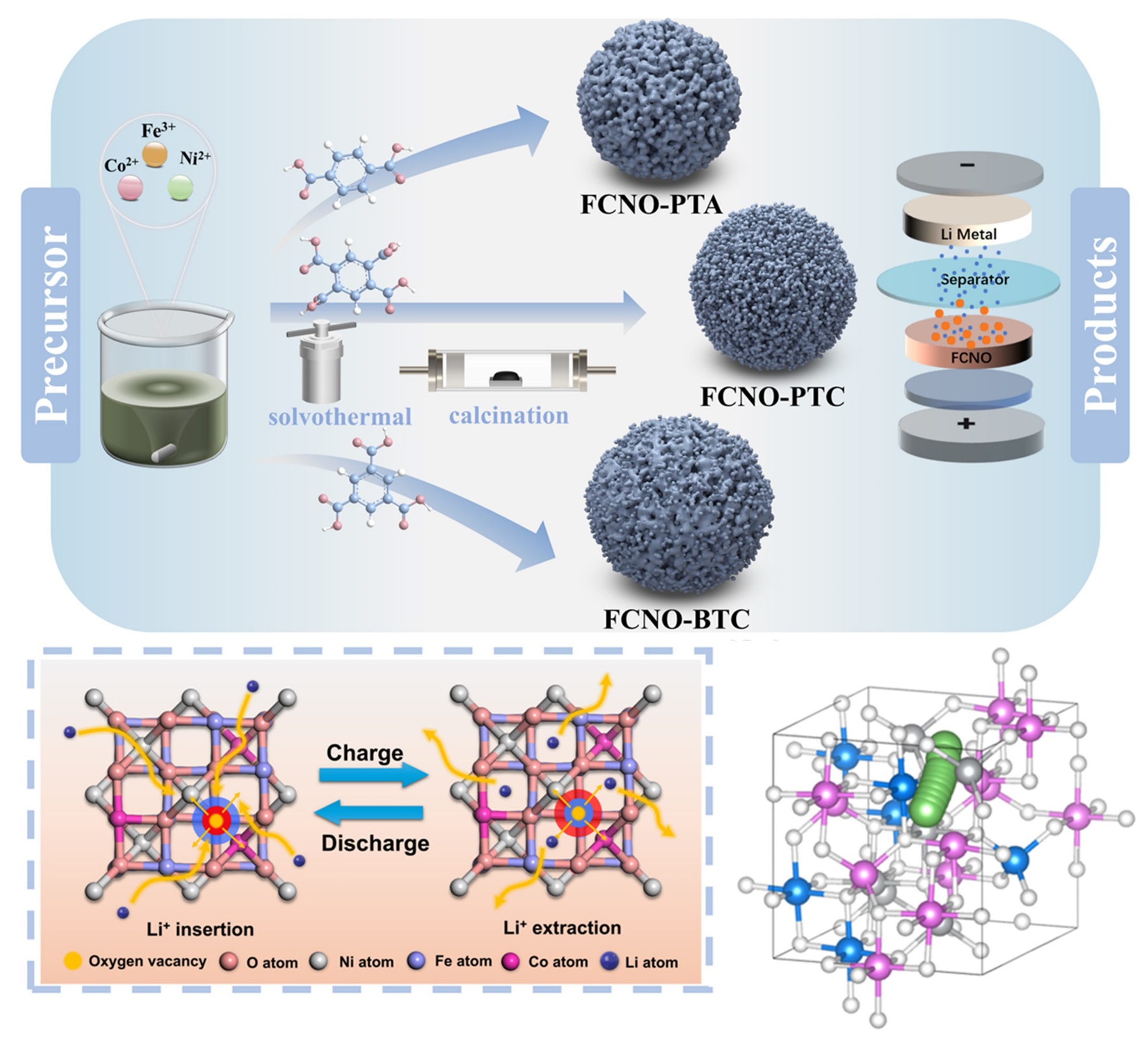
As key components of lithium-ion batteries (LIBs), anode materials can determine the capacity, stability, and safety of LIBs. Transition metal oxides have been regarded as promising LIB anodes due to their low cost, natural abundance, and substantial theoretical capacity. Nevertheless, the large-scale use of metal oxides is hampered by their intrinsic demerits, including low conductivity and large volume fluctuation. Several strategies have been proposed to address these limitations, such as morphological/structural design, heterostructuring, and defect engineering. It’s feasible to integrate the above strategies by using suitable self-sacrificial templates. Owing to their multiformity, porosity, and large surface area, metal-organic frameworks (MOFs) remain suitable templates for metal oxide fabrication. Herein, this work develops a series of oxygen-deficient (FeCoNi)3O4 using different MOFs (terephthalic acid, 1,3,5-benzenetricarboxylic acid, and pyromellitic acid) as self-sacrificial templates (denoted as FCNO-PTA, FCNO-BTC, and FCNO-PTC, respectively). Both experimental and theoretical studies reveal that abundant oxygen vacancies can create local built-in electric fields. This not only provides additional lithium adsorption sites but also facilitates the formation of a robust solid electrolyte interface (SEI), thereby mitigating the lattice strain upon lithiation/delithiation and enhancing overall performance. Remarkably, FCNO-PTC demonstrates the optimal reversible capacities (1176 mAh g–1 at 0.2 A g–1 after 150 cycles; 725 mAh g–1 at 1 A g–1 after 350 cycles) due to its higher oxygen vacancy content. This work provides new insights into the optimisation of metal oxides at an atomic scale.




- Address: Fuzhou High & New Technology Industrial Zone, Shangjie, Minhou, Fuzhou, Fujian 350108, China
- Tel: (86)-591-63173769, 63173770
- E-mail: cjsc@fjirsm.ac.cn
CN 35–1112/TQ, ISSN 0254–5861, Online ISSN: 2949-768X Copyright @ 2022 Chinese Journal of Structural Chemistry-www.Chinese Journal of Structural Chemistry.net. All Rights Reserved 闽ICP备2022002645号-1