

Just Accepted
Just Accepted Articles have been posted online after technical editing and typesetting for immediate view. The final edited version with page numbers will appear in the Current Issue soon.
Submit a Manuscript

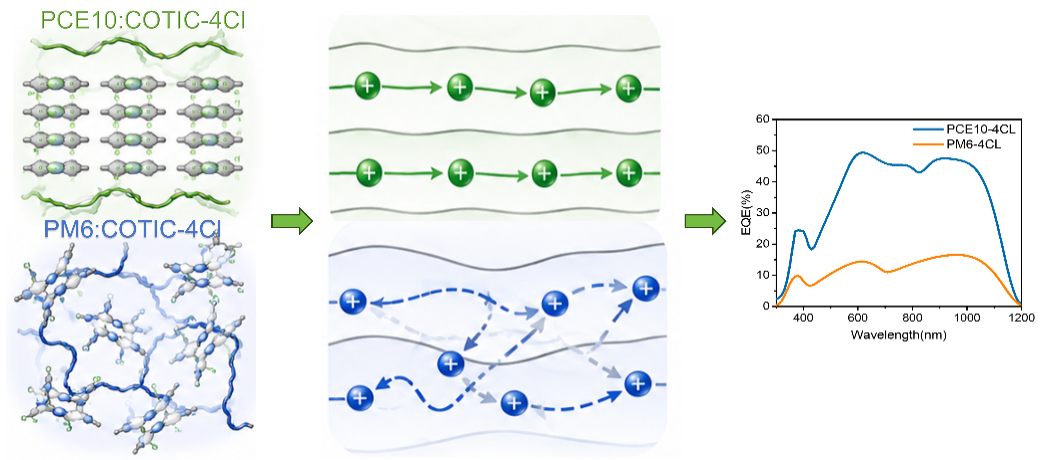
Donor dependent molecular packing and charge transport govern the performance of COTIC-4Cl based organic shortwave infrared photodiodes
Guohao Dai, Suhao Hu, Chunlong Sun, Xiaocai Lv, Yue Sun, Hui Sun, Meiqi Zhang, Jianfeng Wang, Jingyu Cui, Jing Li, Long Ye, Weigang Zhu*, Wenping Hu*
https://doi.org/10.1016/j.cjsc.2026.101076
Organic photodiode; Shortwave-infrared detection; Molecular packing; Charge transport
ABSTRACT
hortwave infrared organic photodiodes (SWIR OPDs) have emerged as promising candidates for low-cost, and large-area photodetection. However, efficient charge generation and transport under low-energy infrared excitation remain challenging. Herein, two different polymer donor:COTIC-4Cl bulk-heterojunctions, namely semi-crystalline π-edge-on PM6 and amorphous π-face-on PCE10 with COTIC-4Cl, are systematically investigated for SWIR photodetection. COTIC-4Cl exhibits broad absorption extending to approximately 1400 nm, while both blend films retain strong absorption in the 800–1200 nm region. Although efficient ultrafast hole transfer occurs in both systems after selective excitation of COTIC-4Cl at 1060 nm, their device performances differ significantly. The PCE10:COTIC-4Cl device delivers a peak EQE approaching 50% at 1060 nm and a maximum responsivity of 0.38 A W-1, outperforming the PM6:COTIC-4Cl counterpart. GIWAXS and SCLC analyses reveal that the superior performance originates from enhanced molecular ordering and improved hole mobility in the PCE10:COTIC-4Cl blend, whereas COTIC-4Cl disrupts the ordered packing of PM6. Furthermore, the PCE10:COTIC-4Cl device achieves a cutoff frequency of 0.5 MHz and enables photoplethysmography monitoring, highlighting its potential for practical infrared sensing applications.




- Address: Fuzhou High & New Technology Industrial Zone, Shangjie, Minhou, Fuzhou, Fujian 350108, China
- Tel: (86)-591-63173769, 63173770
- E-mail: cjsc@fjirsm.ac.cn
CN 35–1112/TQ, ISSN 0254–5861, Online ISSN: 2949-768X Copyright @ 2022 Chinese Journal of Structural Chemistry-www.Chinese Journal of Structural Chemistry.net. All Rights Reserved 闽ICP备2022002645号-1