

Just Accepted
Just Accepted Articles have been posted online after technical editing and typesetting for immediate view. The final edited version with page numbers will appear in the Current Issue soon.
Submit a Manuscript

Coupling impurity-state engineering with interfacial charge redis-tribution for efficient noble-metal-free photocatalytic hydrogen evolution
Hanmei Yang, Ping Zhou, Xinyu Xu, Bo Su, Xiahui Lin, Binbin Guo*, Xue Feng Lu, Kunlong Liu*, Guigang Zhang, Sibo Wang*
https://doi.org/10.1016/j.cjsc.2026.101101
Photocatalysis; Hydrogen evolution; Cd doping; Charge transfer; Impurity states
ABSTRACT
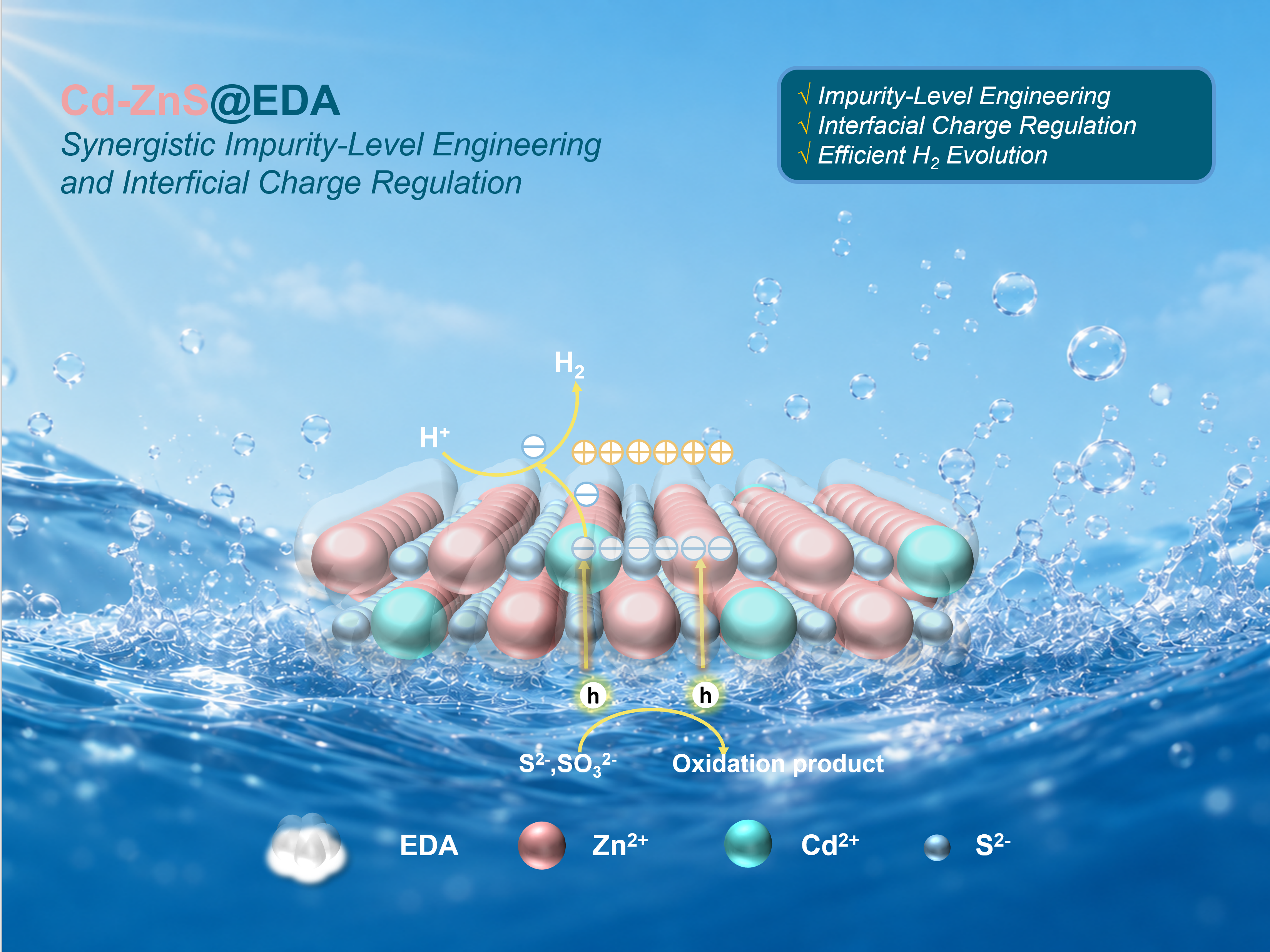
Photocatalytic hydrogen evolution is limited by inefficient charge separation and sluggish interfacial charge-transfer kinetics, necessitating the delicate modulation of carrier-transfer pathways to improve solar-to-hydrogen conversion efficiency. Herein, we report a noble-metal-free Cd-doped ZnS@ethylenediamine photocatalyst (Cd-ZnS@EDA) synthesized via a one-step solvothermal coordination-mediated self-assembly strategy. Cd incorporation generates impurity states within ZnS, which broaden excitation pathways, facilitate carrier redistribution, accelerate electron migration, and suppress charge recombination. Simultaneously, coordinated EDA constructs an amine-rich interface, promoting directional charge separation and interfacial electron migration. Moreover, the amine-rich interfacial environment is expected to facilitate proton adsorption near the catalyst surface and quickens proton-reduction kinetics. Benefiting from the coupling of impurity-state engineering and interfacial charge regulation, Cd-ZnS@EDA exhibits substantially improved charge generation, separation, transport, and utilization while effectively mitigating photocorrosion. As a result, the optimized catalyst affords an H2 evolution rate of 97.1 mmol g-1 h-1, outperforming both ZnS@EDA and Cd-ZnS, together with an apparent quantum efficiency of 30.6% and decent cycling stability. Combined experimental and theoretical investigations reveal that the cooperative effects of Cd-induced impurity states and EDA-mediated interfacial charge redistribution are responsible for the improved photocatalytic performance. This work establishes an effective strategy for integrating electronic-structure engineering with molecular interfacial regulation to develop efficient noble-metal-free photocatalysts for hydrogen production.




- Address: Fuzhou High & New Technology Industrial Zone, Shangjie, Minhou, Fuzhou, Fujian 350108, China
- Tel: (86)-591-63173769, 63173770
- E-mail: cjsc@fjirsm.ac.cn
CN 35–1112/TQ, ISSN 0254–5861, Online ISSN: 2949-768X Copyright @ 2022 Chinese Journal of Structural Chemistry-www.Chinese Journal of Structural Chemistry.net. All Rights Reserved 闽ICP备2022002645号-1