

Just Accepted
Just Accepted Articles have been posted online after technical editing and typesetting for immediate view. The final edited version with page numbers will appear in the Current Issue soon.
Submit a Manuscript

Engineering hydrothermal carbonaceous carbon photocatalysts from biomass for efficient photocatalysis
Liangpang Xu, Baoting Yi, Xingjie Wang, Junli Ren*, Jimmy C. Yu*
https://doi.org/10.1016/j.cjsc.2026.101117
Hydrothermal carbonaceous carbon; Biomass; Photocatalysis; Modification strategies; Energy and environmental applications
ABSTRACT
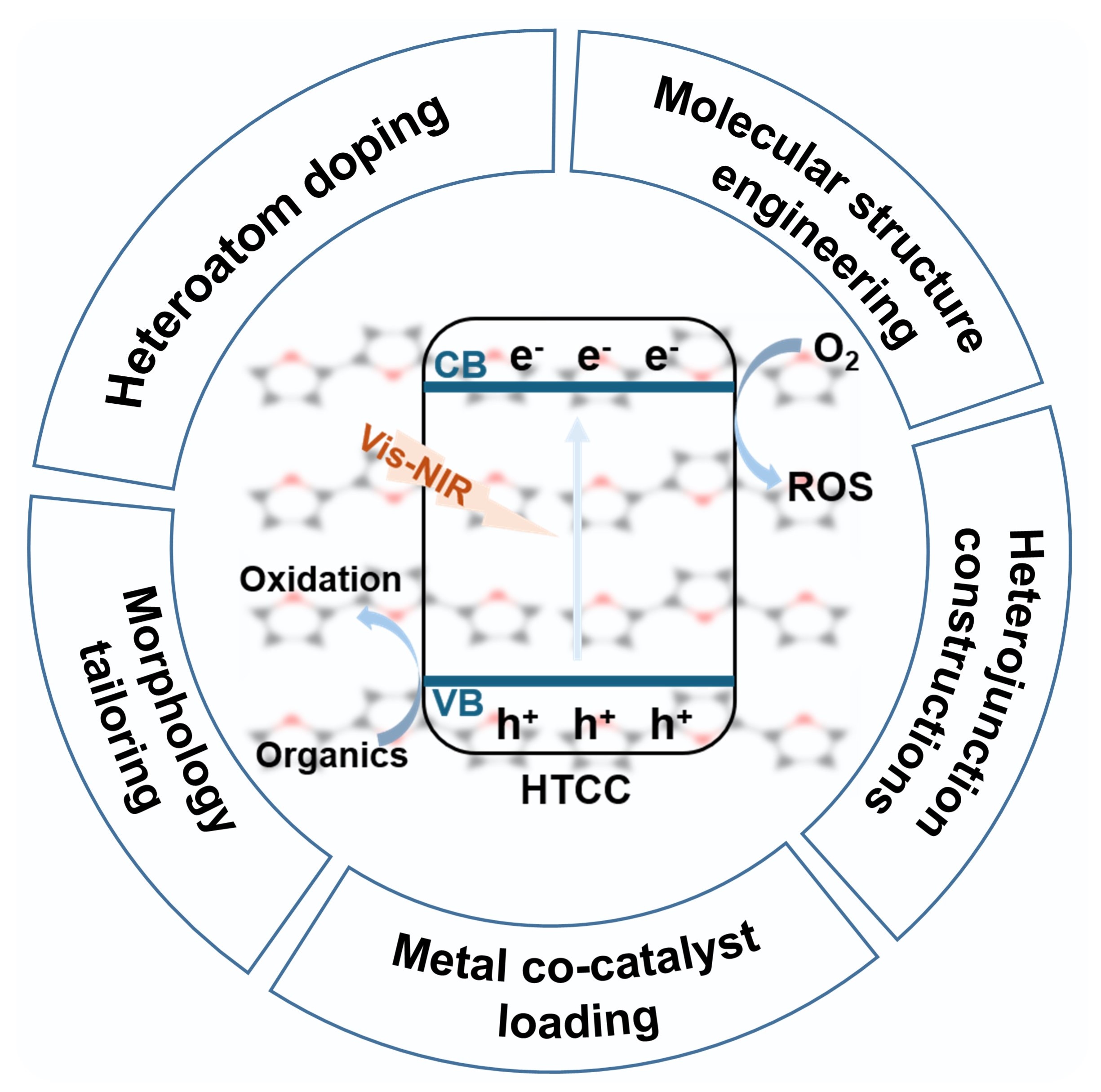
Hydrothermal carbonaceous carbon (HTCC) is a sustainable metal-free photocatalyst derived from biomass via mild hydrothermal carbonization. Its tunable band gap, appropriate redox potentials, and effective reactive oxygen species (ROS) generation under visible light render it highly promising for applications in pollutant degradation, water disinfection, and H2O2 photosynthesis. However, the photocatalytic efficiency of pure HTCC is limited by inherent bottlenecks such as severe recombination of photogenerated carriers, low interchain charge transport efficiency, and insufficient surface active sites. To overcome these limitations, a series of modification strategies have been developed. This review systematically summarizes the latest progress in five major modification strategies for HTCC-based photocatalysts: (1) heteroatom doping (N, P, I, Cl, Fe) to regulate band structure and induce polyfuran chain configuration distortion; (2) molecular structure engineering, including the construction of donor-acceptor (D-A) conjugated systems and acid-assisted structural reconstruction; (3) heterostructure construction (type-II, Z-type, S-type) to achieve efficient charge separation while maintaining strong redox capabilities; (4) metal co-catalyst loading to form Schottky junctions and provide activation sites of small-molecules; and (5) morphology regulation to shorten carrier migration paths and increase active-site exposure. This paper discusses in detail the charge transfer mechanism, structure-activity relationship, and their roles in enhancing photocatalytic performance for each modification strategy. Finally, we summarize the current challenges and outline future research directions, emphasizing the importance of precise structural regulation, in-depth research on charge dynamics, and expansion of application scenarios. The aim is to provide theoretical guidance for the rational design of high-performance HTCC photocatalysts that would be key components in artificial photosynthesis and environmental treatment.




- Address: Fuzhou High & New Technology Industrial Zone, Shangjie, Minhou, Fuzhou, Fujian 350108, China
- Tel: (86)-591-63173769, 63173770
- E-mail: cjsc@fjirsm.ac.cn
CN 35–1112/TQ, ISSN 0254–5861, Online ISSN: 2949-768X Copyright @ 2022 Chinese Journal of Structural Chemistry-www.Chinese Journal of Structural Chemistry.net. All Rights Reserved 闽ICP备2022002645号-1