

Just Accepted
Just Accepted Articles have been posted online after technical editing and typesetting for immediate view. The final edited version with page numbers will appear in the Current Issue soon.
Submit a Manuscript

Isoreticular in-situ engineering the cationic unit of a charge-assisted HOF for efficient methane purification
Banghao Wei, Yi Chen, Zhiyong Lu*
https://doi.org/10.1016/j.cjsc.2026.101123
Charge-assisted hydrogen-bonded organic frameworks; Cationic unit; In-situ solvent decomposition; Diethylammonium; Methane purification
ABSTRACT
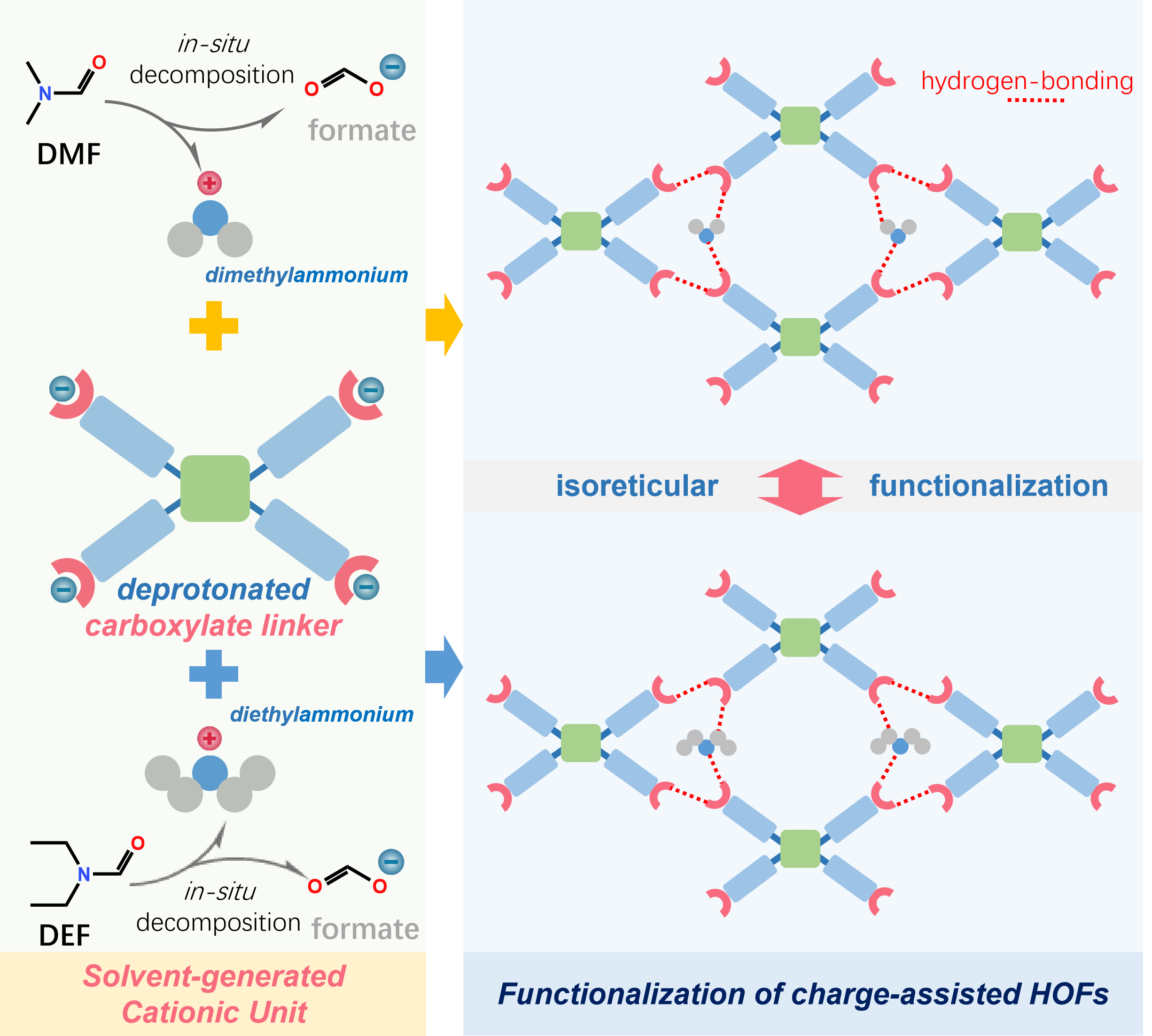
An isoreticular functionalization strategy for charge-assisted Hydrogen-bonded Organic Frameworks (HOFs) via in-situ solvent decomposition is presented. By simply replacing DMF with DEF as the reaction medium, the in-situ generated counterions change from dimethylammonium to diethylammonium while keeping the same organic linker (H4BTBA). The two resulting isoreticular HOFs, BTBA-1 and NJTech-HOF-1, share identical topologies but exhibit distinct pore chemistries due to the different cation sizes. Although NJTech-HOF-1 shows slightly reduced surface area and porosity, it displays significantly enhanced adsorption selectivity for C2H6 and C3H8 over CH4, as evidenced by higher IAST selectivities (C3H8/CH4 : 180.3; C2H6/CH4 : 22.3), larger isosteric heats of adsorption (C3H8 : 41.5 kJ mol-1; C2H6 : 28.5 kJ mol-1), and excellent dynamic breakthrough performance. DFT simulations attribute the improved affinity to enhanced host–guest contacts in the channel pockets governed by the bulkier diethylammonium cations. This work offers a simple, organic-synthesis-avoiding route to fine-tune the separation properties of HOFs, highlighting the critical role of solvent-derived cations in constructing robust and selective adsorbents for natural gas purification.




- Address: Fuzhou High & New Technology Industrial Zone, Shangjie, Minhou, Fuzhou, Fujian 350108, China
- Tel: (86)-591-63173769, 63173770
- E-mail: cjsc@fjirsm.ac.cn
CN 35–1112/TQ, ISSN 0254–5861, Online ISSN: 2949-768X Copyright @ 2022 Chinese Journal of Structural Chemistry-www.Chinese Journal of Structural Chemistry.net. All Rights Reserved 闽ICP备2022002645号-1