

Just Accepted
Just Accepted Articles have been posted online after technical editing and typesetting for immediate view. The final edited version with page numbers will appear in the Current Issue soon.
Submit a Manuscript

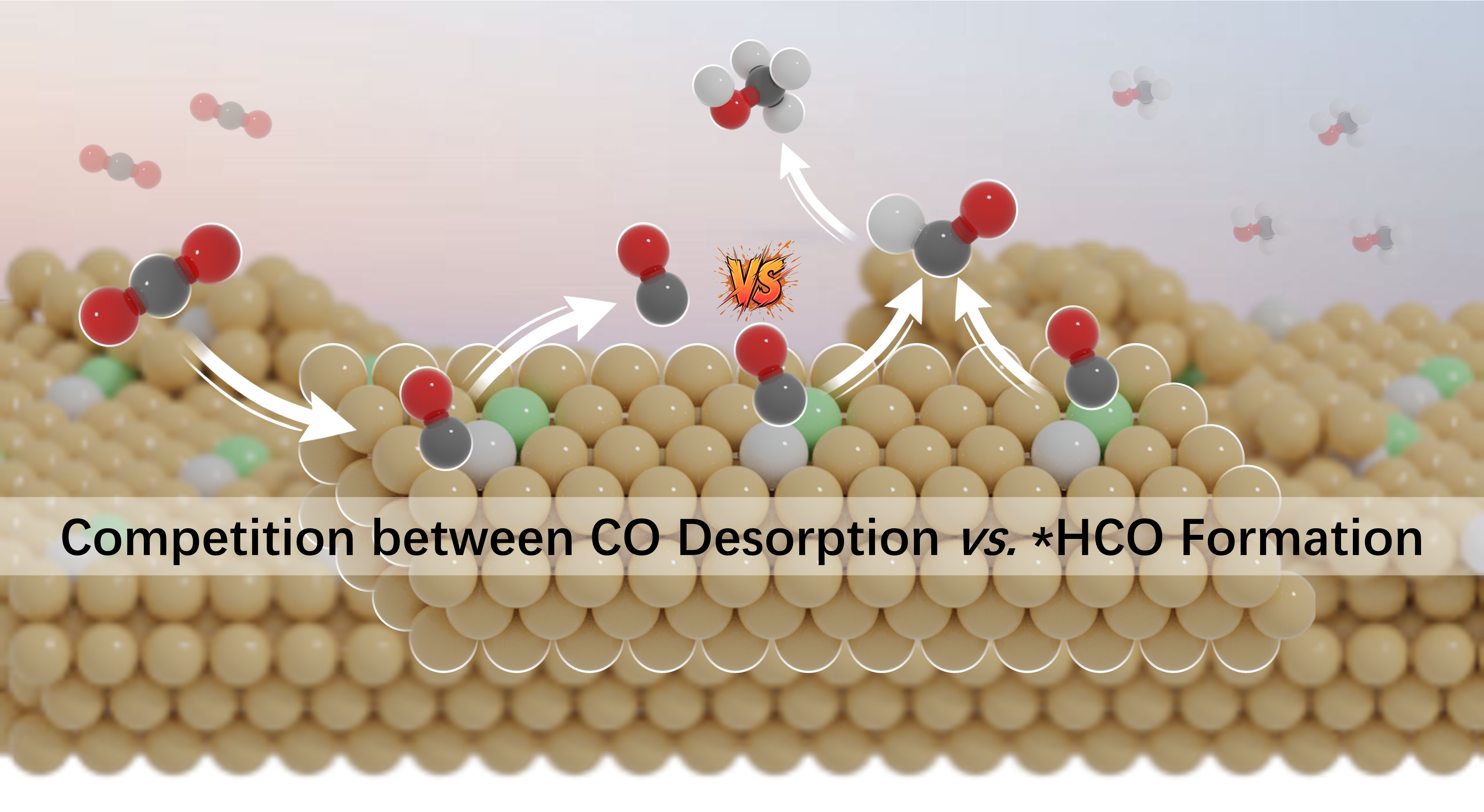
Controlling CO2 hydrogenation selectivity through heterometallic cooperation in Ti–X@Cu dual-atom alloys
Lulu Chen, Shuyun Zhou, Rong Jiang*, Sen Lin*
https://doi.org/10.1016/j.cjsc.2026.101124
Dual-atom alloys; CO2 hydrogenation; microkinetic simulations; electronic structure descriptor
ABSTRACT
Steering product selectivity in CO2 hydrogenation remains a central challenge for catalyst design. The transition from single-atom alloys (SAAs) to dual-atom alloys (DAAs) offers a compelling strategy to overcome the limitations of isolated active sites, yet the role of the secondary metal in governing selectivity is poorly understood. Here, we move beyond conventional SAA design by systematically investigating Ti–X@Cu DAAs (X = Ni, Rh, Pd, Ir, Pt, Au) using density functional theory and microkinetic simulations. Although all catalysts share a common reaction network, we discover that product selectivity is dictated by a subtle kinetic competition between CO desorption and its hydrogenation towards *HCO intermediate. This competition is captured by a simple descriptor that measures the energetic balance between CO desorption and *HCO formation. Larger descriptor values favors *HCO formation over CO release, thereby steering the pathway toward methanol. The secondary metal modulates this descriptor by reshaping the CO adsorption mode: π-backdonation-dominated binding (e.g., Ir, Ni) stabilizes CO and promotes hydrogenation, whereas σ-donation-dominated interactions (e.g., Pd, Au) weaken CO adsorption and favor desorption. Notably, Ti–Ni@Cu exhibits a unique dual-mode binding (bridge σ-donation and top π-backdonation), providing mechanistic flexibility that leads to high methanol selectivity. Consequently, Ti–Ir@Cu and Ti–Ni@Cu achieve the highest methanol selectivity, while Ti–Pd@Cu preferentially produces CO. Our findings establish a descriptor-governed link between the electronic structure of Ti–X@Cu DAAs and catalytic selectivity, providing a mechanistic basis for understanding selectivity trends within this series of bimetallic systems.




- Address: Fuzhou High & New Technology Industrial Zone, Shangjie, Minhou, Fuzhou, Fujian 350108, China
- Tel: (86)-591-63173769, 63173770
- E-mail: cjsc@fjirsm.ac.cn
CN 35–1112/TQ, ISSN 0254–5861, Online ISSN: 2949-768X Copyright @ 2022 Chinese Journal of Structural Chemistry-www.Chinese Journal of Structural Chemistry.net. All Rights Reserved 闽ICP备2022002645号-1