

Just Accepted
Just Accepted Articles have been posted online after technical editing and typesetting for immediate view. The final edited version with page numbers will appear in the Current Issue soon.
Submit a Manuscript

Solution-processable chiral Cu4I4 hybrid clusters enabling efficient circularly polarized electroluminescence through intrinsic triplet emission
Hai-Ning Zhu, Hao Zeng, Jin-Yun Wang, Jia-Rui Xu, Yue Wu, Shu-Cheng Liu, Xu-Yang Ding*, Liang-Jin Xu*
https://doi.org/10.1016/j.cjsc.2026.101130
ABSTRACT
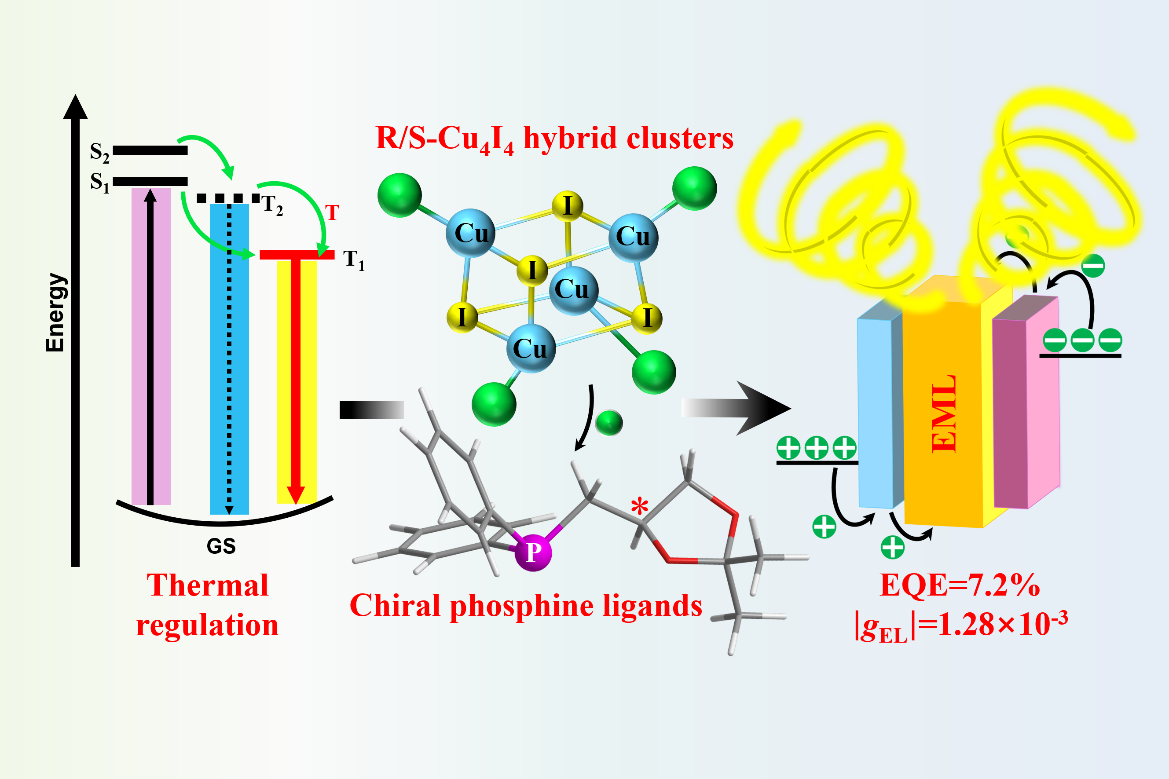
Circularly polarized electroluminescence (CPEL) enables compact and energy-efficient photonic technologies by eliminating external polarization optics. Although copper(I) halide clusters are attractive emissive materials owing to their low cost, environmental compatibility, and highly efficient triplet emission, the development of solution-processable chiral copper halide emitters for CPEL remains largely unexplored. Herein, we report a pair of enantiomeric Cu4I4 hybrid clusters supported by chiral phosphine ligands, combining efficient phosphorescence, intrinsic circularly polarized luminescence (CPL), and excellent solution processability. The clusters exhibit intense yellow phosphorescence centered at 573 nm, with photoluminescence quantum yields exceeding 40.0% in the solid state and reaching 45.1% in doped films. Variable-temperature spectroscopy and time-dependent density functional theory reveal a thermally regulated dual-triplet emission mechanism involving higher-lying mixed metal-to-ligand/ligand-to-ligand charge-transfer and lower-lying ligand-centered triplet states, accounting for the temperature-dependent emission. Efficient chirality transfer from the phosphine ligands to the Cu4I4 core generates mirror-image CPL with |glum| values approaching 1.2 × 10⁻³ in powders and solution-processed films. Solution-processed circularly polarized OLEDs based on these clusters achieve a maximum external quantum efficiency of 7.2% and |gEL| = 1.28 × 10⁻³. This work establishes chiral Cu4I4 clusters as promising emitters for sustainable circularly polarized optoelectronics.




- Address: Fuzhou High & New Technology Industrial Zone, Shangjie, Minhou, Fuzhou, Fujian 350108, China
- Tel: (86)-591-63173769, 63173770
- E-mail: cjsc@fjirsm.ac.cn
CN 35–1112/TQ, ISSN 0254–5861, Online ISSN: 2949-768X Copyright @ 2022 Chinese Journal of Structural Chemistry-www.Chinese Journal of Structural Chemistry.net. All Rights Reserved 闽ICP备2022002645号-1