

Just Accepted
Just Accepted Articles have been posted online after technical editing and typesetting for immediate view. The final edited version with page numbers will appear in the Current Issue soon.
Submit a Manuscript

Crystal-packing-dependent thermally activated delayed fluorescence and negative thermal quenching in heteroleptic Cu(I) complexes
Elvira I. Musina*, Igor D. Strelnik, Valeriia A. Iakhieia, Feifei Gao*, Daria I. Shamshina, Igor A. Litvinov, Artemiy G. Shmelev, Ekaterina M. Zueva, Qingfeng Mu, Andrey A. Karasik, Hui Xu
https://doi.org/10.1016/j.cjsc.2026.101133
Copper complex; Cyclic diphosphine; Phenanthroline; Structure; Luminescence; Thermally activated delayed fluorescence (TADF); Negative thermal quenching (NTQ); Phase-dependent luminescence
ABSTRACT
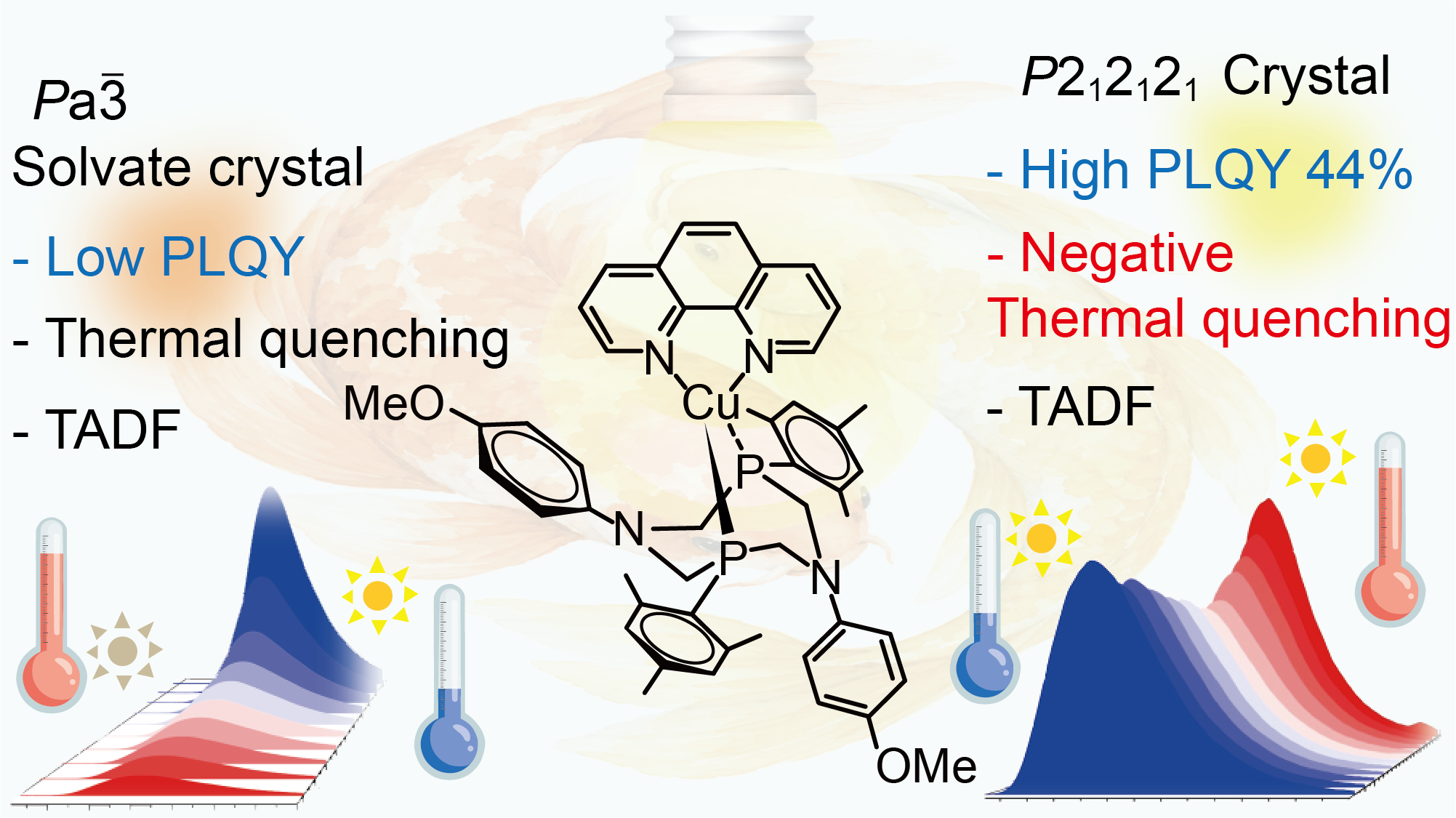
Heteroleptic complex [Cu(phen)(PˆP)]BF4 (2), where PˆP is a 3,7-bis(mesityl)-1,5-bis(4-methoxyphenylmethyl)-1,5,3,7-diazadiphosphacyclooctane, phen - 1,10-phenanthroline, was synthesized and isolated as three different forms - amorphous phase 2-am, crystal solvate 2-solv in Pa space group, and crystal 2-y in P212121 space group. Their structure was fully characterized by different analytical and spectroscopic techniques (NMR spectroscopy, mass-spectrometry, single-crystal and powder X-ray analysis). The X-ray analysis reveals a distorted tetrahedral geometry around the copper(I) ion formed by phenanthroline and cyclic diphosphine ligands. The electronic excited states were investigated by UV/Vis and luminescence spectroscopy and identified using density functional theory (DFT) and time-dependent DFT (TDDFT) fmethods. The isolated solid phases exhibit different emission characteristics, such as emission wavelength, photoluminescence quantum yield (PLQY), lifetime of luminescence, and negative thermal quenching (NTQ) behavior. Differences in emission properties reflect a strong impact of solid-state architecture and non-covalent network on the excited-state characteristics. The presence of multiple intermolecular contacts and especially strong intermolecular π-stacking interactions in the crystal lattice of 2-y allows us to achieve a bright yellow emission, maximize the PLQY up to 44% and observe the NTQ phenomenon, which is crucial for luminescent materials including OLED.




- Address: Fuzhou High & New Technology Industrial Zone, Shangjie, Minhou, Fuzhou, Fujian 350108, China
- Tel: (86)-591-63173769, 63173770
- E-mail: cjsc@fjirsm.ac.cn
CN 35–1112/TQ, ISSN 0254–5861, Online ISSN: 2949-768X Copyright @ 2022 Chinese Journal of Structural Chemistry-www.Chinese Journal of Structural Chemistry.net. All Rights Reserved 闽ICP备2022002645号-1