

Just Accepted
Just Accepted Articles have been posted online after technical editing and typesetting for immediate view. The final edited version with page numbers will appear in the Current Issue soon.
Submit a Manuscript

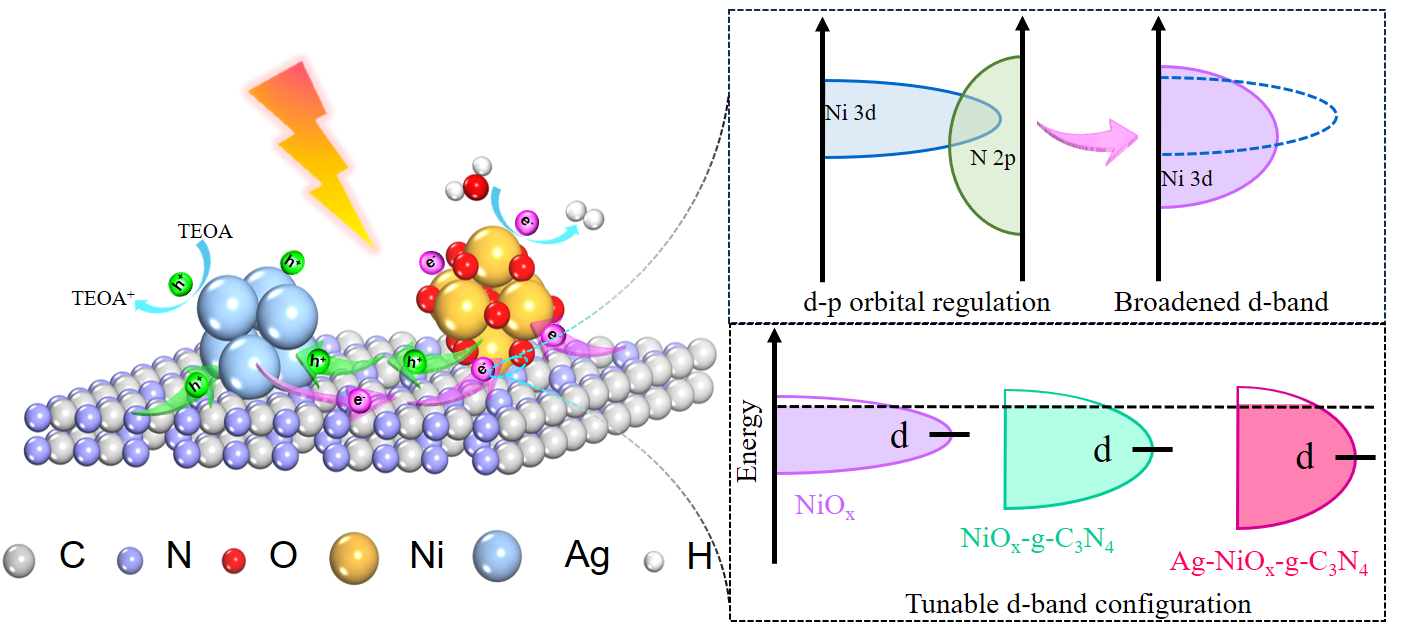
Synergistic work-function gradient and d-p orbital hybridization unlock charge migration and H2 adsorption/desorption kinetics in Ag-NiOx-g-C3N4
Yiming Zhang*, Jiakai Hu, Yunpeng Zhang, Zhenggang An, Haize Jin, Ruilong Ma, Xu Zhang, Xusheng Wang*
https://doi.org/10.1016/j.cjsc.2026.101134
d-p orbital hybridization; Work-function gradient; Photocatalytic H2 evolution; DFT calculation
ABSTRACT
Efficient photocatalytic hydrogen evolution demands precise orchestration of charge separation and hydrogen adsorption/desorption kinetics. Here we tackle this challenge by synergistically integrating a work-function gradient with d-p orbital hybridization in a ternary Ag-NiOx-g-C3N4 architecture. Pronounced work function mismatch, confirmed by synchronous illumination X-ray photoelectron spectroscopy and density functional theory calculations, drives a directional electron cascade from Ag to NiOx via the g-C3N4 bridge, enforcing unidirectional charge migration. Concurrently, experimental and theoretical analyses reveal strong Ni 3d-N 2p orbital hybridization, which broadens Ni 3d band and downshifts its center to -2.12 eV. Compared with the control models, orbital hybridization induced Ni 3d band modulation fine-tunes hydrogen adsorption/desorption free energy to a near optimal -1.28 eV and concomitantly lowers interfacial charge transfer barrier. Consequently, the optimized 2%Ag-1.5% NiOx-g-C3N4 delivers an outstanding H2 evolution rate of 3594 μmol h-1 g-1, outperforming pristine g-C3N4 (25 μmol h-1 g-1), 2%Ag-g-C3N4 (284 μmol h-1 g-1) and 1.5% NiOx-g-C3N4 (1391 μmol h-1 g-1) by factors of 143.8, 12.6 and 2.6, respectively. This work establishes a general paradigm that couples macroscopic charge steering with microscopic orbital engineering for solar-to-hydrogen conversion.




- Address: Fuzhou High & New Technology Industrial Zone, Shangjie, Minhou, Fuzhou, Fujian 350108, China
- Tel: (86)-591-63173769, 63173770
- E-mail: cjsc@fjirsm.ac.cn
CN 35–1112/TQ, ISSN 0254–5861, Online ISSN: 2949-768X Copyright @ 2022 Chinese Journal of Structural Chemistry-www.Chinese Journal of Structural Chemistry.net. All Rights Reserved 闽ICP备2022002645号-1