


Ziyan Wang, Yihe Gao, Chao Han*
Chin. J. Struct. Chem., 2025, 44(10), 100679. DOI: 10.1016/j.cjsc.2025.100679
October 15, 2025
ABSTRACT
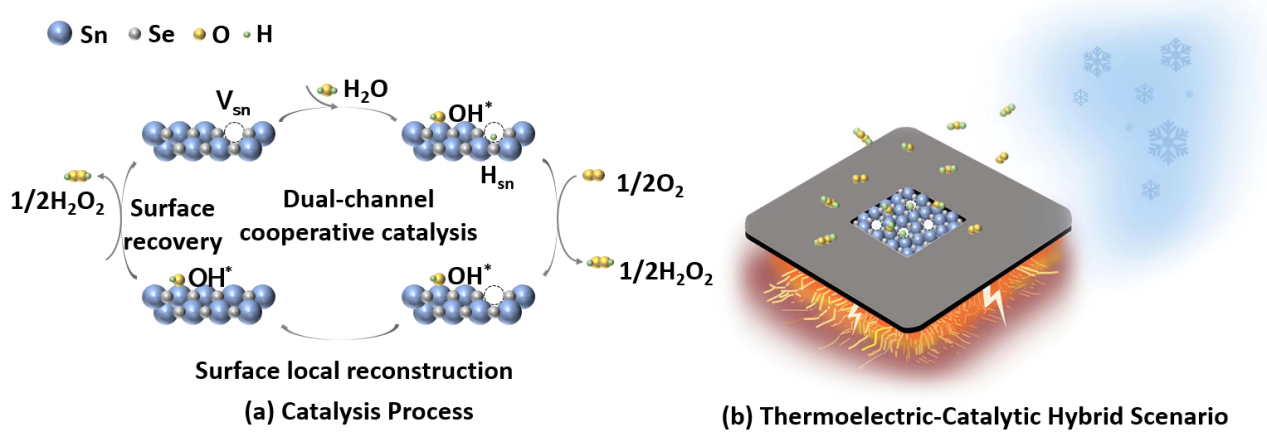
Moreover, this work demonstrates a defect-driven thermocatalytic system based
on SnSe nanospheres that efficiently produces H₂O₂ from H₂O and O₂ at
remarkably low temperatures (40°C), without requiring additional energy input
or chemical additives. The SnSe nanosheet catalyst with Sn vacancies achieves a
high H2O2 production rate of 2.6 mmol g-1 h-1 at 40°C and exhibits excellent stability, maintaining consistent performance for over 50 hours in a
flow reactor. Notably, most such defect-rich materials (including SnSe) possess
excellent thermoelectric properties. This dual functionality suggests a
promising strategy for developing hybrid low-temperature thermoelectric-catalytic
systems, where low-grade waste heat could be effectively harvested through
thermoelectric effects to further reduce the overall energy consumption of the
catalytic process. In contrast, current water electrolysis systems typically
operate with hot water (80–90 °C), noble metal Pt-based catalysts, and exhibit
high electrical energy consumption. By integrating thermoelectric catalysis
with low-cost thermoelectric materials as catalysts, significant energy savings
can be achieved—a prospect that underscores both technological attractiveness
and the need for further research.




- Address: Fuzhou High & New Technology Industrial Zone, Shangjie, Minhou, Fuzhou, Fujian 350108, China
- Tel: (86)-591-63173769, 63173770
- E-mail: cjsc@fjirsm.ac.cn