


Lead-free organic antimony halide with dual-band intrinsic white light emission for warm WLED directly
Hua Tong, Haibo Li*, Wei Liu*, Gangfeng Ouyang*
Chin. J. Struct. Chem., 2025, 44(10), 100678. DOI: 10.1016/j.cjsc.2025.100678
October 15, 2025
Organic antimony halides; White light emission; Self-trapped excitons (STEs); WLED
ABSTRACT
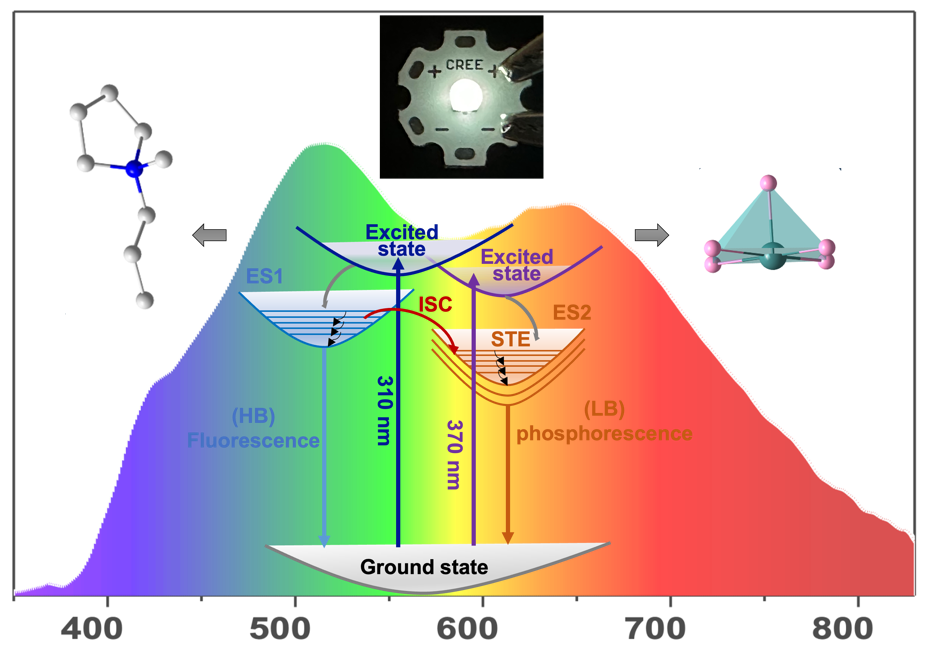
Organic metal halides with white-light emissions have shown important application prospects in the field of solid-state lighting and displays, but their structural design ad synthesis remains a huge challenge. Here, the material design concept of functional units has been applied to prepare a zero-dimensional (0D) organic antimony halide (1-BMP)5(SbCl5)2SbCl4 with two luminescent centers from the inorganic units and the organic units, emitting red about 670 nm and cyan about 508 nm respectively, combined to form white light. Based on the photoluminescence (PL), the time-resolved PL analysis and density functional theory (DFT) calculation, it is shown that the red emission comes from STEs related to inorganic units [SbCl5]2-, and the cyan emission comes from the fluorescence of organic cations 1-BMP+. This work provides new methods and ideas for the development of low-cost and ecofriendly white emission phosphors for single-component solid-states WLEDs.




- Address: Fuzhou High & New Technology Industrial Zone, Shangjie, Minhou, Fuzhou, Fujian 350108, China
- Tel: (86)-591-63173769, 63173770
- E-mail: cjsc@fjirsm.ac.cn
CN 35–1112/TQ, ISSN 0254–5861, Online ISSN: 2949-768X Copyright @ 2022 Chinese Journal of Structural Chemistry-www.Chinese Journal of Structural Chemistry.net. All Rights Reserved 闽ICP备2022002645号-1