


Lingyue Liu*, Jie Ding*
Chin. J. Struct. Chem., 2025, 44(10), 100681. DOI: 10.1016/j.cjsc.2025.100681
October 15, 2025
ABSTRACT
Beyond
mechanistic insights, this work demonstrates the practical utility of Co1CNCl/S
in real water systems. The catalyst maintains high activity in diverse water
matrices and shows excellent reusability and scalability, enabling continuous
flow treatment of 189.6 L g-1 with minimal cost ($0.22 per ton of
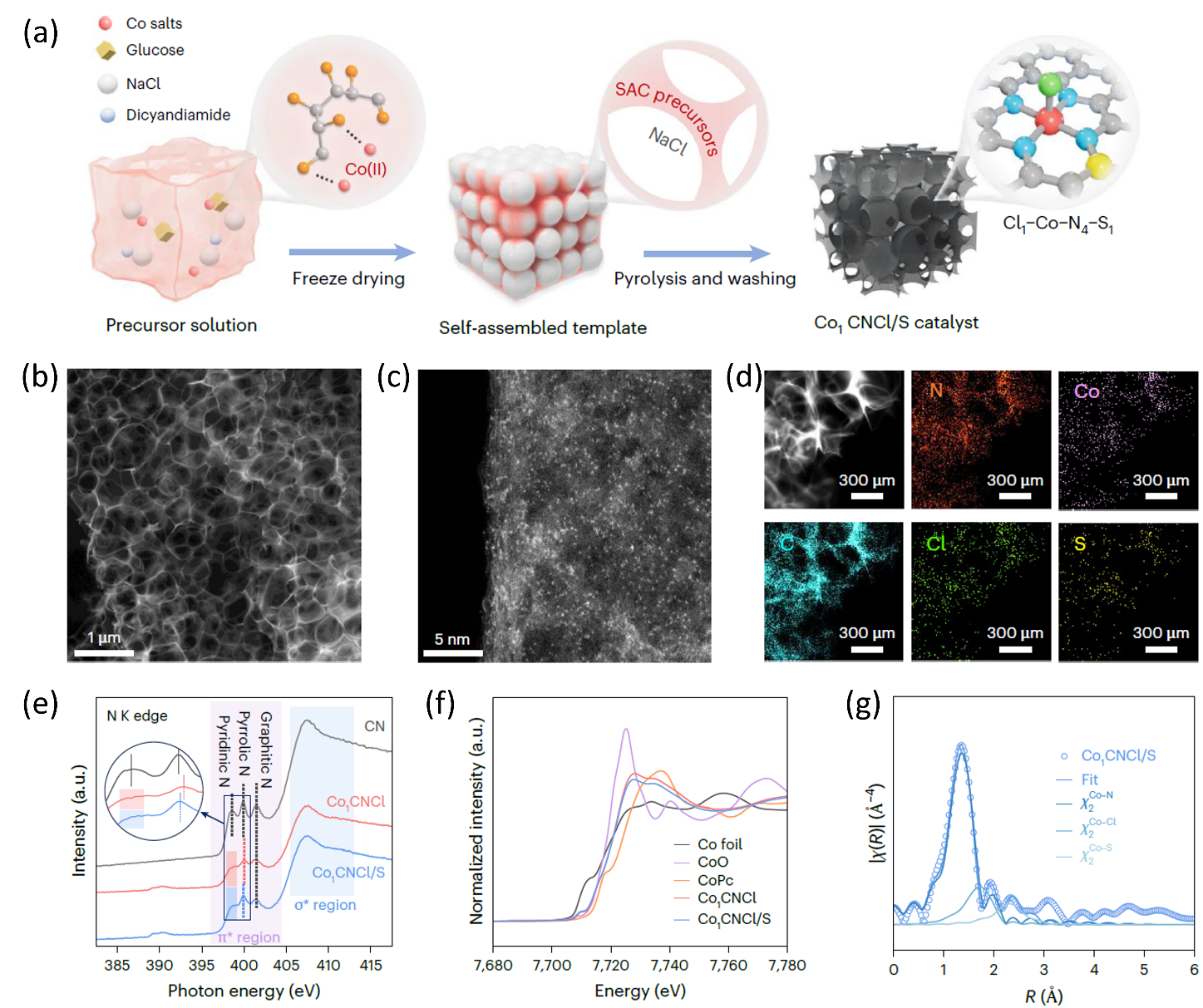
treated water). The Cl/S bicoordination creates a cooperative electronic
environment that modulates the oxidation state and reactivity of the Co site.
Axial Cl induces electron withdrawal, raising the oxidation state and shifting
the d-band center, while second-shell S doping stabilizes the high-valent Co
intermediate via π-backdonation. This facilitates PMS* adsorption and
stabilizes the ETP route over radical-based mechanisms. This study exemplifies
how precise spatial and electronic engineering of SACs can fundamentally
redirect reaction pathways, favoring non-radical routes with improved
selectivity and stability. The axial–second-shell coordination strategy opens
new directions in the design of robust, high-performance SACs for environmental
remediation and beyond. Future efforts may extend this concept to other redox
reactions and SAC platforms, integrating dynamic in situ characterizations and
computational modeling to accelerate the development of intelligent,
function-oriented catalytic materials.




- Address: Fuzhou High & New Technology Industrial Zone, Shangjie, Minhou, Fuzhou, Fujian 350108, China
- Tel: (86)-591-63173769, 63173770
- E-mail: cjsc@fjirsm.ac.cn