


Ziqi Chen, Miriding Mutailipu*
Chin. J. Struct. Chem., 2025, 44(10), 100695. DOI: 10.1016/j.cjsc.2025.100695
October 15, 2025
Birefringence; π-conjugated group; Hydrogen bonding; Optical anisotropy
ABSTRACT
Birefringent materials play a crucial role in light
polarization, with important applications in fiber-optic communications.
However, developing such materials for the solar-blind region and shorter
wavelengths remains challenging due to the inherent trade-off between
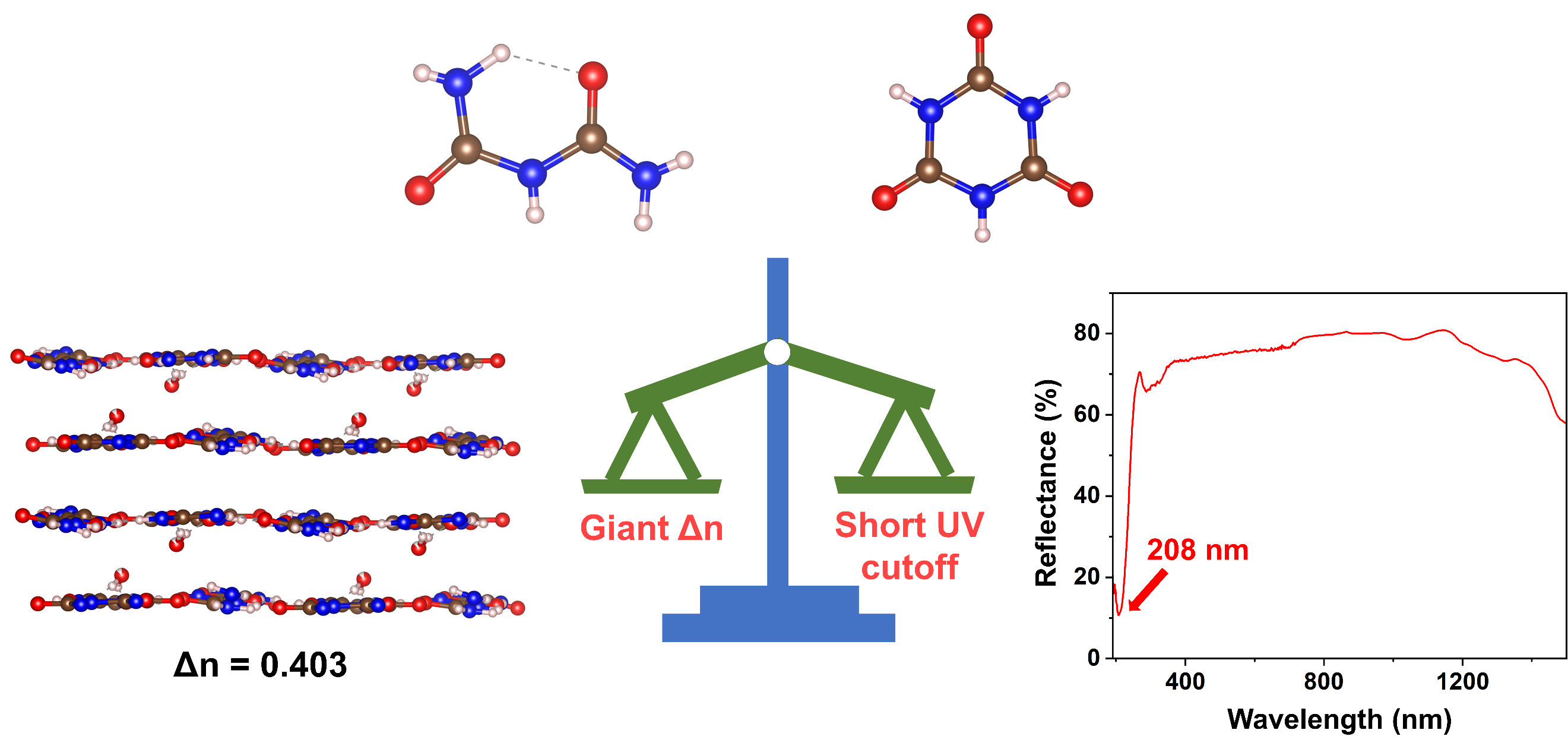
birefringence and bandgap. In this work, we introduce a strategic assembly of
cyanuric rings with biuret units—the latter identified for the first time as a
birefringence-active motif—resulting in two new compounds: [H5C2N3O2][H3C3N3O3]
(1) and [H5C2N3O2][H3C3N3O3]·xH2O (x ≈ 0.43) (2). Through hydrogen
bonding-driven structural optimization, compound 2 achieves a 50% increase in birefringence (Δn = 0.403 @ 546 nm) compared to 1, while retaining a short cutoff edge of 208 nm. This advancement
demonstrates that hydrogen-bond-guided structural design, combined with novel
functional units, can overcome the traditional birefringence-bandgap conflict,
opening new possibilities for short-wavelength birefringent materials with
strong optical anisotropy.




- Address: Fuzhou High & New Technology Industrial Zone, Shangjie, Minhou, Fuzhou, Fujian 350108, China
- Tel: (86)-591-63173769, 63173770
- E-mail: cjsc@fjirsm.ac.cn