


Cover Picture
MOF derived Co–Mo2C heterojunctions with interfacial electronic modulation for oxygen reduction reaction and zinc-air batteries
Desheng Li#, Qin Li#, Peng Xu, Xingyu Guo, Heng Wu, Rui Liu*, Fei Tan* Submit a Manuscript
MOF derived Co–Mo2C heterojunctions with interfacial electronic modulation for oxygen reduction reaction and zinc-air batteries
Desheng Li#, Qin Li#, Peng Xu, Xingyu Guo, Heng Wu, Rui Liu*, Fei Tan* Submit a Manuscript
Interface engineering of Co9S8/Ni3S2 heterojunction with robust stability for boosting peroxymonosulfate activation
Xiaohan Wang, Xue Guo, Zhuo Song, Chen Guan, Chengyu Yang, Tianyang Li, Yukun Zhu*, Yan Xu*
Chin. J. Struct. Chem., 2026, 45(2), 100771. DOI: 10.1016/j.cjsc.2025.100771
February 1, 2026
Metal sulfides; Heterojunction; Peroxymonosulfate; Interface; Antibiotic
ABSTRACT
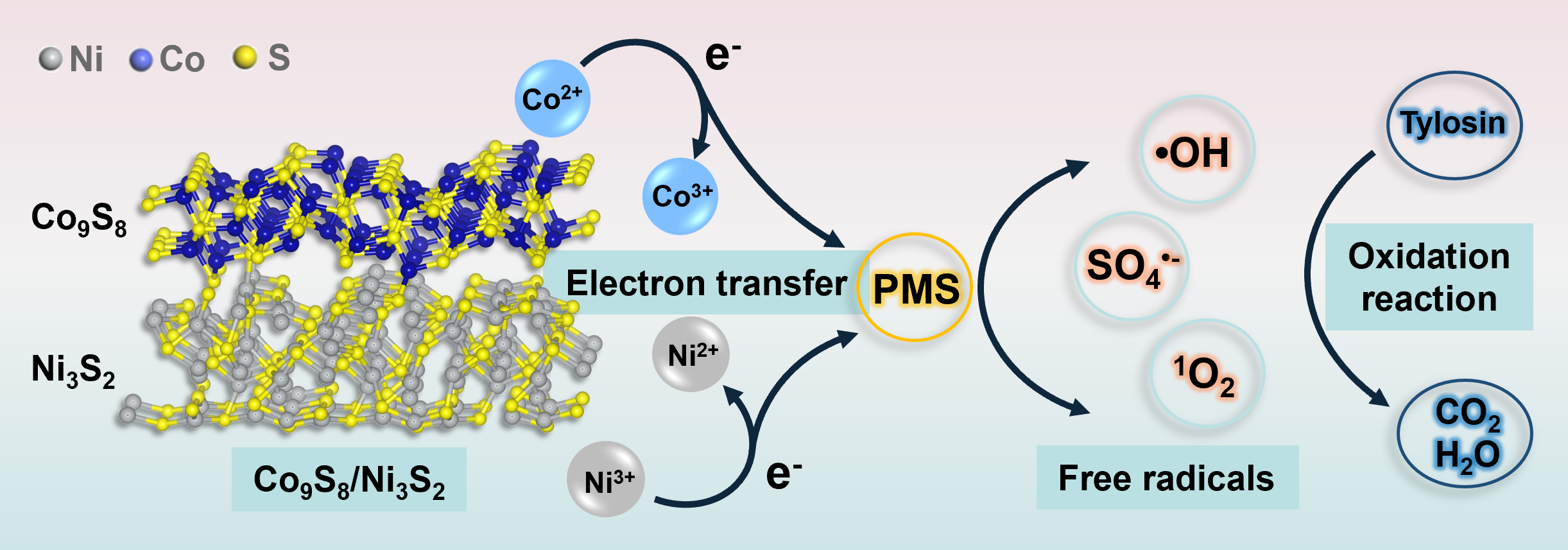
Cobalt-based catalysts for peroxymonosulfate (PMS) activation are often hindered by metal leaching and structural instability, limiting their practical application. To address these challenges, we developed a novel Co9S8/Ni3S2 heterojunction catalyst via a hydrothermal method followed by thermal reduction, employing interface engineering to inhibit metal co leaching. The resulting Co9S8/Ni3S2/PMS system achieved complete tylosin degradation within 120 s. Notably, cobalt leaching was reduced by 4.5 times compared to pure Co9S8, demonstrating significantly enhanced catalyst stability. Furthermore, the system exhibited high efficiency in degrading a variety of antibiotics, good cyclic stability, and strong tolerance to diverse aqueous environments. The enhanced performance is attributed to the interface-engineered heterostructure, which not only improves the structural stability by suppresses metal cation leaching, but also facilitates enhanced PMS adsorption onto the catalyst surface. This improved PMS adsorption, particularly on cobalt active sites, results in substantial electron enrichment, thereby promoting efficient tylosin degradation. This work highlights the importance of interface engineering in designing advanced heterojunction catalysts for stable, and efficient antibiotic wastewater treatment.




- Address: Fuzhou High & New Technology Industrial Zone, Shangjie, Minhou, Fuzhou, Fujian 350108, China
- Tel: (86)-591-63173769, 63173770
- E-mail: cjsc@fjirsm.ac.cn
CN 35–1112/TQ, ISSN 0254–5861, Online ISSN: 2949-768X Copyright @ 2022 Chinese Journal of Structural Chemistry-www.Chinese Journal of Structural Chemistry.net. All Rights Reserved 闽ICP备2022002645号-1