


Cover Picture
MOF derived Co–Mo2C heterojunctions with interfacial electronic modulation for oxygen reduction reaction and zinc-air batteries
Desheng Li#, Qin Li#, Peng Xu, Xingyu Guo, Heng Wu, Rui Liu*, Fei Tan* Submit a Manuscript
MOF derived Co–Mo2C heterojunctions with interfacial electronic modulation for oxygen reduction reaction and zinc-air batteries
Desheng Li#, Qin Li#, Peng Xu, Xingyu Guo, Heng Wu, Rui Liu*, Fei Tan* Submit a Manuscript
Excitation-dependent tunable photoluminescence in CsCdCl3 all-inorganic perovskite for anti-counterfeiting
Guojun Zhou#*, Qiqiong Ren#, Yanting Wang#, Nan Zhang, Yilin Mao, Pei Wang, Xian-Ming Zhang*
Chin. J. Struct. Chem., 2026, 45(2), 100774. DOI: 10.1016/j.cjsc.2025.100774
February 1, 2026
ABSTRACT
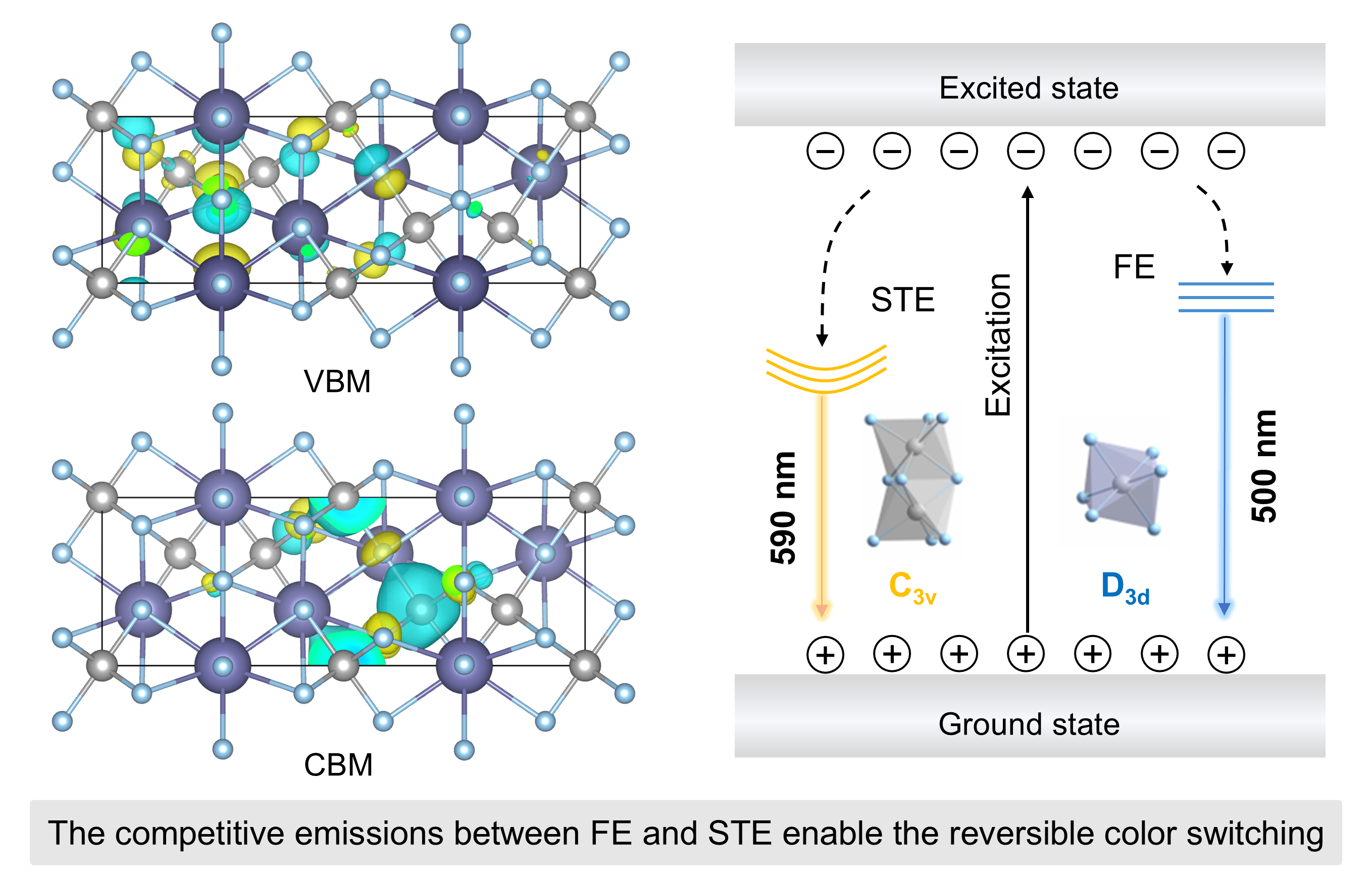
Developing single-component all-inorganic perovskites with excitation-dependent multicolor emission remains a considerable challenge for next-generation anti-counterfeiting technologies. Herein, we report an excitation-dependent tunable photoluminescence (PL) switching behavior in all-inorganic CsCdCl3 perovskite, which arises from by its unique structural asymmetry featuring both isolated [CdCl6]4− octahedra (D3d symmetry) and face-sharing [Cd2Cl9]5− dimers (C3v symmetry). This dual-coordination environment facilitates the dual-band emissions at 500 nm and 590 nm, attributed to free exciton (FE) recombination in [CdCl6]4− octahedra and self-trapped exciton (STE) emission from [Cd2Cl9]5− dimers, respectively. The competitive excitation pathways between FE and STE enable the reversible color switching between green and orange emission via excitation-wavelength modulation. The excitation-wavelength sensitivity is governed by the emission intensity ratio, where 254 nm excitation favors the dimer-associated STE emission at 590 nm while 365 nm excitation selectively strengthens the octahedral FE emission at 500 nm. Density functional theory (DFT) calculations confirm the direct bandgap of CsCdCl3 (2.62 eV), and elucidate the electronic transition mechanism. The excitation-dependent color-switching capability of CsCdCl3 offers promising potential for advanced applications in anti-counterfeiting and information encryption technologies. This work establishes a paradigm for designing single-component emitters with excitation-controlled multicolor PL, thereby unlocking possibilities for developing high-security anti-counterfeiting technologies.




- Address: Fuzhou High & New Technology Industrial Zone, Shangjie, Minhou, Fuzhou, Fujian 350108, China
- Tel: (86)-591-63173769, 63173770
- E-mail: cjsc@fjirsm.ac.cn
CN 35–1112/TQ, ISSN 0254–5861, Online ISSN: 2949-768X Copyright @ 2022 Chinese Journal of Structural Chemistry-www.Chinese Journal of Structural Chemistry.net. All Rights Reserved 闽ICP备2022002645号-1