


Cover Picture
MOF derived Co–Mo2C heterojunctions with interfacial electronic modulation for oxygen reduction reaction and zinc-air batteries
Desheng Li#, Qin Li#, Peng Xu, Xingyu Guo, Heng Wu, Rui Liu*, Fei Tan* Submit a Manuscript
MOF derived Co–Mo2C heterojunctions with interfacial electronic modulation for oxygen reduction reaction and zinc-air batteries
Desheng Li#, Qin Li#, Peng Xu, Xingyu Guo, Heng Wu, Rui Liu*, Fei Tan* Submit a Manuscript
TMO-based SERS: Dual enhancement mechanisms and multi-functional analytical applications
Xiaoyu Song, Lei Xu, Xiangyu Meng, Yuening Wang, Mingjian Zhang, Aochi Liu, Jie Lin*, Xiaotian Wang*
Chin. J. Struct. Chem., 2026, 45(2), 100797. DOI: 10.1016/j.cjsc.2025.100797
February 1, 2026
Transition metal oxides; Surface-enhanced Raman scattering; Enhancement mechanisms; Defect engineering; Analytical applications
ABSTRACT
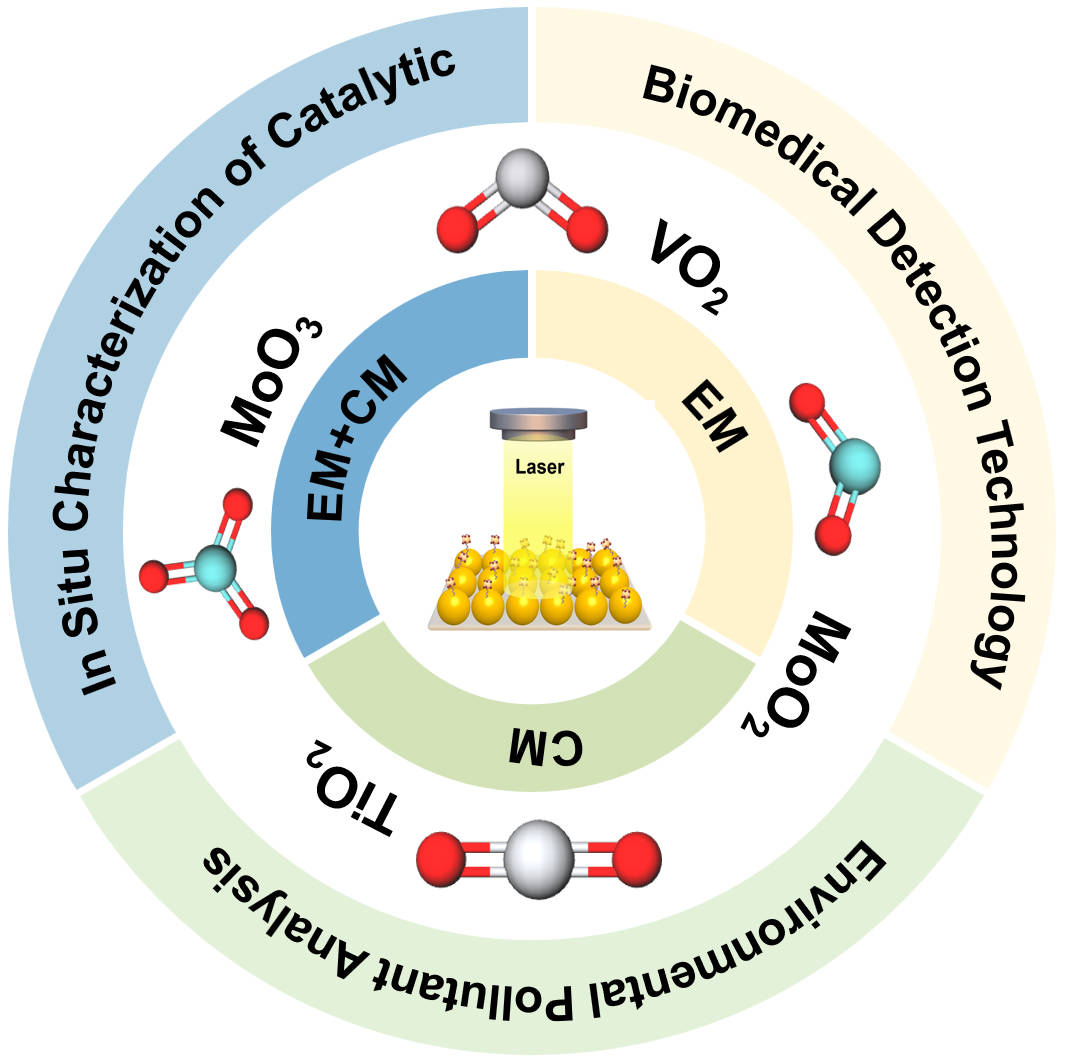
Surface-enhanced Raman scattering (SERS) spectroscopy based on transition metal oxide (TMO) substrates has emerged as a frontier research area, offering distinctive advantages in chemical stability, cost-effectiveness, and tunable optoelectronic properties compared to conventional noble metal substrates. This review systematically clarifies the dual enhancement mechanisms of TMO-based SERS including charge transfer (CT) resonance at the molecule-semiconductor interface and electromagnetic field amplification induced by localized surface plasmon resonance (LSPR); the two work synergistically to achieve signal amplification. In practical applications, TMO enable multi-scenario analysis via the controllable defect engineering-interfacial CT synergistic mechanism in SERS technology. These scenarios include ultrasensitive detection of biomarkers, dynamic tracking of cellular metabolism, real-time monitoring of environmental pollutants, and mechanistic analysis of catalytic reaction pathways. Nevertheless, critical challenges persist, particularly regarding quantitative reproducibility and long-term stability under operational conditions. This review focuses on discussing the SERS enhancement mechanisms of TMO, summarizing their diverse analytical applications across multiple fields, and briefly addressing existing limitations, aiming to provide insights for further advancement in TMO-based SERS research.




- Address: Fuzhou High & New Technology Industrial Zone, Shangjie, Minhou, Fuzhou, Fujian 350108, China
- Tel: (86)-591-63173769, 63173770
- E-mail: cjsc@fjirsm.ac.cn
CN 35–1112/TQ, ISSN 0254–5861, Online ISSN: 2949-768X Copyright @ 2022 Chinese Journal of Structural Chemistry-www.Chinese Journal of Structural Chemistry.net. All Rights Reserved 闽ICP备2022002645号-1