


Cover Picture
MOF derived Co–Mo2C heterojunctions with interfacial electronic modulation for oxygen reduction reaction and zinc-air batteries
Desheng Li#, Qin Li#, Peng Xu, Xingyu Guo, Heng Wu, Rui Liu*, Fei Tan* Submit a Manuscript
MOF derived Co–Mo2C heterojunctions with interfacial electronic modulation for oxygen reduction reaction and zinc-air batteries
Desheng Li#, Qin Li#, Peng Xu, Xingyu Guo, Heng Wu, Rui Liu*, Fei Tan* Submit a Manuscript
Hydrogen migration induced magnetic phase transitions in two-dimensional Fe-porphyrinoid metal-organic frameworks
Chao Jia, Min Ren, Yingdi Jin*, Xingxing Li*
Chin. J. Struct. Chem., 2026, 45(2), 100801. DOI: 10.1016/j.cjsc.2025.100801
February 1, 2026
Hydrogen migration; Metal-organic frameworks; Diradical; Porphyrinoid; Q2 Magnetic phase transition
ABSTRACT
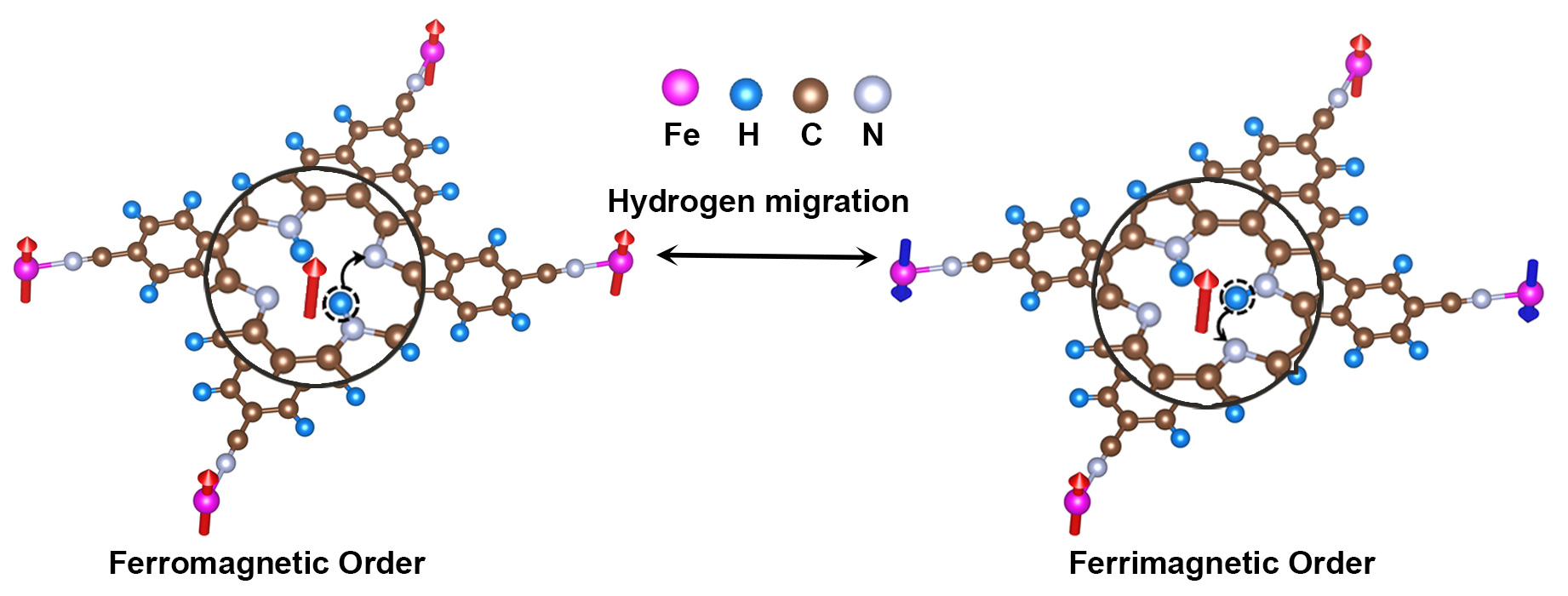
The control of magnetic state is crucial for spintronic applications but remains a significant challenge. Traditionally, controlling magnetic state relies on physical approaches, such as applying external magnetic fields or utilizing spin-orbit coupling. In our previous work, we proposed a novel chemical approach to manipulate the magnetic state of a system through lactim-lactam tautomerization. Here, by first principles calculations, we extend the type of tautomerization to intramolecular hydrogen migration, and reveal that hydrogen migration can modulate magnetic coupling and lead to distinct magnetic configurations in two-dimensional (2D) metal-organic frameworks (MOFs) composed of diradical porphyrinoid and Fe. The migration of hydrogen atoms within porphyrinoid results in four isometric MOFs with notable changes in spin density distribution on organic linkers, which subsequently alters the magnetic coupling between the metal node and organic linkers, leading to ferromagnetic-ferrimagnetic transition in the framework. The magnetic coupling strength also changes significantly, with the Curie temperature enhanced from 5.2 K to 100.1 K. Furthermore, accompanying with the magnetic transition, the MOFs experience an electronic transition from normal half semiconductors (with band gaps of 0.11 and 0.03 eV), where the valence band (VB) and conduction band (CB) share the same spin channel, to bipolar magnetic semiconductors (with band gaps of 0.06 and 0.13 eV), where the VB and CB become fully spin-polarized in opposite directions.




- Address: Fuzhou High & New Technology Industrial Zone, Shangjie, Minhou, Fuzhou, Fujian 350108, China
- Tel: (86)-591-63173769, 63173770
- E-mail: cjsc@fjirsm.ac.cn
CN 35–1112/TQ, ISSN 0254–5861, Online ISSN: 2949-768X Copyright @ 2022 Chinese Journal of Structural Chemistry-www.Chinese Journal of Structural Chemistry.net. All Rights Reserved 闽ICP备2022002645号-1