

Just Accepted
Just Accepted Articles have been posted online after technical editing and typesetting for immediate view. The final edited version with page numbers will appear in the Current Issue soon.
Submit a Manuscript

Modification of open metal sites in metal-organic frameworks for the enhancement of CO2 capture and alkane separation
Xufei Li, Junfa Fu, Weiqiu Huang*, Zhaoqiang Zhang*, Xiaofang Lv, Jiahao Kang, Jixing Xu, Jiahua Cheng, Yuhao Lu, Yitong Sun
https://doi.org/10.1016/j.cjsc.2026.100892
MOFs; Open metal sites; Modified strategy; Stability; CO2 capture; Alkane separation
ABSTRACT
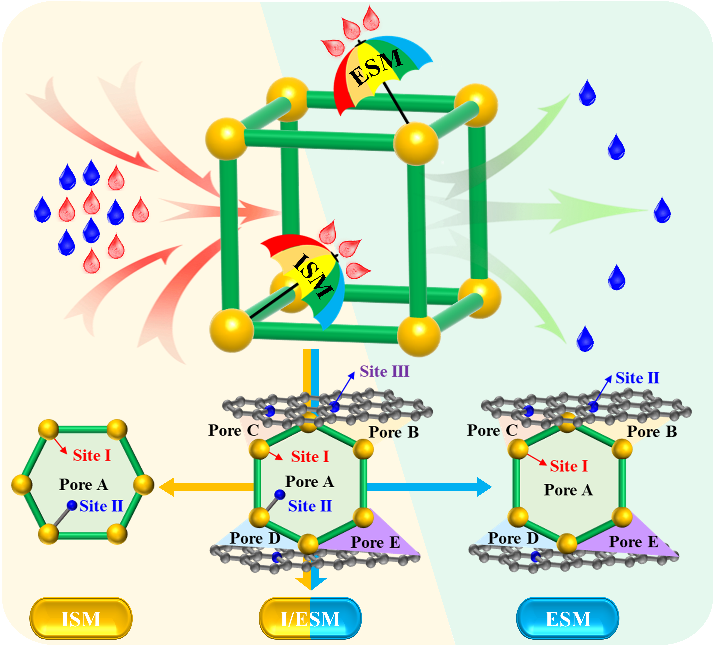
Metal-organic frameworks (MOFs) containing open metal sites (OMSs) exhibit abundant Lewis acid sites (LASs), whereas these sites readily coordinate with water molecules under humidity, which can lead to pore collapse and a reduction in available adsorption sites, ultimately compromising their separation performances. Meanwhile, the OMSs lack effective specific recognition ability at partial pressure, such as CO2 (400 ppm) or alkane (C2H6, 50 kPa). To overcome these dilemmas, this review systematically focuses on their modified strategies and gas separation applications. Firstly, modified strategies have been divided into three types, including single internal and external, and integrated internal/external surface modification (ISM, ESM and I/ESM), that is, functional modifiers are grafted into the interior or covered on the surface of MOFs depended on OMSs. As a result, the functionalized composites demonstrated customized pore size/shape and chemistry due to their synergic effects, exhibiting outstanding separation ability for challenging gases, particularly in the capture and separation of CO2 (e.g., diamine-appended MOF-74 variants displayed S-shaped CO2 isotherms), as well as in the separation of alkanes (e.g., peroxo-MOF-74 achieved reversed separation of C2H6/C2H4). Furthermore, their structure-property relationship between guest molecules and the composites are elucidated, and the future prospects for designing stable and excellent OMS-MOFs are highlighted and outlined.




- Address: Fuzhou High & New Technology Industrial Zone, Shangjie, Minhou, Fuzhou, Fujian 350108, China
- Tel: (86)-591-63173769, 63173770
- E-mail: cjsc@fjirsm.ac.cn
CN 35–1112/TQ, ISSN 0254–5861, Online ISSN: 2949-768X Copyright @ 2022 Chinese Journal of Structural Chemistry-www.Chinese Journal of Structural Chemistry.net. All Rights Reserved 闽ICP备2022002645号-1