


Cover Picture
Recent progress in amorphous metal halides for optoelectronics
Shun-Shun Li, Kaifeng Wu*, Pengfei Cheng* Submit a Manuscript
Recent progress in amorphous metal halides for optoelectronics
Shun-Shun Li, Kaifeng Wu*, Pengfei Cheng* Submit a Manuscript
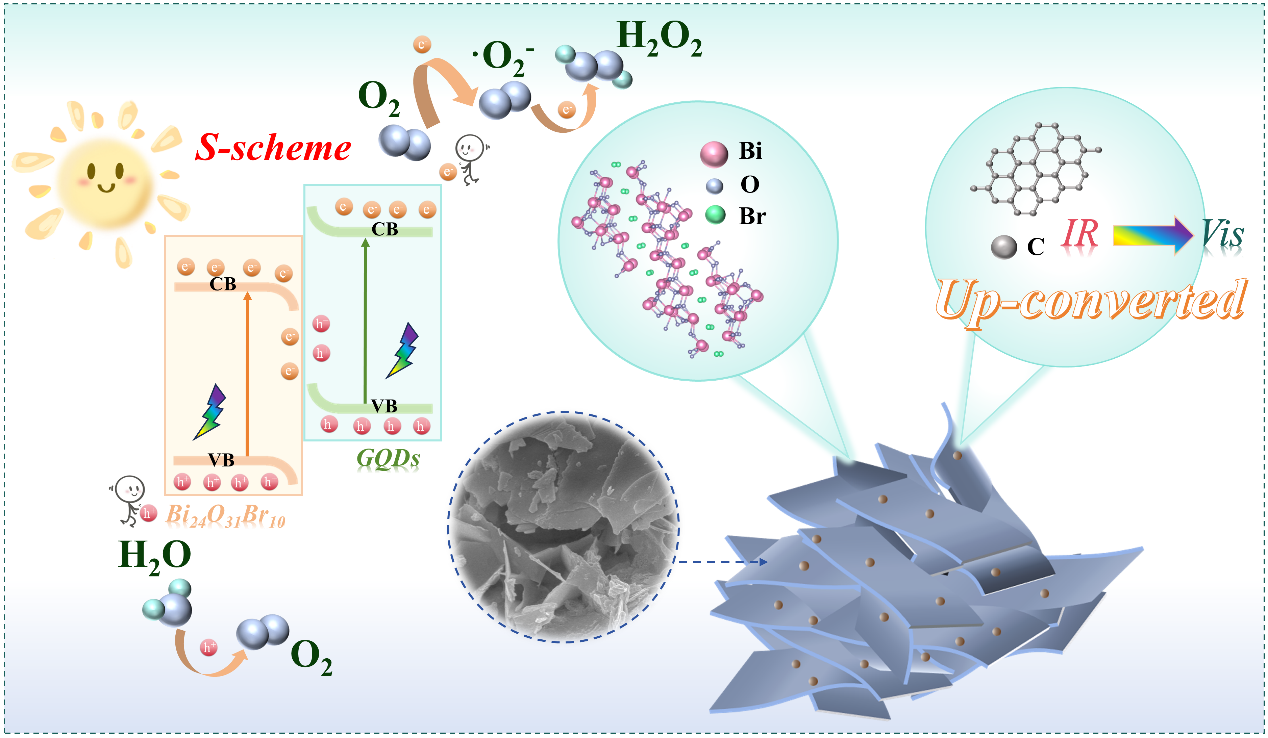
S-scheme GQDs/Bi24O31Br10 heterojunction boosts photocatalytic H2O2 production and tetracycline degradation
Mengqing Li, Changzhao Chen*, Qishen Wang, Kai Dai*
Chin. J. Struct. Chem., 2026, 45(7), 100891. DOI: 10.1016/j.cjsc.2026.100891
July 1, 2026
S-scheme heterojunction; Bifunctional photocatalyst; Photocatalytic H2O2 production; Antibiotic degradation; Charge separation
ABSTRACT
GQDs/Bi24O31Br10 S-scheme heterojunction composite was successfully constructed via a hydrothermal method and systematically evaluated its bifunctional performance in photocatalytic antibiotic (TC) degradation and hydrogen peroxide (H2O2) production. Results demonstrate that the optimized composite exhibits excellent activity in both reactions, it achieved a tetracycline degradation rate of 88.5% within 20 min, and H2O2 production yield of 104.53 μM within the same time, which is 4.2 times that of pure Bi24O31Br10. Mechanism studies reveal that the superoxide radical serves as a key reactive species, acting as both a crucial intermediate for H2O2 synthesis and the dominant active species for TC degradation. The built-in electric field at S-scheme heterojunction interface enables efficient spatial separation of photogenerated carriers, highly reductive electrons accumulate on graphene quantum dots (GQDs) to promote the two-step single-electron reduction of O2 for H2O2 generation, while strongly oxidative holes remain on Bi24O31Br10 to maintain degradation capability. This work not only develops an efficient and stable bifunctional photocatalyst but also elucidates, at the microscopic scale, the S-scheme heterojunction synergistically drives different reactions through precise regulation of charge transfer pathways, providing a theoretical foundation and practical guidance for designing novel photocatalytic systems for environmental remediation and green synthesis.




- Address: Fuzhou High & New Technology Industrial Zone, Shangjie, Minhou, Fuzhou, Fujian 350108, China
- Tel: (86)-591-63173769, 63173770
- E-mail: cjsc@fjirsm.ac.cn
CN 35–1112/TQ, ISSN 0254–5861, Online ISSN: 2949-768X Copyright @ 2022 Chinese Journal of Structural Chemistry-www.Chinese Journal of Structural Chemistry.net. All Rights Reserved 闽ICP备2022002645号-1