


Cover Picture
Recent progress in amorphous metal halides for optoelectronics
Shun-Shun Li, Kaifeng Wu*, Pengfei Cheng* Submit a Manuscript
Recent progress in amorphous metal halides for optoelectronics
Shun-Shun Li, Kaifeng Wu*, Pengfei Cheng* Submit a Manuscript
Surface confined nano-copper synergistically promotes the dehydrogenation of cyclohexanol to cyclohexanone
Xue Zhao*, Cuiyu Li, Qiao Ye, Hongqin Wang, Yicheng Zhang*, Nihong An*
Chin. J. Struct. Chem., 2026, 45(7), 100917. DOI: 10.1016/j.cjsc.2026.100917
Nano-copper; Biochar; Cyclohexanol; Cyclohexanone; Dehydrogenation
ABSTRACT
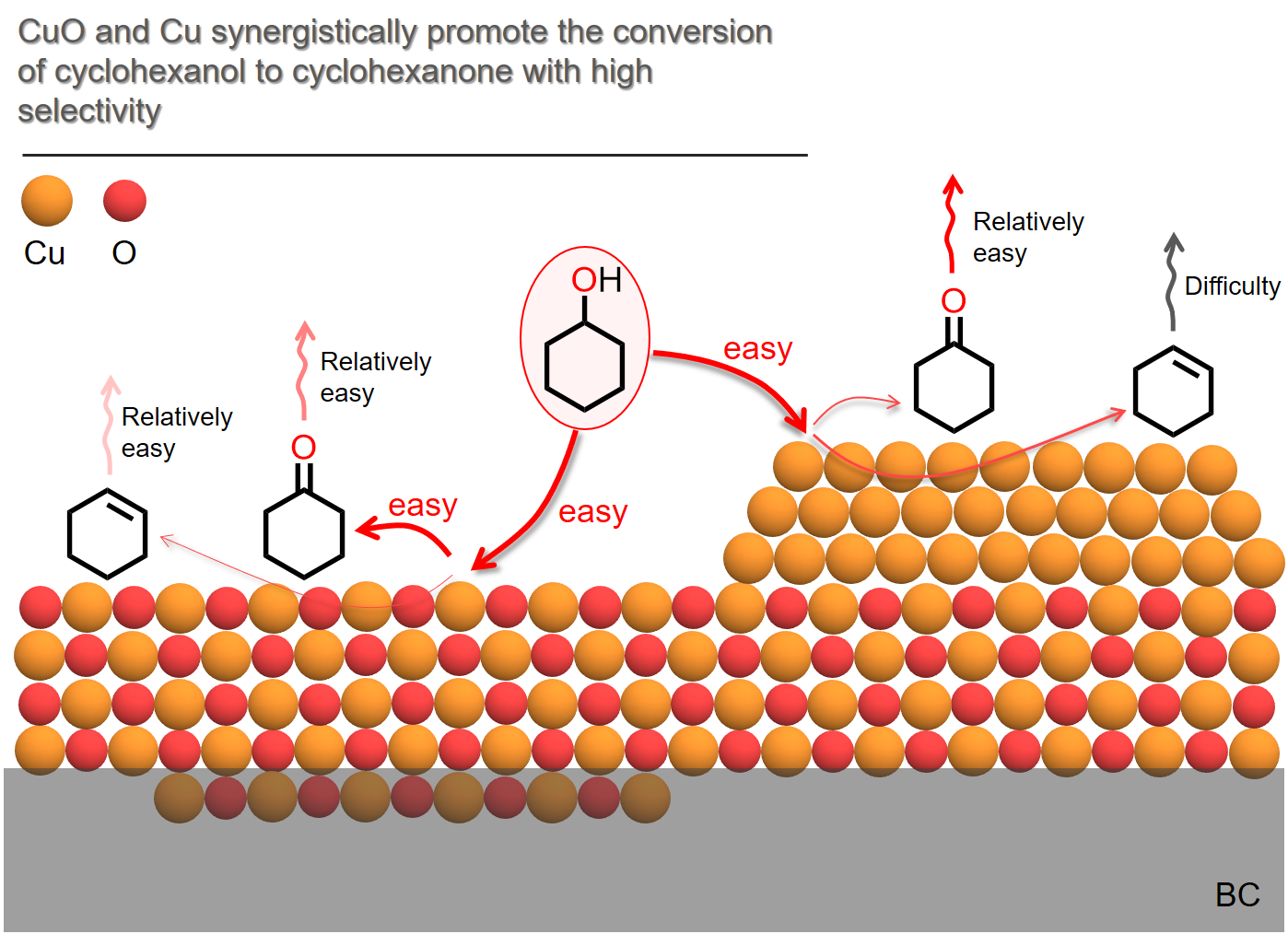
The dehydrogenation of cyclohexanol to cyclohexanone is a pathway with significant implications for the production of nylon or nylon 66; however, the core catalyst has long faced the challenge of balancing activity, selectivity, and stability. Herein, we report the use of hard-template biochar as a confining support for copper species, in which spindle-shaped nano-copper particles are embedded on the surface. This configuration promotes nearly 100% conversion of cyclohexanol to cyclohexanone across a broad temperature range (240-270 °C), accompanied by high conversion rate and long-term operation stability. Density functional theory calculations reveal that both CuO and amorphous copper in the catalyst facilitate the capture and cleavage of cyclohexanol, while exhibiting stronger adsorption capacity for cyclohexene, thereby preventing its desorption and enhancing the selectivity toward cyclohexanone.




- Address: Fuzhou High & New Technology Industrial Zone, Shangjie, Minhou, Fuzhou, Fujian 350108, China
- Tel: (86)-591-63173769, 63173770
- E-mail: cjsc@fjirsm.ac.cn
CN 35–1112/TQ, ISSN 0254–5861, Online ISSN: 2949-768X Copyright @ 2022 Chinese Journal of Structural Chemistry-www.Chinese Journal of Structural Chemistry.net. All Rights Reserved 闽ICP备2022002645号-1