


Recent progress in amorphous metal halides for optoelectronics
Shun-Shun Li, Kaifeng Wu*, Pengfei Cheng* Submit a Manuscript
Lirong He, Mingmao Chen, Yan Liu*, Xueyuan Chen
Chin. J. Struct. Chem., 2026, 45(7), 100916. DOI: 10.1016/j.cjsc.2026.100916
July 1, 2026
ABSTRACT
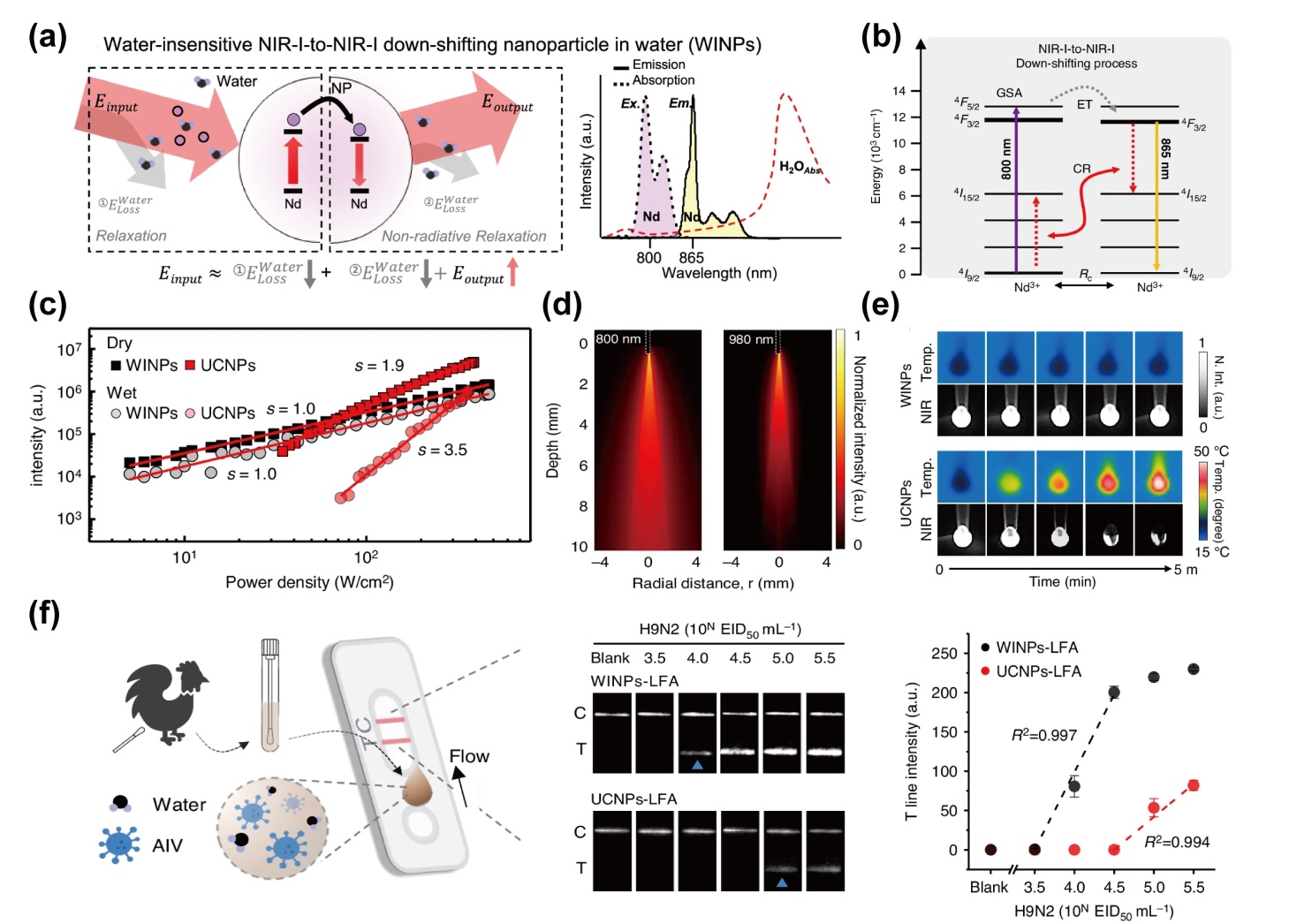
These findings established
a new paradigm for designing water-compatible NIR nanoprobes by fully
leveraging the NIR-I biological window. The WINPs’ exceptional stability, high
QY, and low-power operation address long-standing challenges in aqueous
biosensing. Looking forward, several avenues remain open for further
development: (1) expanding the application modes of the WINP system by
leveraging its distinct lifetime signatures and environmentally sensitive
spectral shifts; (2) exploiting the intrinsic NIR-II emission of Nd3+ (e.g., ~1060 nm and ~1330 nm transitions) to develop probes with deeper tissue
penetration for in vivo sensing and imaging; and (3) surface-engineering for
broader biomarker conjugation. With their low excitation power requirements and
compatibility with silicon detectors, WINPs are poised to advance point-of-care
testing and deep-tissue imaging, bridging the gap between laboratory innovation
and real-world biomedical applications.




- Address: Fuzhou High & New Technology Industrial Zone, Shangjie, Minhou, Fuzhou, Fujian 350108, China
- Tel: (86)-591-63173769, 63173770
- E-mail: cjsc@fjirsm.ac.cn