

Just Accepted
Just Accepted Articles have been posted online after technical editing and typesetting for immediate view. The final edited version with page numbers will appear in the Current Issue soon.
Submit a Manuscript

Bismuth-based S-scheme heterojunctions for efficient photocatalytic energy conversion and application
Wenbo Zheng, Xianfeng Qiao, Shuo Wang, Ying Wang*, Zhengxin Ding*, Jinlin Long*
https://doi.org/10.1016/j.cjsc.2026.100971
S-scheme heterojunctions; Bismuth-based catalysts; Photocatalysis; Environmental application
ABSTRACT
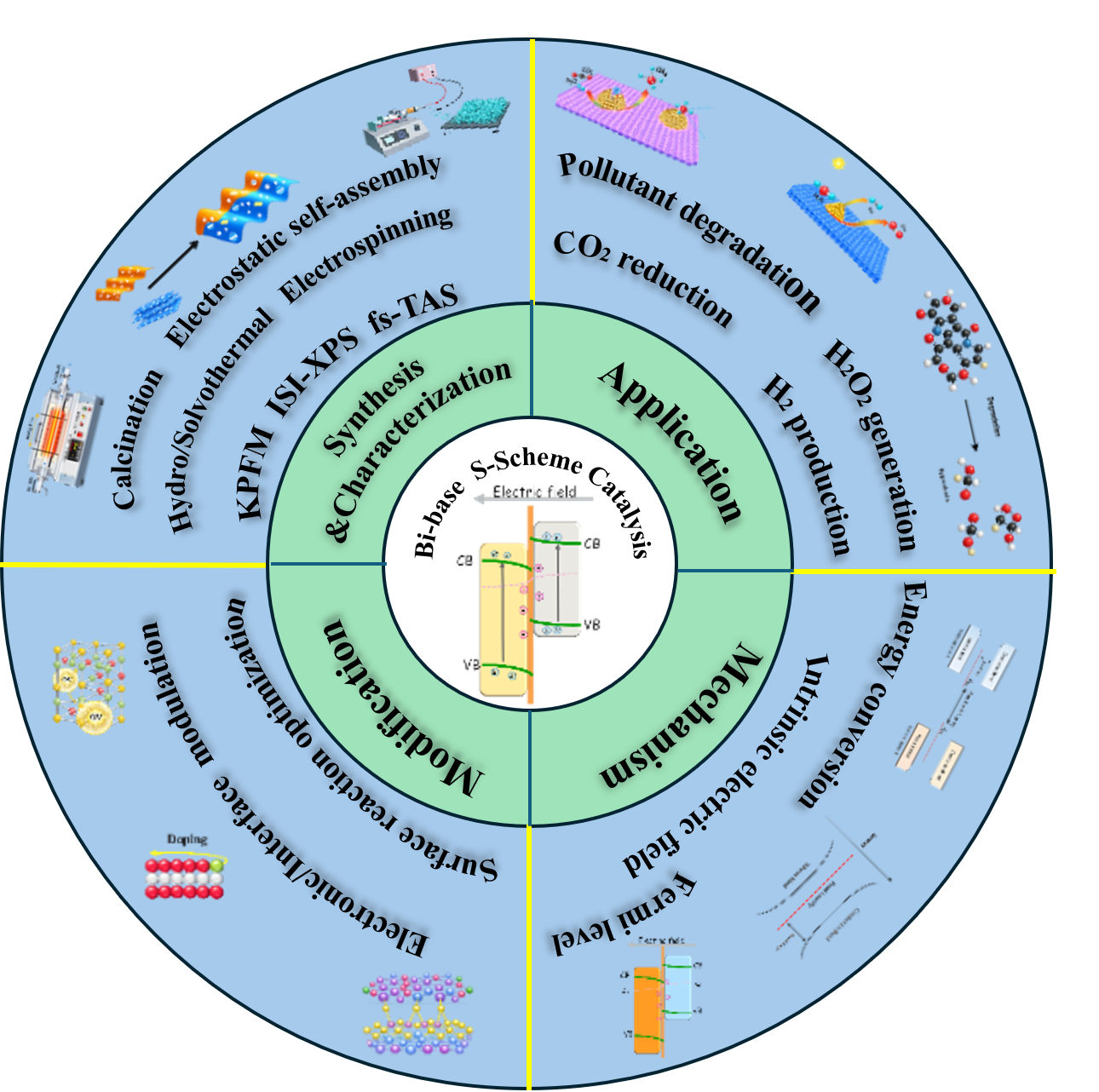
Photocatalytic technology, which enables the direct conversion of solar energy into chemical energy, presents a compelling and sustainable approach to mitigating the pressing issues of the global energy crisis and environmental degradation. S-Scheme heterojunctions have garnered significant attention in photocatalysis due to their exceptional charge separation efficiency and enhanced redox properties. Bismuth-based semiconductors, characterized by their unique layered structures, tunable electronic band configurations, and responsiveness to visible light, offer substantial advantages in the fabrication of S-Scheme heterojunctions. This review systematically summarizes recent advances in Bi-based S-Scheme heterojunctions for photocatalytic applications, focusing on the improvement of charge separation and utilization efficiency. We first elucidate the fundamental charge transfer mechanism of S-Scheme heterojunctions, followed by a comprehensive overview of construction methods including in situ hydrothermal/solvothermal synthesis, electrospinning, calcination, and electrostatically driven assembly. Advanced characterization techniques such as Kelvin Probe Force Microscopy (KPFM), in situ irradiated X-ray photoelectron spectroscopy (ISI-XPS), and femtosecond transient absorption spectroscopy (fs-TAS) for verifying the S-Scheme charge transfer mechanism are discussed in detail. Various modulation strategies to improve photocatalytic performance are thoroughly examined, including electronic structure regulation (element doping and defect engineering), interface structure regulation (electron bridges and crystal facet engineering), and morphology/dimension engineering to optimize the surface reaction. Moreover, the applications of Bi-based S-Scheme heterojunctions in photocatalytic water splitting for hydrogen production, CO2 reduction, pollutant degradation and H2O2 generation are comprehensively summarized. Finally, the current challenges and future perspectives for the development of high-performance Bi-based S-Scheme heterojunction photocatalysts are presented. This review aims to provide profound theoretical insights and strategic frameworks for the rational design of high-efficiency Bi-based S-Scheme photocatalysts.




- Address: Fuzhou High & New Technology Industrial Zone, Shangjie, Minhou, Fuzhou, Fujian 350108, China
- Tel: (86)-591-63173769, 63173770
- E-mail: cjsc@fjirsm.ac.cn
CN 35–1112/TQ, ISSN 0254–5861, Online ISSN: 2949-768X Copyright @ 2022 Chinese Journal of Structural Chemistry-www.Chinese Journal of Structural Chemistry.net. All Rights Reserved 闽ICP备2022002645号-1