


Cover Picture
Strengthening hydrophilicity in covalent-organic frameworks to boost CO2 photoreduction
Si-Zhan Feng†, Chong-Jiu Lu†, Ji-Hua Deng*, Tong-Bu Lu, Di-Chang Zhong* Submit a Manuscript
Strengthening hydrophilicity in covalent-organic frameworks to boost CO2 photoreduction
Si-Zhan Feng†, Chong-Jiu Lu†, Ji-Hua Deng*, Tong-Bu Lu, Di-Chang Zhong* Submit a Manuscript
Strengthening hydrophilicity in covalent-organic frameworks to boost CO2 photoreduction
Si-Zhan Feng†, Chong-Jiu Lu†, Ji-Hua Deng*, Tong-Bu Lu, Di-Chang Zhong*
Chin. J. Struct. Chem., 2026, 45(10), 100984. DOI: 10.1016/j.cjsc.2026.100984
October 1, 2026
Covalent organic frameworks (COFs); Hydrophilicity-hydrophobicity; CO2 reduction; HCOOH; Photocatalysis
ABSTRACT
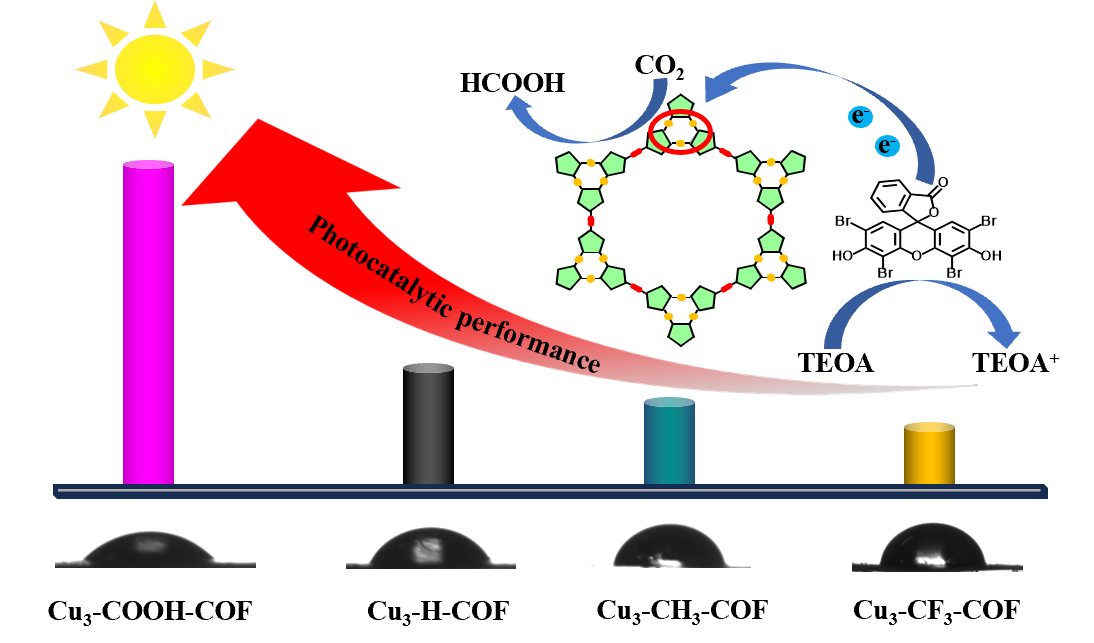
Hydrophilic-hydrophobic properties exert a vital influence on the reaction process of photocatalytic CO2 reduction. However, systematic study on revealing the relationship between photocatalytic activity and hydrophilicity-hydrophobicity has not been reported. Herein, based on covalent organic frameworks (COFs) with well-defined structures and structural tunability, we tentatively built the above relationship. Specifically, we designed and synthesized four isostructural COFs (Cu3-COOH-COF, Cu3-H-COF, Cu3-CH3-COF and Cu3-CF3-COF) with distinct hydrophilicity-hydrophobicity via Schiff base condensation reactions between trinuclear copper complex and p-phenylenediamine derivatives bearing different functional groups. We found that the most hydrophilic Cu3-COOH-COF achieved the highest photocatalytic activity for CO2 reduction, with the formic acid generation rate of 353.5 μmol g−1 h−1, 2.9, 4.7, and 6.0 folds over that of Cu3-H-COF, Cu3-CH3-COF, and Cu3-CF3-COF, respectively. Mechanistic studies demonstrate that enhanced hydrophilicity can optimize the interfacial wettability of the catalysts, accelerate interfacial electron transfer and proton transfer, and thereby significantly boost the photocatalytic activity for CO2 reduction. In contrast, hydrophobic catalysts impede the aforementioned processes, leading to a decline in catalytic performance. This study systematically uncovers the structure-activity relationship between the photocatalytic activity for CO2 reduction and the hydrophilic-hydrophobic properties of the catalyst.




- Address: Fuzhou High & New Technology Industrial Zone, Shangjie, Minhou, Fuzhou, Fujian 350108, China
- Tel: (86)-591-63173769, 63173770
- E-mail: cjsc@fjirsm.ac.cn
CN 35–1112/TQ, ISSN 0254–5861, Online ISSN: 2949-768X Copyright @ 2022 Chinese Journal of Structural Chemistry-www.Chinese Journal of Structural Chemistry.net. All Rights Reserved 闽ICP备2022002645号-1