

Just Accepted
Just Accepted Articles have been posted online after technical editing and typesetting for immediate view. The final edited version with page numbers will appear in the Current Issue soon.
Submit a Manuscript

Interface-engineered hierarchical MXene-derived In2S3/TiO2/Ti3C2 heterostructure with an S-scheme dual charge-transfer pathway for efficient decontamination of structurally diverse waterborne antibiotics
Dong-Eun Lee, M.V. Jyothirmai, Satyanarayana Moru, Wan-Kuen Jo*, Surendar Tonda*
https://doi.org/10.1016/j.cjsc.2026.101006
In2S3; Ti3C2 MXene; S-scheme mechanism; Antibiotic degradation; Water purification
ABSTRACT
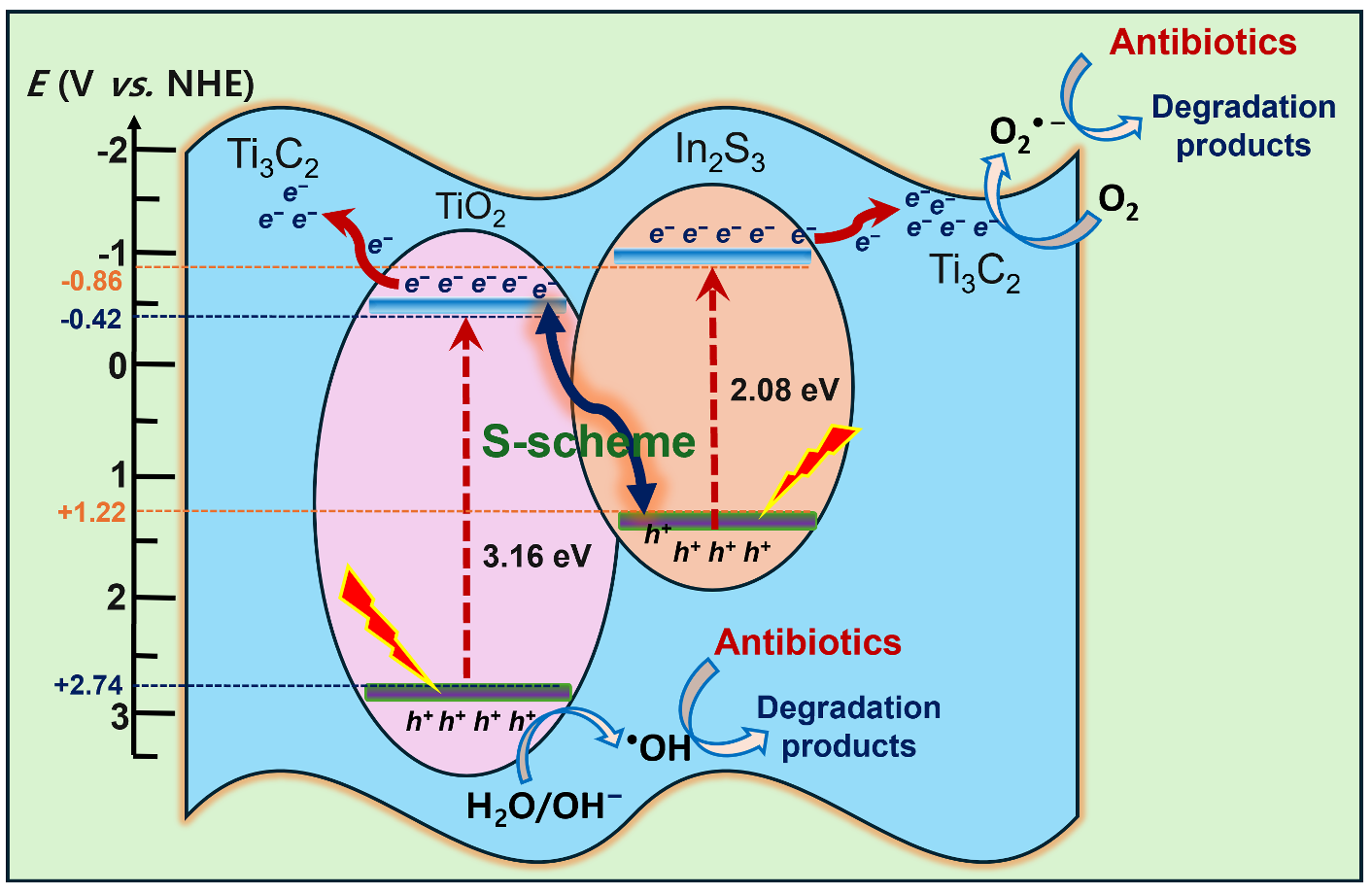
Interface engineering of multicomponent photocatalysts offers a powerful strategy to overcome charge recombination limitations in solar-driven water purification. Herein, we report the rational construction of a hierarchical MXene-derived In2S3/TiO2/Ti3C2 (IS/TO/TM) ternary heterostructure via an in situ solvothermal approach, in which ultrathin In2S3 nanosheets and TiO2 nanorods are simultaneously generated and uniformly integrated onto a conductive Ti3C2 MXene framework. Structural and surface characterizations confirm the formation of a robust three-dimensional architecture with intimate interfacial contact among all components. The optimized IS/TO/TM25 photocatalyst exhibits 98.9% cefixime degradation within 60 min under simulated solar irradiation, with a reaction rate several times higher than those of its individual and binary counterparts. Notably, IS/TO/TM25 also achieves >95% degradation efficiencies toward multiple structurally diverse antibiotics under identical conditions, accompanied by substantial total organic carbon removal, indicating effective mineralization. The photocatalyst maintains high degradation efficiency across a broad pH range and in the presence of common coexisting anions and cations, while exhibiting stable performance over successive cycles, underscoring its robustness under environmentally relevant conditions. Mechanistic investigations reveal that the enhanced photocatalytic performance arises from an S-scheme charge-transfer pathway, which selectively preserves highly reductive electrons on In2S3 and strongly oxidative holes on TiO2. This configuration facilitates the efficient generation of reactive oxygen species for antibiotic degradation while suppressing charge recombination. This work provides fundamental insight into MXene-derived S-scheme heterostructures and presents a promising photocatalytic platform for advanced antibiotic wastewater treatment.




- Address: Fuzhou High & New Technology Industrial Zone, Shangjie, Minhou, Fuzhou, Fujian 350108, China
- Tel: (86)-591-63173769, 63173770
- E-mail: cjsc@fjirsm.ac.cn
CN 35–1112/TQ, ISSN 0254–5861, Online ISSN: 2949-768X Copyright @ 2022 Chinese Journal of Structural Chemistry-www.Chinese Journal of Structural Chemistry.net. All Rights Reserved 闽ICP备2022002645号-1