

Just Accepted
Just Accepted Articles have been posted online after technical editing and typesetting for immediate view. The final edited version with page numbers will appear in the Current Issue soon.
Submit a Manuscript

Photon upconversion enhanced by proton shuttle-assisted triplet energy transfer
Zhaolong Wang, Meng Liu, Junhui Wang, Kaifeng Wu*
https://doi.org/10.1016/j.cjsc.2026.101007
Triplet energy transfer; Proton transfer; Quantum dots; Ultrafast spectroscopy; Photon upconversion
ABSTRACT
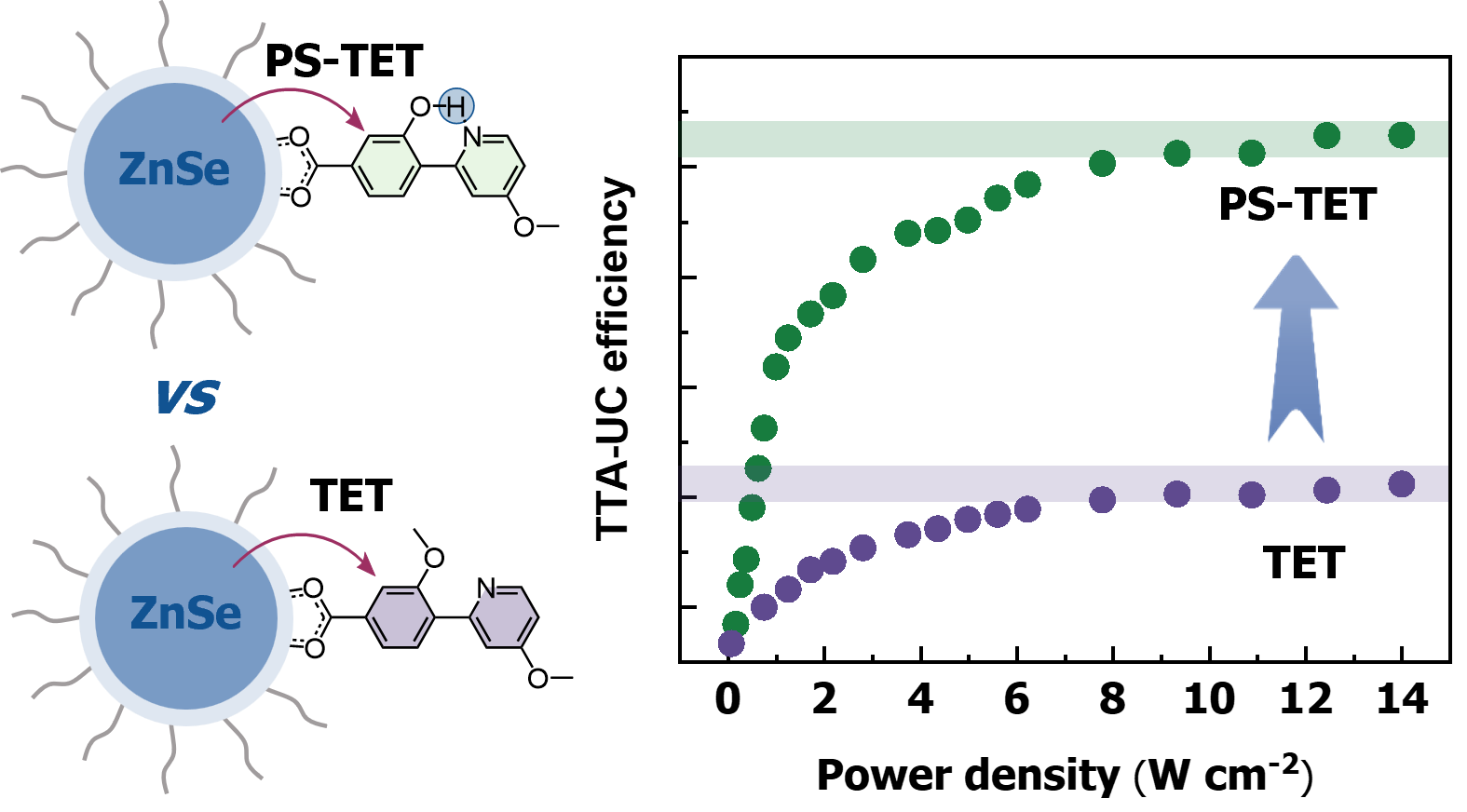
Inorganic semiconductor quantum dots (QDs) have emerged as promising sensitizers for triplet-triplet annihilation photon upconversion (TTA-UC) owing to negligible internal energy loss and broad, tunable absorption bands of QDs. The overall quantum efficiency of QD-sensitized TTA-UC is usually controlled by the efficiency of triplet energy transfer (TET) across the QD/molecule interfaces. Recently, we reported a new mechanism termed proton shuttle-assisted triplet energy transfer (PS-TET) that substantially enhanced both the rate and efficiency of TET from QDs to surface-anchored dyadic molecules. Here, we investigate the effectiveness of PS-TET in TTA-UC applications. Compared to a QD-dyad system lacking the proton shuttle, the PS-TET-based system exhibits approximately three-fold enhancement in the TTA-UC quantum efficiency, exemplifying the benefit of PS-TET in spin-triplet-related photochemistry. Furthermore, substituent effects on TTA-UC performance of the QD-dyad systems reveal that triplet properties of the surface-anchored molecules also play a crucial role in determining the TTA-UC performance.




- Address: Fuzhou High & New Technology Industrial Zone, Shangjie, Minhou, Fuzhou, Fujian 350108, China
- Tel: (86)-591-63173769, 63173770
- E-mail: cjsc@fjirsm.ac.cn
CN 35–1112/TQ, ISSN 0254–5861, Online ISSN: 2949-768X Copyright @ 2022 Chinese Journal of Structural Chemistry-www.Chinese Journal of Structural Chemistry.net. All Rights Reserved 闽ICP备2022002645号-1