

Just Accepted

Jia Wang, Xin-Ping Wu*
https://doi.org/10.1016/j.cjsc.2026.101015
ABSTRACT
Finite cluster models are widely used to study the photophysics and
photochemistry of metal−organic frameworks, yet their construction is often
arbitrary and lacks systematic benchmarking. Boundary truncation and capping
can contaminate frontier orbitals and even introduce artificial near-frontier
orbitals, leading to substantial misinterpretation of excited-state character
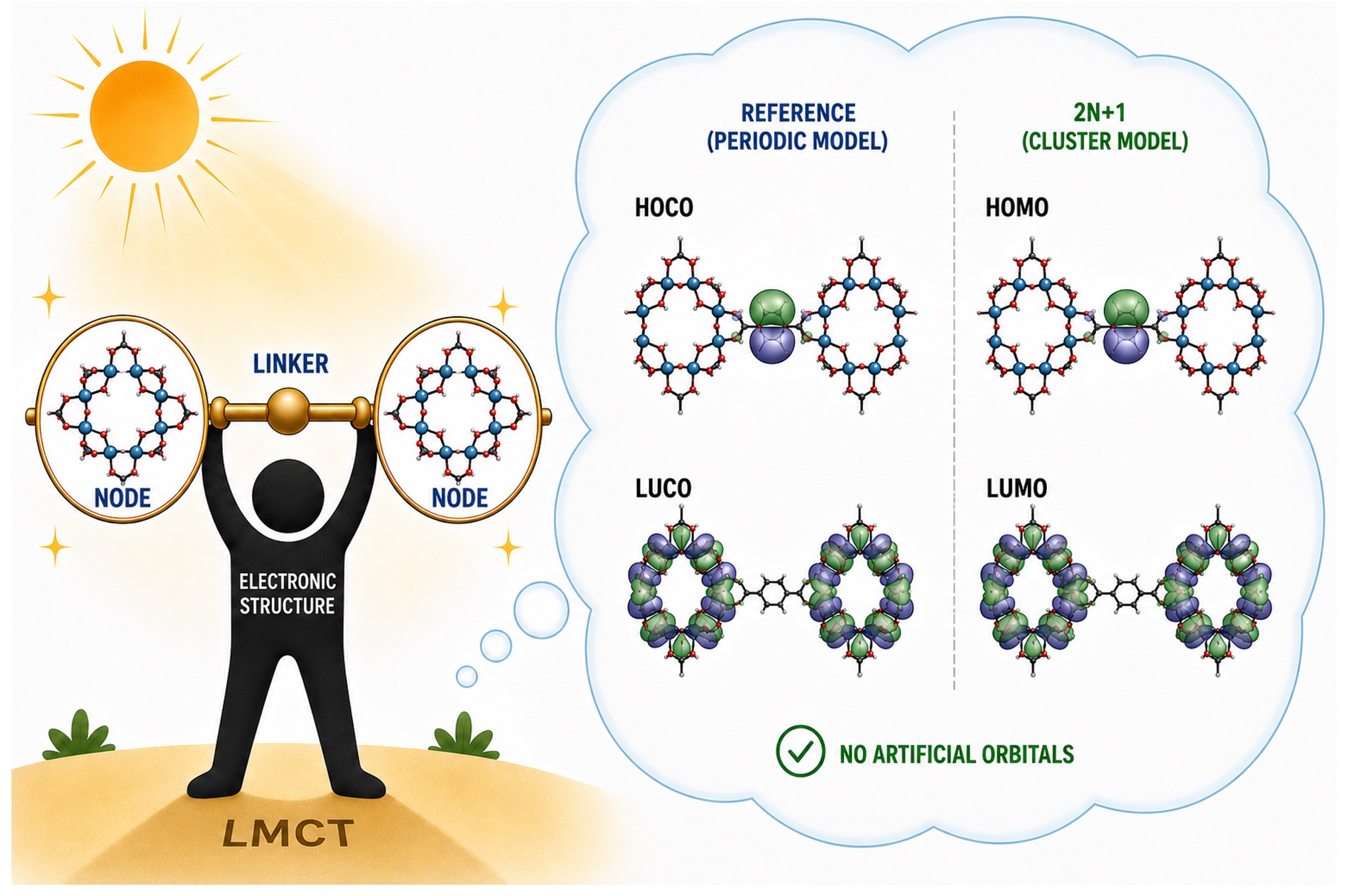
and photobehavior. Here, we systematically benchmark four representative MIL-125
cluster models containing different numbers of inorganic nodes and organic
linkers across eight density functionals. We compare their local structure,
fundamental and optical gaps, electron−hole centroid distance in
the first ligand-to-metal charge-transfer state, atomic
charges, frontier orbitals, and low-energy excitation landscapes. It was found
that the hybrid functionals with
a low fraction of Hartree−Fock
exchange are providing a more reasonable description of both ground and excited states, with
HSE06 giving the most balanced overall performance. Among the models examined,
the cluster containing two inorganic nodes connected by one organic linker shows the closest overall agreement with the
periodic reference while avoiding contaminated frontier orbitals and artificial
orbitals. By contrast, the fully capped single-node model and the most compact single-node single-linker model exhibit pronounced truncation- and
capping-induced contamination of frontier orbitals and artificial
orbitals, whereas the single-node four-linker model remains useful for
interligand analysis despite residual artifacts. These results provide
physically grounded guidelines for cluster-model construction and density-functional selection in MIL-125.




- Address: Fuzhou High & New Technology Industrial Zone, Shangjie, Minhou, Fuzhou, Fujian 350108, China
- Tel: (86)-591-63173769, 63173770
- E-mail: cjsc@fjirsm.ac.cn