

Just Accepted
Just Accepted Articles have been posted online after technical editing and typesetting for immediate view. The final edited version with page numbers will appear in the Current Issue soon.
Submit a Manuscript

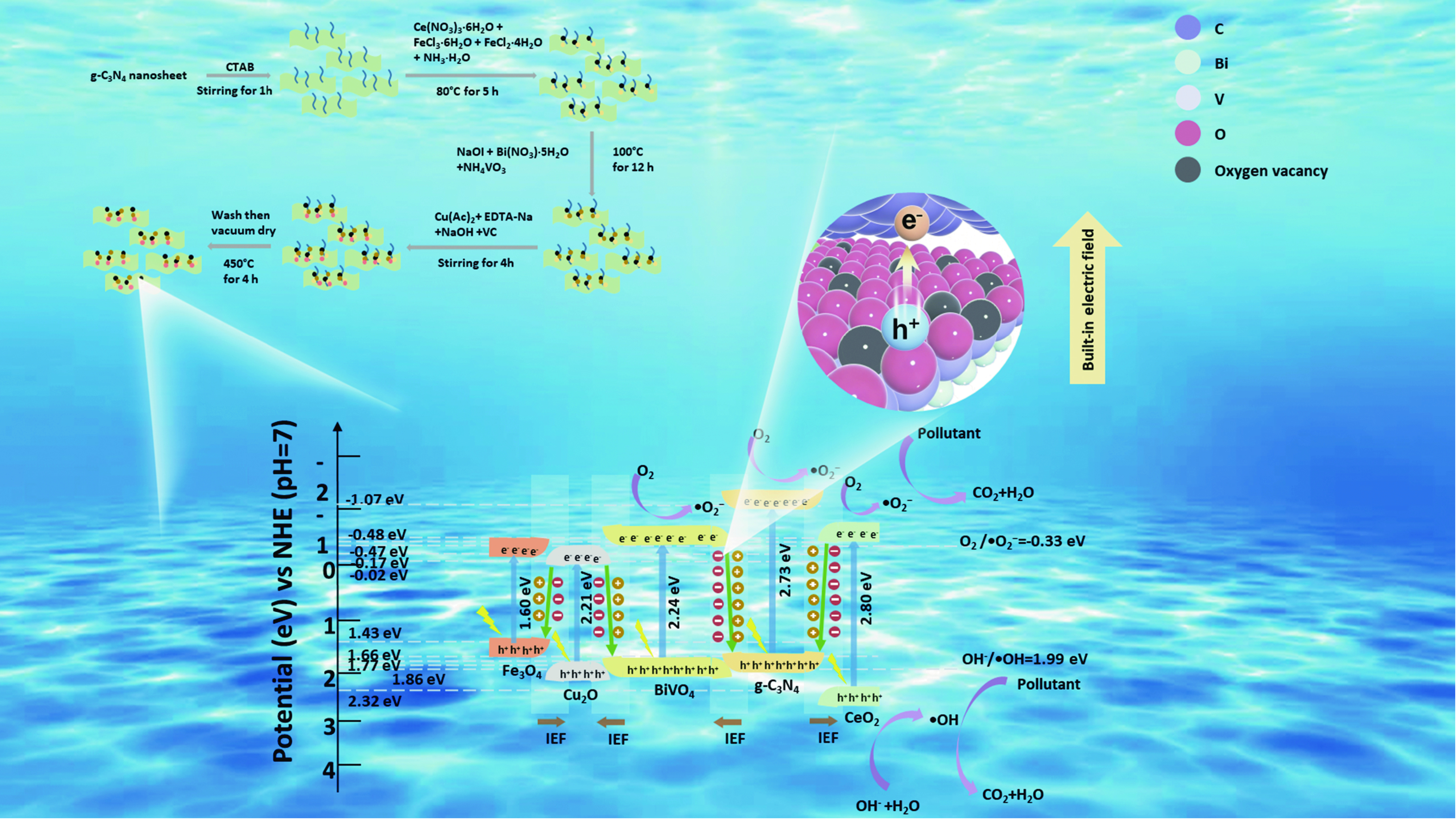
Defect-polaron-electric field synergy in a quinary S-scheme heterojunction for ciprofloxacin degradation
Tianqi Liu, Zhiyi Zhou, Xinge Hu, Xingda An, Pow-Seng Yap, Konstantinos Papadikis*, Graham Dawson*
https://doi.org/10.1016/j.cjsc.2026.101014
Graphitic carbon nitride; Quinary nanocomposite; Visible light photocatalysis; Organic pollutant degradation; Photocatalytic mechanism
ABSTRACT
The construction of an S-scheme heterojunction has emerged as a cutting-edge strategy for boosting photocatalytic performance. This approach showcases remarkable advantages in promoting the migration of photoinduced charges. It enables the attainment of high redox potentials, significantly enhancing the photocatalyst's ability to drive redox reactions. Therefore, a novel multiple S-scheme heterojunction g-C3N4/Fe3O4/CeO2/BiVO4/Cu2O was designed and synthesized. The photocatalytic degradation of ciprofloxacin (CIP) using the quinary nanocomposite was performed under visible light irradiation. Within 60 min of visible light irradiation, g-C3N4/Fe3O4/CeO2/BiVO4/Cu2O achieved a CIP degradation efficiency of 84%, which represents a substantial 45% improvement compared to the 39% degradation efficiency of bulk g-C3N4. The S-scheme can enable the optimal regulation of the separation and recombination of charge carriers through band bending and the presence of built-in electric fields, and generate the high redox potential of g-C3N4/Fe3O4/CeO2/BiVO4/Cu2O. The study demonstrates that oxygen vacancies act as dual-function hubs by creating mid-gap states for enhanced light absorption and by facilitating the formation of polarons. It presents an efficient approach for the rapid determination of band bending and built-in electric fields by synergistically integrating in-situ X-ray photoelectron spectroscopy (XPS), and Kelvin probe force microscopy (KPFM). This method provides a real-time, multi-dimensional view of the photocatalytic process, addressing the challenge of correlating structural defects with electronic properties. Photoluminescence (PL) spectra, time-resolved photoluminescence (TRPL), and in-situ electron paramagnetic resonance (EPR) were also utilized to explore the intricate interactions between oxygen vacancy, polarons, and built-in electric fields, thereby enabling an in-depth exploration of the photocatalytic mechanism.




- Address: Fuzhou High & New Technology Industrial Zone, Shangjie, Minhou, Fuzhou, Fujian 350108, China
- Tel: (86)-591-63173769, 63173770
- E-mail: cjsc@fjirsm.ac.cn
CN 35–1112/TQ, ISSN 0254–5861, Online ISSN: 2949-768X Copyright @ 2022 Chinese Journal of Structural Chemistry-www.Chinese Journal of Structural Chemistry.net. All Rights Reserved 闽ICP备2022002645号-1