

Just Accepted

Jin Chen, Lao-Bang Wang, Fei-Fan Lang*, Meng-Qi Zhou, Yun-Hu Deng, Jian-Ping Lang*
https://doi.org/10.1016/j.cjsc.2026.101016
ABSTRACT
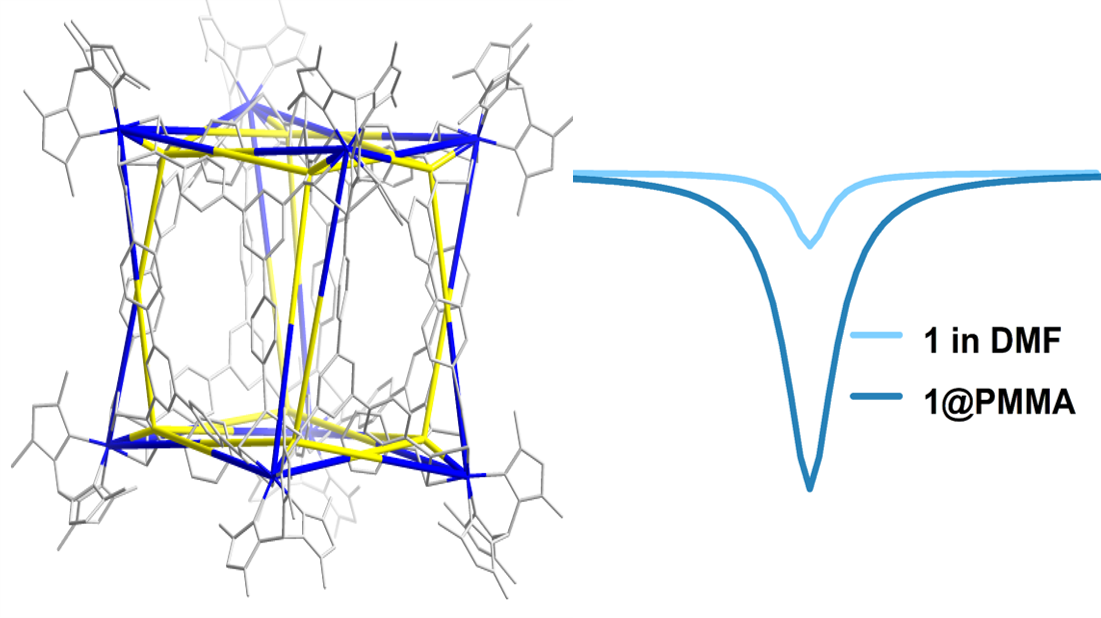
In summary, we report a coordination-covalent synergistic assembly
strategy for the construction of two unprecedented distorted W/Cu/S
cluster-based supramolecular cubes (1 and 2) using the precursor A,
Cu(I), and angle-defined alkyne-functionalized pyridyl ligands (L1 and L2). The approach integrates in-situ alkyne–sulfur
covalent bond formation with pyridyl-Cu(I) coordination, generating robust
cluster nodes that direct the formation of discrete cubic architectures. Systematic
ligand modification enables precise structural control over the resulting
assemblies. In particular, replacement of the central benzene unit with a more
rigid naphthalene moiety (L1→L2) induces a rigidity-dominated
distortion mode, establishing a clear structure–geometry correlations in which ligand
architecture governs symmetry and distortion behavior without significantly
altering overall cage dimensions. Beyond structural regulation, these W/Cu/S supramolecular
cubes exhibit intrinsic NLO activity. While moderate nonlinear absorption is
observed in solution, incorporation into PMMA matrices results in enhancements
approaching three orders of magnitude, underscoring the critical role of
solid-state organization in amplifying macroscopic optical responses. This work
expands the structural landscape of coordination–covalent supramolecular
assembly and provides mechanistic insight into ligand-directed topological
control. More broadly, it establishes a direct structure–property relationship
linking ligand geometry, supramolecular distortion, and functional optical
performance. The combined strategy of rational ligand design and polymer
integration offers a viable pathway toward stable, processable, and
high-performance cluster-based nonlinear optical materials, advancing design
principles for next-generation supramolecular photonic systems.




- Address: Fuzhou High & New Technology Industrial Zone, Shangjie, Minhou, Fuzhou, Fujian 350108, China
- Tel: (86)-591-63173769, 63173770
- E-mail: cjsc@fjirsm.ac.cn