

Just Accepted
Just Accepted Articles have been posted online after technical editing and typesetting for immediate view. The final edited version with page numbers will appear in the Current Issue soon.
Submit a Manuscript

Photon-to-product design of reticular photocatalysts for solar-to-chemical conversion
Yukai Liu, Xi Zhu, Mingsheng Cen, Liyang Qin*, Liangfeng Luo*, Mingyang Li*, Gangfeng Ouyang*
https://doi.org/10.1016/j.cjsc.2026.101040
Reticular frameworks; Photocatalysis; Charge transfer; Donor-acceptor
ABSTRACT
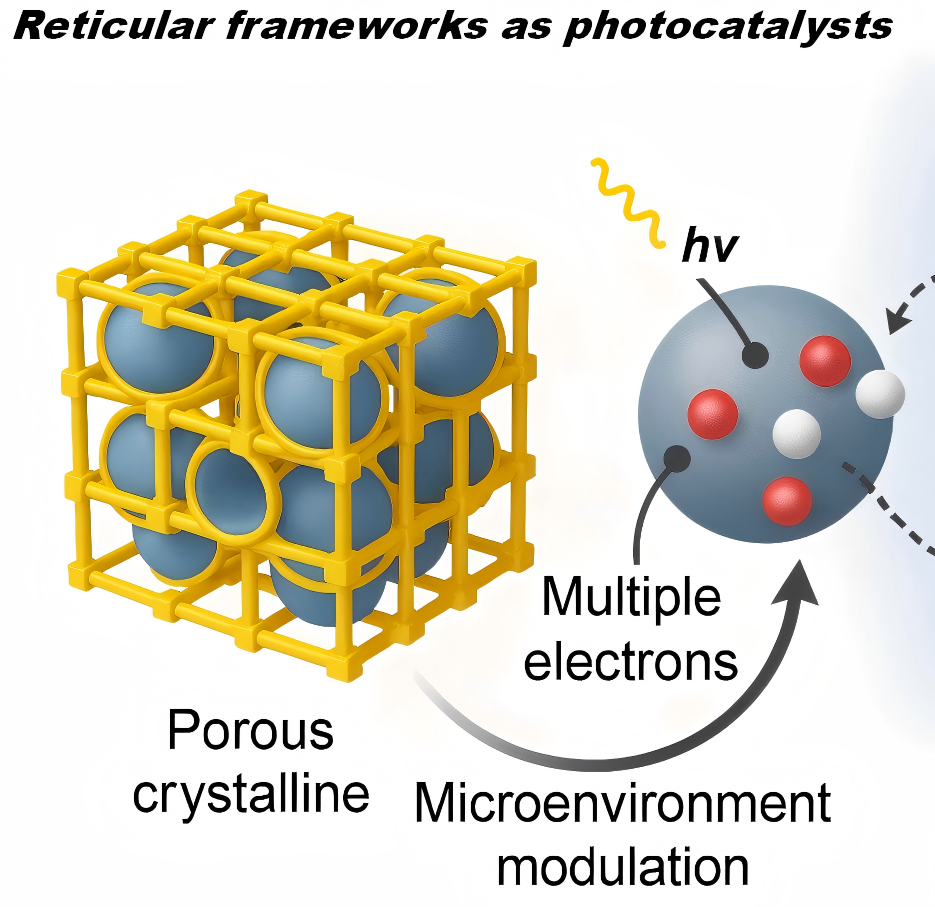
Reticular frameworks have emerged as versatile platforms for photocatalysis, offering precise control over light harvesting, charge transfer, and surface catalysis through their modular building blocks, ordered porosity, and tunable chemical microenvironments. Despite these advantages, their performance is frequently constrained by a kinetic mismatch between ultrafast charge recombination and the relatively slow turnover of chemical substrates. Adopting a "photon-to-product" perspective, we highlight mechanistic strategies for regulating light absorption, excited-state dynamics, charge separation/extraction, triplet and energy-transfer pathways, and active-site microenvironments. We propose targeted design principles aimed at accelerating the translation of reticular photocatalysts from proof-of-concept studies to quantitative, highly stable systems capable of reaction-specific practicality.




- Address: Fuzhou High & New Technology Industrial Zone, Shangjie, Minhou, Fuzhou, Fujian 350108, China
- Tel: (86)-591-63173769, 63173770
- E-mail: cjsc@fjirsm.ac.cn
CN 35–1112/TQ, ISSN 0254–5861, Online ISSN: 2949-768X Copyright @ 2022 Chinese Journal of Structural Chemistry-www.Chinese Journal of Structural Chemistry.net. All Rights Reserved 闽ICP备2022002645号-1