

Just Accepted
Just Accepted Articles have been posted online after technical editing and typesetting for immediate view. The final edited version with page numbers will appear in the Current Issue soon.
Submit a Manuscript

Perovskite-based S-scheme heterojunction photocatalysts: Mechanisms, activity-stability trade-offs, and rational design strategies
Adedamola T. Ojedokun, Benjamin O. Orimolade, Damilola C. Akintayo, Henrietta W. Langmi, Tunde L. Yusuf*
https://doi.org/10.1016/j.cjsc.2026.101049
Perovskite photocatalysts; S-scheme heterojunctions; Charge-transfer mechanisms; Environmental remediation; Piezophotocatalysis
ABSTRACT
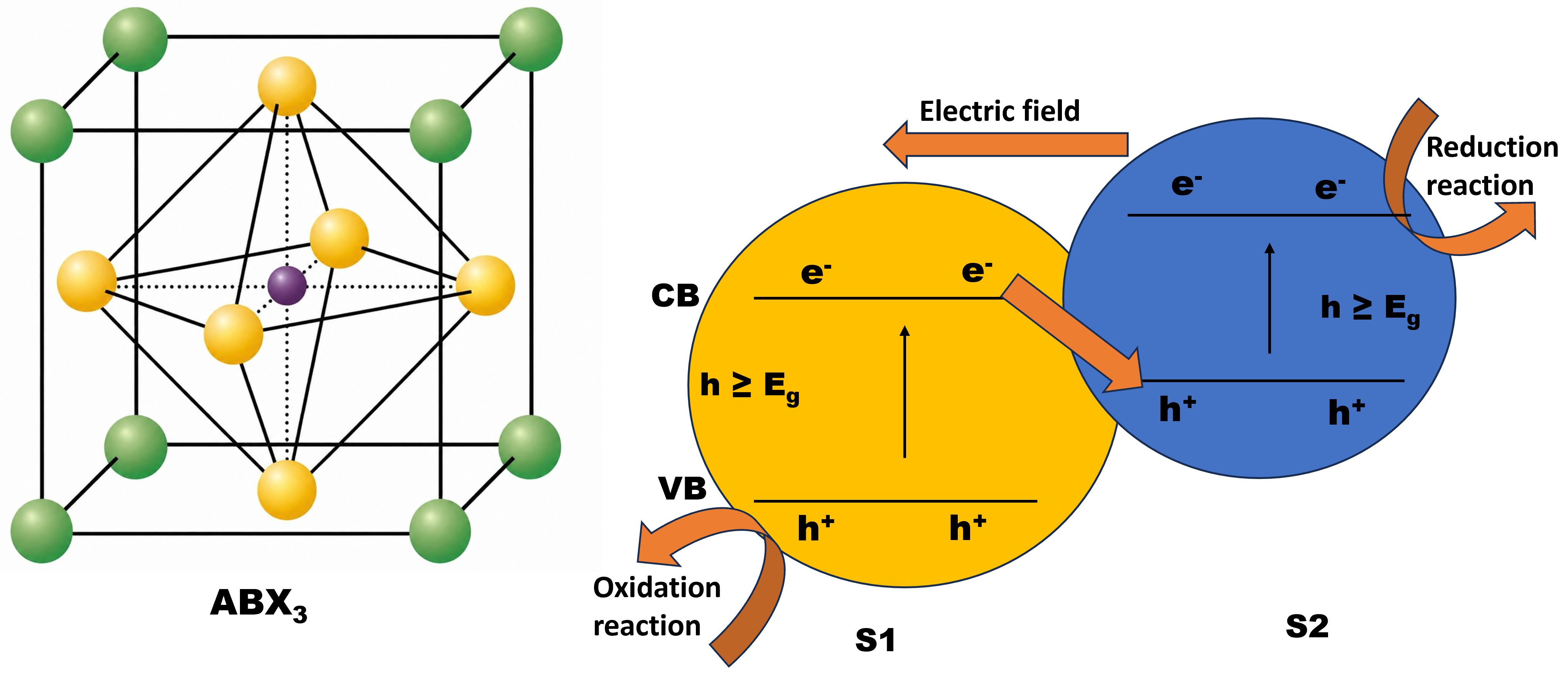
Photocatalysis has emerged as a promising solar-driven technology for environmental remediation, renewable fuel production, and carbon-neutral chemical synthesis. Nevertheless, the practical efficiency of many photocatalytic systems remains limited by the redox-potential loss associated with conventional type-II heterojunctions, where improved charge separation is often achieved at the expense of photocatalytic driving force. The S-scheme heterojunction has recently gained considerable attention as an alternative charge-transfer model that overcomes this limitation. Through the formation of a built-in interfacial electric field, S-scheme systems selectively recombine low-energy charge carriers while retaining highly reducing electrons and highly oxidizing holes, thereby maximizing photocatalytic redox capability. Perovskite materials are attractive building blocks for S-scheme photocatalysts because their composition and structure can be readily tailored to regulate band structures, Fermi-level positions, defect concentrations, dielectric properties, and piezoelectric responses. These unique characteristics provide extensive opportunities for optimizing interfacial charge transfer and photocatalytic performance. This review critically evaluates recent advances in perovskite-based S-scheme heterojunctions, focusing on the fundamental mechanisms governing charge separation, including Fermi-level equilibration, band bending, interfacial electric field formation, and the influence of Fermi-level pinning on long-term photocatalytic operation. The review further examines rational design approaches, including compositional and defect engineering, interface modulation, hierarchical two-dimensional and core-shell architectures, dual S-scheme systems, cocatalyst integration, and emerging machine-learning-assisted materials discovery. Mechanistic insights into key photocatalytic applications (including pollutant degradation, reactive oxygen species generation, hydrogen evolution, hydrogen peroxide production, CO2 photoreduction, and bicarbonate-to-formate conversion) are discussed, with emphasis on the combined use of in situ DRIFTS and DFT calculations to elucidate reaction pathways and product selectivity. The role of advanced characterization techniques, such as ISIXPS, KPFM, transient absorption spectroscopy, EPR, and operando spectroscopies, in validating S-scheme charge-transfer mechanisms is also highlighted. Finally, major challenges, including the stability limitations of halide perovskites, interfacial evolution during operation, activity-stability trade-offs, and the lack of standardized benchmarking protocols, are critically assessed. Future progress will depend on the integration of advanced operando characterization, data-driven materials discovery, environmentally benign perovskite design, and scalable reactor technologies, paving the way for the practical implementation of perovskite-based S-scheme photocatalysts in sustainable energy and environmental applications.




- Address: Fuzhou High & New Technology Industrial Zone, Shangjie, Minhou, Fuzhou, Fujian 350108, China
- Tel: (86)-591-63173769, 63173770
- E-mail: cjsc@fjirsm.ac.cn
CN 35–1112/TQ, ISSN 0254–5861, Online ISSN: 2949-768X Copyright @ 2022 Chinese Journal of Structural Chemistry-www.Chinese Journal of Structural Chemistry.net. All Rights Reserved 闽ICP备2022002645号-1