

Just Accepted
Just Accepted Articles have been posted online after technical editing and typesetting for immediate view. The final edited version with page numbers will appear in the Current Issue soon.
Submit a Manuscript

Size-dependent nonlinear optical responses and optical power limiting of Pt(II) metallacycles
Lai Hu, Chenglong Wu, Zhiyuan Chen, Ruiqi Chen, Hongjun Zhu, Senqiang Zhu*, Rui Liu*
https://doi.org/10.1016/j.cjsc.2026.101082
Organometallic complexes; Coordination-driven self-assembly; Metallacycles; Nonlinear optics; Optical power limiting
ABSTRACT
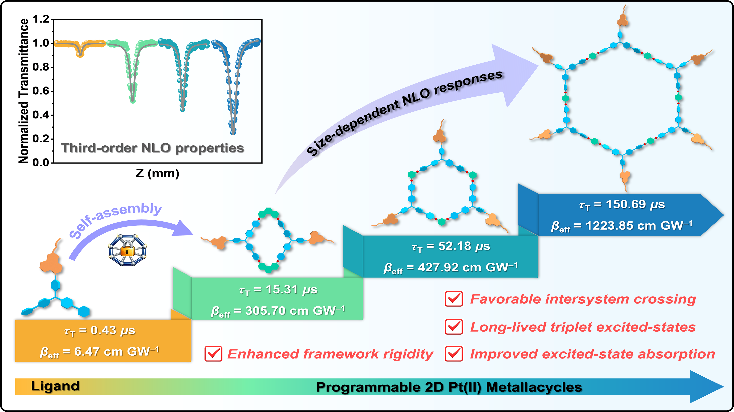
Developing organometallic complexes that combine strong nonlinear optical (NLO) responses with outstanding optical power limiting (OPL) performance is pivotal for laser protection and advanced optoelectronic devices. Yet, achieving substantial NLO amplification with precise and predictable tunability remains highly challenging. Here we present a topology- and size-programmable coordination-driven self-assembly that affords Pt(II) metallacycles (MPt-1–MPt-3) and reveals how metallacyclic topology and size influence third-order NLO responses. Photophysical studies indicate that formation of Pt(II) metallacycles modulates the electronic structure of the ligand (L-NI) while reinforcing framework rigidity and spin–orbit coupling (SOC), thereby affording prolonged triplet-state lifetimes (τT = 15.31–150.69 μs) and strengthened excited-state absorption (ESA). Consequently, MPt-1–MPt-3 display pronounced size-dependent NLO responses at 532 nm, outperforming both L-NI and C60. Notably, the [6+6] MPt-3 achieves an impressive effective nonlinear absorption coefficient (βeff = 1223.85 cm GW–1) and a large imaginary third-order susceptibility (Im χ(3) = 45.06 × 10⁻¹¹ esu). This corresponds to a >190-fold enhancement over L-NI, placing MPt-3 among the highest-performing Pt(II) complexes reported under comparable conditions. This work demonstrates that coordination-driven self-assembly provides an effective platform for regulating excited-state dynamics in organometallic complexes and establishes a structure-guided design strategy for next-generation NLO materials.




- Address: Fuzhou High & New Technology Industrial Zone, Shangjie, Minhou, Fuzhou, Fujian 350108, China
- Tel: (86)-591-63173769, 63173770
- E-mail: cjsc@fjirsm.ac.cn
CN 35–1112/TQ, ISSN 0254–5861, Online ISSN: 2949-768X Copyright @ 2022 Chinese Journal of Structural Chemistry-www.Chinese Journal of Structural Chemistry.net. All Rights Reserved 闽ICP备2022002645号-1