

Just Accepted
Just Accepted Articles have been posted online after technical editing and typesetting for immediate view. The final edited version with page numbers will appear in the Current Issue soon.
Submit a Manuscript

Defect engineering in metal sulfide photocatalysts: Implications for hydrogen evolution
Mingzhu Xue, Xiangjiu Guan*, Liejin Guo*
https://doi.org/10.1016/j.cjsc.2026.101114
Defect engineering; Metal sulfides; Photocatalysis; Hydrogen evolution; Photocatalytic performance
ABSTRACT
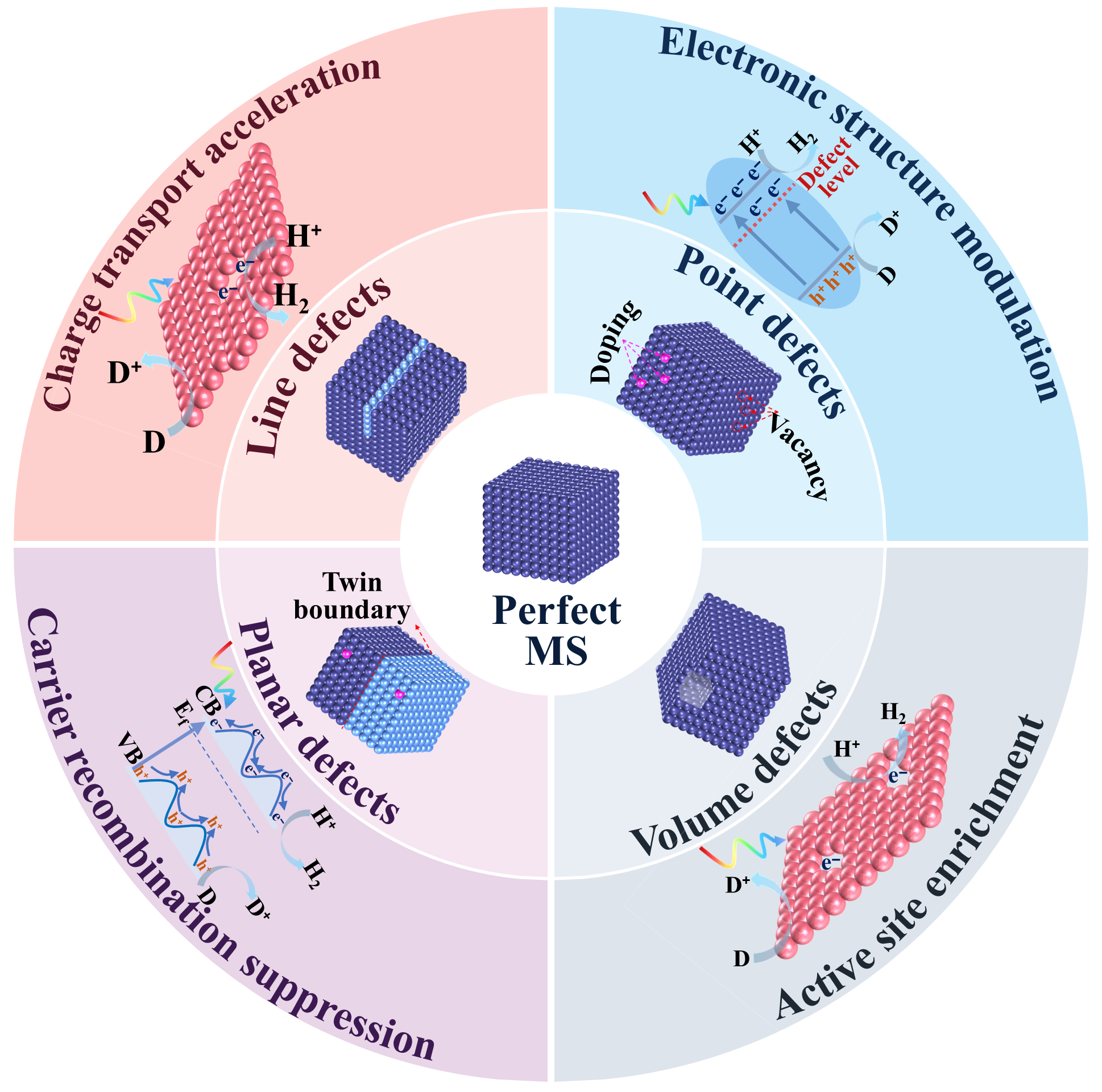
Solar-driven photocatalytic hydrogen evolution (PHE) offers a sustainable route to green hydrogen production, but practical deployment is limited by a shortage of efficient, stable, low-cost photocatalysts. Metal sulfides (MSs) are promising visible-light candidates with tunable band structures, suitable redox potentials and low manufacturing costs. However, pristine MSs suffer from rapid charge recombination, limited active sites and photocorrosion, restricting performance. Defect engineering could help to effectively address these drawbacks. Rooted in photocatalysis and defect chemistry principles, this review systematically examines roles and mechanisms of diverse defects in MS photocatalysts for PHE. Defects are categorized by dimensionality: zero-dimensional point defects (vacancies and doping), one-dimensional line defects (dislocations), two-dimensional planar defects (stacking faults and twin boundaries), and three-dimensional bulk defects, with their respective modulation effects analyzed from a structural chemistry perspective. We further clarify applicable boundaries of mainstream defect characterization techniques, elucidate defect-heterostructure synergistic coupling rules, extract general design principles for high-performance systems, and summarize stability bottlenecks and mitigation strategies. Finally, current challenges and future directions are outlined, to guide the design of efficient, stable, cost-effective photocatalytic systems for green hydrogen production.




- Address: Fuzhou High & New Technology Industrial Zone, Shangjie, Minhou, Fuzhou, Fujian 350108, China
- Tel: (86)-591-63173769, 63173770
- E-mail: cjsc@fjirsm.ac.cn
CN 35–1112/TQ, ISSN 0254–5861, Online ISSN: 2949-768X Copyright @ 2022 Chinese Journal of Structural Chemistry-www.Chinese Journal of Structural Chemistry.net. All Rights Reserved 闽ICP备2022002645号-1