

Just Accepted
Just Accepted Articles have been posted online after technical editing and typesetting for immediate view. The final edited version with page numbers will appear in the Current Issue soon.
Submit a Manuscript

Zn single-atoms microenvironment regulation for base-free reductive amination reaction of alcohols and amines
Guanghan Liu#, Shulin Liu#*, Yahan Zhang, Kehui Zhang, Shenghan Gao, Shaopeng Li, Tianjiao Wang, Shaonan Gu, Falu Hu, Guowei Zhou*, Huizhen Liu*
https://doi.org/10.1016/j.cjsc.2026.101113
Zn single-atom; C-N bond construction; base-free; microenvironment regulation; intrinsic acid-base synergy
ABSTRACT
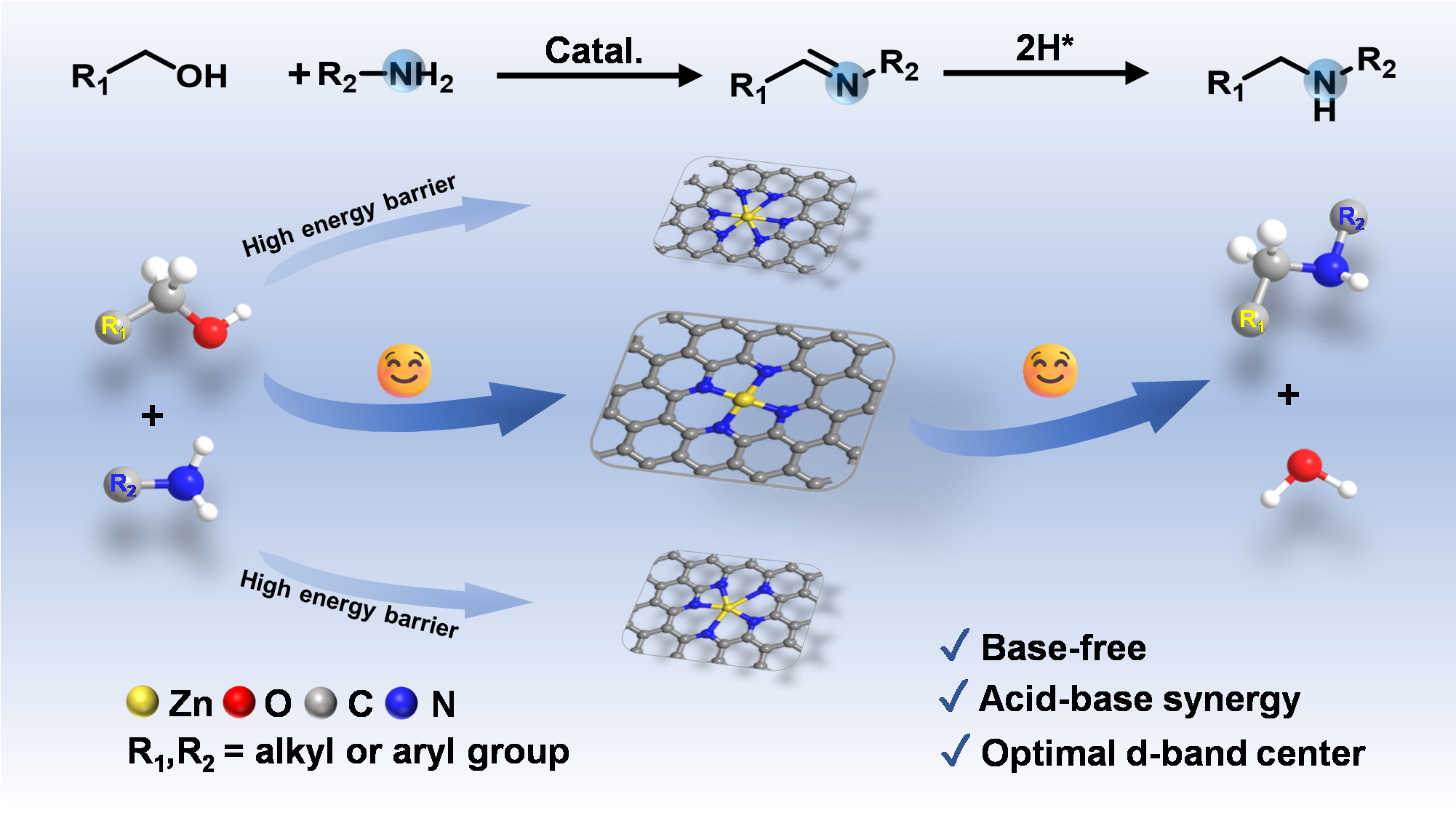
Although the construction of C-N bonds via reductive amination of alcohols and amines over non-noble metal single-atom catalysts holds great potential, achieving high activity and selectivity without the addition of a base as an additive remains a significant challenge. The strategy of precisely modifying the local coordination environment of single-atom centers offers a promising opportunity to enhance the intrinsic activity of such catalysts and establish clear structure-activity relationships. Herein, we prepared a series of ZnNC catalysts with tunable coordination numbers. Notably, the ZnNC-900 catalyst, containing a Zn-N4 structure, achieved the 100% conversion and 99% selectivity in the hydrogen transfer reductive amination of alcohols and amines. Mechanism studies revealed that the dehydrogenation of alcohol is the rate-determining step in this tandem reaction. The Zn-N4 coordination structure possesses a lower central charge density and an optimal d-band center energy level, leading to the most favorable acid-base synergy. Furthermore, DFT calculations confirmed that the Zn-N4 structure requires a relatively lower activation energy for the reaction compared to its Zn-N6 counterpart.




- Address: Fuzhou High & New Technology Industrial Zone, Shangjie, Minhou, Fuzhou, Fujian 350108, China
- Tel: (86)-591-63173769, 63173770
- E-mail: cjsc@fjirsm.ac.cn
CN 35–1112/TQ, ISSN 0254–5861, Online ISSN: 2949-768X Copyright @ 2022 Chinese Journal of Structural Chemistry-www.Chinese Journal of Structural Chemistry.net. All Rights Reserved 闽ICP备2022002645号-1