

Just Accepted

Tian Wang, Zaiwang Zhao*, Yifan Ding*
https://doi.org/10.1016/j.cjsc.2026.101131
ABSTRACT
In summary,
the significance of this work lies in the fact that it provides a promising
complementary strategy for selecting nanoporous carbon materials. BET analysis and pore-size distribution remain useful for pore
characterization, but they do not describe either the local structure
of the carbon wall or the fraction of that structure reached by the working
electrolyte. The study
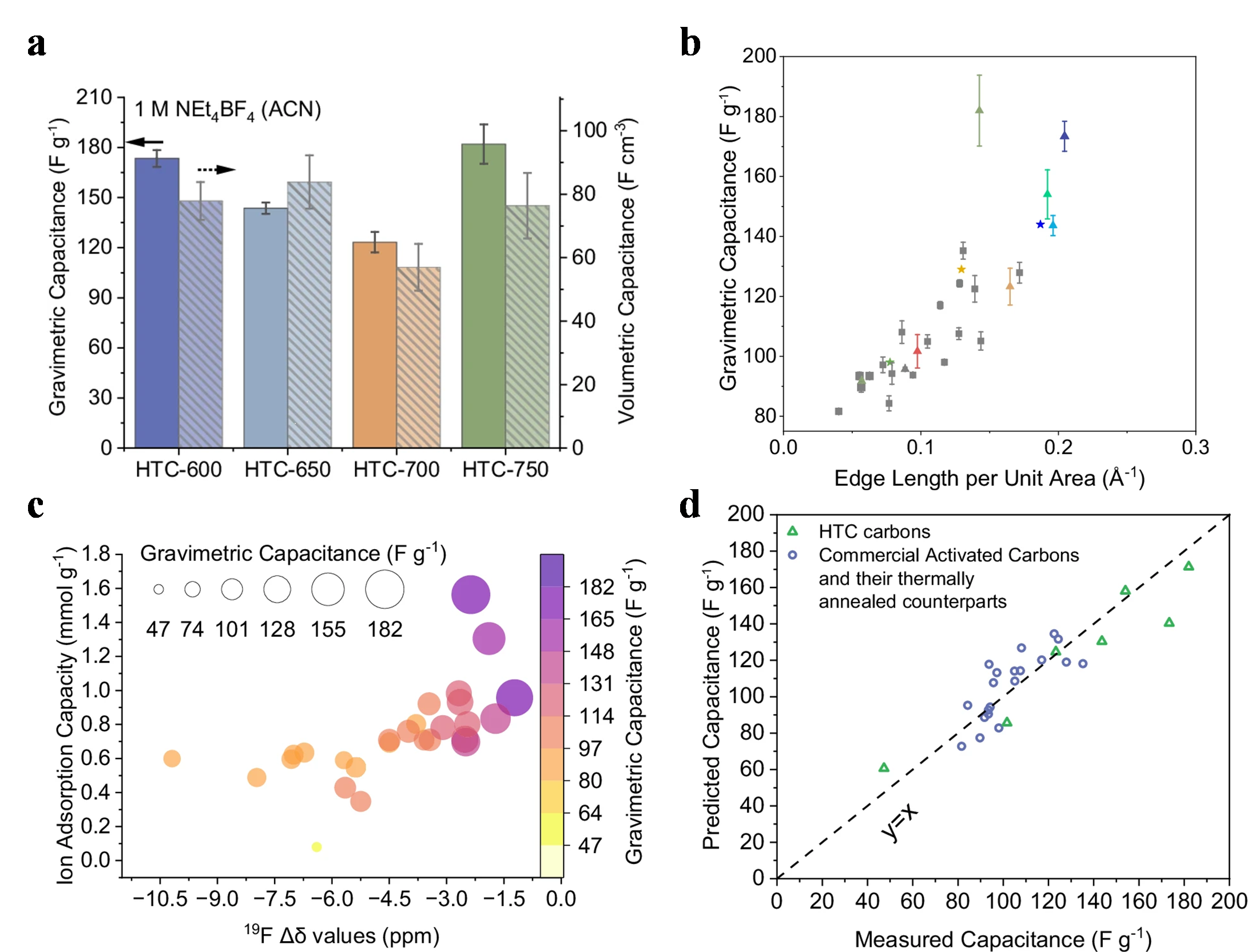
establishes a measurable relations hip among local domain size,
electrolyte-ion accessibility, and capacitance, while also showing that no
single descriptor is sufficient. This study not only emphasizes the importance of
disordered structures, but also indicates that by using NMR technology, we can
simultaneously quantify the degree of disorder and the ion accessibility, and
thereby predict the capacitance value. This shifts the focus of design from
optimization centered on porosity to a design approach guided by the degree of
disorder and ionic accessibility. Although highly disordered carbon materials with
extremely high porosity can offer excellent gravitational capacitance
performance, they may simultaneously reduce electrode density, volumetric
capacitance, conductivity, and stability. Therefore, the design of nanoporous
carbon materials should balance mass performance, volumetric performance,
conductivity, and stability, rather than simply maximizing surface area.




- Address: Fuzhou High & New Technology Industrial Zone, Shangjie, Minhou, Fuzhou, Fujian 350108, China
- Tel: (86)-591-63173769, 63173770
- E-mail: cjsc@fjirsm.ac.cn