
Just Accepted
Just Accepted Articles have been posted online after technical editing and typesetting for immediate view. The final edited version with page numbers will appear in the Current Issue soon.
Submit a Manuscript

Ionic supramolecular frameworks assembled from indium(III)-imidazolate cages for the selective removal of perfluoro-carboxylic acids
Yu-an-Biao Yu, Gui-You Wei, You-Liang Wu, Hao-Jie Zhang, Chuang-Wei Zhou, Jingxian Pang, Huaining Zhong, Yong-Liang Huang, Jun-Wei Hou, Wen-Jing Luo, Xue-Zhi Wang*, Xiao-Ping Zhou*, Dong Luo*, Dan Li
https://doi.org/10.1016/j.cjsc.2026.101145
Metal-imidazolate cage; Supramolecular framework; Perfluorocarboxylic acid; Selective adsorption; Supramolecular interaction
ABSTRACT
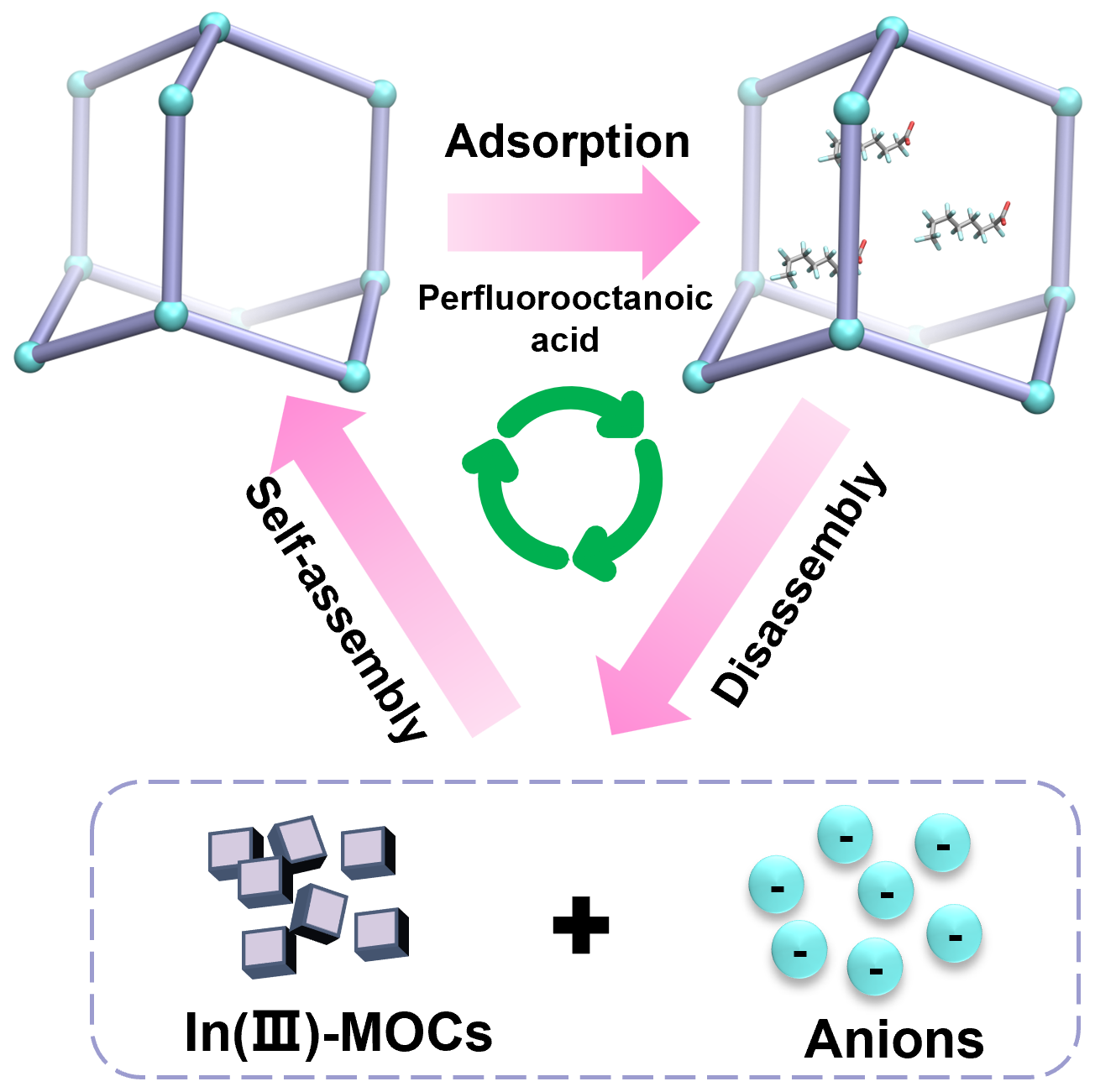
Per- and polyfluoroalkyl substances (PFAS) are persistent environmental contaminants that threaten human health and ecosystems, driving demand for adsorbents that combine high capacity, selectivity, and sustainable regenerability. Here we report the solvothermal subcomponent self-assembly of an octanuclear cubic indium(III)-imidazolate cage and its directed assembly with ClO4- anions into a cationic supramolecular framework, 1-ClO4-, featuring a dia topology network and a hierarchical porous architecture. The imidazole N–H groups on the pore walls of the supramolecular framework serve as hydrogen-bond donor sites for perfluorooctanoic acid (PFOA) recognition, acting cooperatively with the electrostatic attraction of the cationic skeleton and the hydrophobic affinity of the pore channels. Benefiting from this multi-supramolecular interaction synergy, 1-ClO4- reaches a PFOA adsorption capacity of 367 mg g-1 with rapid pseudo-second-order kinetics (k2 = 3.86 × 10⁻⁴ g mg-1 min-1) and retains high removal efficiency in the presence of seven common coexisting anions. Nuclear magnetic resonance (NMR) titration experiments and DFT calculation confirmed that the imidazole N-H group was involved in the binding with PFOA. Exploiting the dynamic reversibility of the cage-anion assembly, the disassembly-reassembly protocol based on anion exchange enables regeneration of the adsorbent with an average recovery of approximately 88.7%. This work establishes cage-assembled supramolecular frameworks as a promising platform for recyclable perfluorocarboxylic acid remediation.




- Address: Fuzhou High & New Technology Industrial Zone, Shangjie, Minhou, Fuzhou, Fujian 350108, China
- Tel: (86)-591-63173769, 63173770
- E-mail: cjsc@fjirsm.ac.cn
CN 35–1112/TQ, ISSN 0254–5861, Online ISSN: 2949-768X Copyright @ 2022 Chinese Journal of Structural Chemistry-www.Chinese Journal of Structural Chemistry.net. All Rights Reserved 闽ICP备2022002645号-1